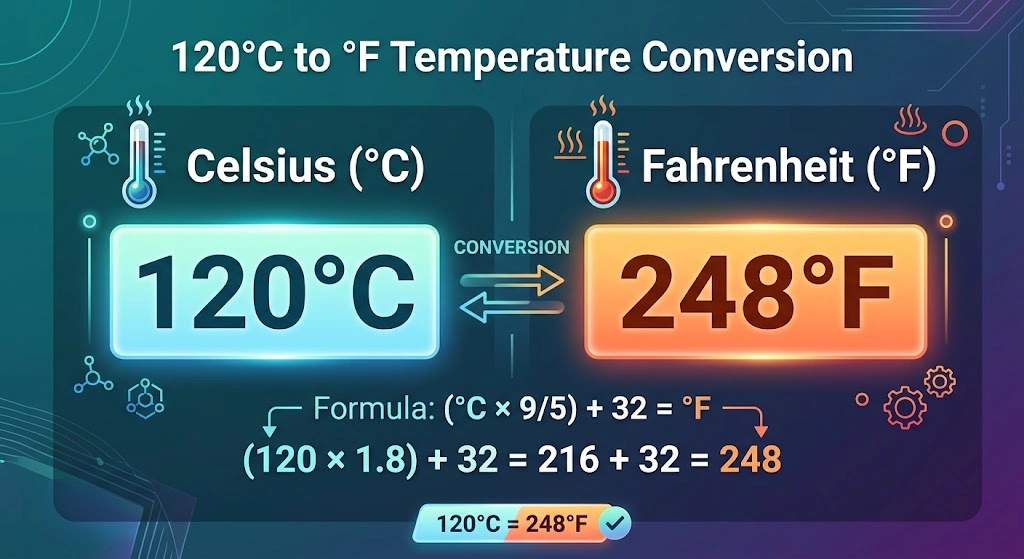
Need to convert 120°C to Fahrenheit? The exact answer is 248°F. Learn the formula, see the calculation step by step, check oven and Gas Mark equivalents, and explore a practical Celsius-to-Fahrenheit chart.
Quick Answer: 120 C to F
120°C equals 248°F. To convert Celsius to Fahrenheit, multiply the Celsius temperature by 9/5 and then add 32.
Immediate Answer: 120 C to F Conversion
If you want to convert 120 C to F, the exact result is 248 degrees Fahrenheit.
- Exact temperature: 248°F
- Celsius temperature: 120°C
- Conversion type: Celsius to Fahrenheit
How to Convert 120 C to F Step by Step
The standard formula for converting Celsius to Fahrenheit is:
Multiply by 9/5
Start with 120°C:
120 × 9/5 = 216
Add 32
Add 32 to the result:
216 + 32 = 248°F
The same formula works for virtually any Celsius-to-Fahrenheit conversion.
Quick Mental Math Trick for C to F
A commonly used shortcut is to double the Celsius temperature and add 30. However, this is only a rough estimate and should not replace the exact formula when accuracy matters.
Using the shortcut with 120°C
120 × 2 = 240
240 + 30 = 270°F
When Should You Use the Exact Formula?
- When following a recipe
- When setting an oven temperature
- For school or scientific calculations
- When an accurate temperature is required
Understanding the Celsius to Fahrenheit Formula
The formula °F = (°C × 9/5) + 32 reflects the different spacing and starting points of the Celsius and Fahrenheit temperature scales.
Why multiply by 9/5?
Between the freezing and boiling points of water, Celsius has 100 degrees while Fahrenheit has 180 degrees. The ratio is:
180 ÷ 100 = 9/5
Why add 32?
Water freezes at 0°C but at 32°F. Adding 32 shifts the converted value so the two scales align correctly.
| Reference Point | Celsius | Fahrenheit |
|---|---|---|
| Water freezing point | 0°C | 32°F |
| Water boiling point | 100°C | 212°F |
| 120°C conversion | 120°C | 248°F |
Where Does the Number 32 Come From?
The Fahrenheit scale was developed by Daniel Gabriel Fahrenheit in the early 18th century. The modern Fahrenheit scale places water’s freezing point at 32°F and its boiling point at 212°F under standard atmospheric pressure.
Celsius vs Fahrenheit: What’s the Difference?
| Feature | Celsius | Fahrenheit |
|---|---|---|
| Freezing point of water | 0°C | 32°F |
| Boiling point of water | 100°C | 212°F |
| Degrees between freezing & boiling | 100 | 180 |
| Common everyday use | Most countries worldwide | Primarily the United States |
Most countries use Celsius for everyday temperature measurements, while the United States commonly uses Fahrenheit for weather and many household applications.
Reverse Conversion: How to Convert 248°F Back to Celsius
If you have a Fahrenheit temperature and need the Celsius equivalent, use:
Example: 248°F to Celsius
- 248 − 32 = 216
- 216 × 5/9 = 120°C
Therefore, 248°F = 120°C.
120 C in Oven Temperature: Cooking Guide
For oven temperatures, 120°C is equivalent to 248°F. It is generally considered a low oven temperature and can be useful for gentle, slow cooking and warming applications.
Slow cooking
A low oven temperature can be useful for dishes that benefit from gentle, extended cooking.
Keeping food warm
A low setting may help keep some prepared foods warm, although the appropriate temperature depends on the food and food-safety requirements.
Low-temperature cooking
Some recipes use temperatures around 120°C for slow cooking or other controlled cooking techniques.
Dehydrating
Some foods can be dried at low temperatures, but the correct temperature depends on the specific food and method.
120 C Fan Oven to Fahrenheit
A fan or convection oven circulates hot air, which can allow food to cook more efficiently. However, there is an important distinction between temperature conversion and fan-oven adjustment.
Some recipes recommend reducing a conventional-oven temperature when using a fan oven, often by around 20°C. If a recipe specifically instructs you to make that adjustment, 120°C conventional would become approximately 100°C in the fan oven:
The correct adjustment depends on the recipe and oven manufacturer, so follow the instructions provided with the recipe whenever possible.
120 C to Gas Mark Equivalent
UK recipes sometimes use Gas Mark settings rather than Celsius or Fahrenheit. 120°C is approximately Gas Mark ½.
| Celsius | Fahrenheit | Gas Mark |
|---|---|---|
| 110°C | 230°F | ¼ |
| 120°C | 248°F | ½ |
| 140°C | 284°F | 1 |
| 160°C | 320°F | 2 |
| 180°C | 356°F | 4 |
Is 120 C Hot or Cold?
From a scientific perspective
120°C is a high temperature. It is above the boiling point of water at standard atmospheric pressure and can cause severe burns.
In cooking
120°C / 248°F is a low oven temperature compared with common baking temperatures such as 180°C / 356°F.
120 C Compared to Other Common Temperatures
| Temperature | Fahrenheit | Typical Context |
|---|---|---|
| 20–25°C | 68–77°F | Approximate room temperature |
| 37°C | 98.6°F | Approximate human body temperature |
| 100°C | 212°F | Water boiling point at standard pressure |
| 120°C | 248°F | Low oven temperature |
| 150°C | 302°F | Moderate oven temperature |
| 180°C | 356°F | Common baking temperature |
| 200°C | 392°F | High oven temperature |
Celsius to Fahrenheit Conversion Chart
Use this quick chart to convert several common temperatures without performing the calculation yourself.
| Celsius | Fahrenheit |
|---|---|
| 100°C | 212°F |
| 110°C | 230°F |
| 120°C | 248°F |
| 150°C | 302°F |
| 180°C | 356°F |
| 200°C | 392°F |
| 220°C | 428°F |
Common Mistakes When Converting C to F
1. Forgetting +32
The formula is not simply Celsius × 9/5. You must add 32 afterward.
2. Reversing the formula
Celsius to Fahrenheit uses 9/5, while Fahrenheit to Celsius uses 5/9.
3. Using the wrong fraction
Remember: C → F = 9/5. The reverse conversion uses 5/9.
4. Rounding too early
Keep calculations exact until the final step whenever precision matters.
216 + 32 = 248°F
Why Do Some Countries Use Celsius and Others Use Fahrenheit?
The use of Celsius or Fahrenheit is largely shaped by historical measurement systems and local convention.
Celsius
Celsius is used in most countries worldwide and is closely associated with the metric system and modern scientific measurement.
Fahrenheit
Fahrenheit remains widely used in the United States, particularly for everyday weather and household temperature measurements.
This difference explains why someone following an international recipe may need to convert a temperature such as 120°C to 248°F.
Frequently Asked Questions
1. What is 120 C in Fahrenheit exactly?
120°C equals 248°F. The formula is (°C × 9/5) + 32.
2. Is 120 C low heat?
In oven cooking, 120°C / 248°F is generally considered a low temperature compared with typical baking and roasting temperatures.
3. Can I round 248°F to 250°F?
For many recipes, rounding to 250°F may be acceptable, but use the exact 248°F value when precision is important.
4. What Gas Mark is 120 C?
120°C is approximately Gas Mark ½.
5. Is 120 C good for baking?
It can be suitable for slow or low-temperature cooking, but it is much lower than the temperature used for many standard cakes and roasted foods.
6. How do you convert Celsius to Fahrenheit quickly?
For an exact result, use (°C × 9/5) + 32. A rough shortcut is to double Celsius and add 30, but this can be substantially inaccurate.
7. Why do we add 32 in the formula?
Because 0°C corresponds to 32°F. The +32 accounts for the different starting points of the two scales.
Related Temperature Conversions
If you regularly convert cooking or oven temperatures, these related conversions can make it easier to move between Celsius and Fahrenheit.