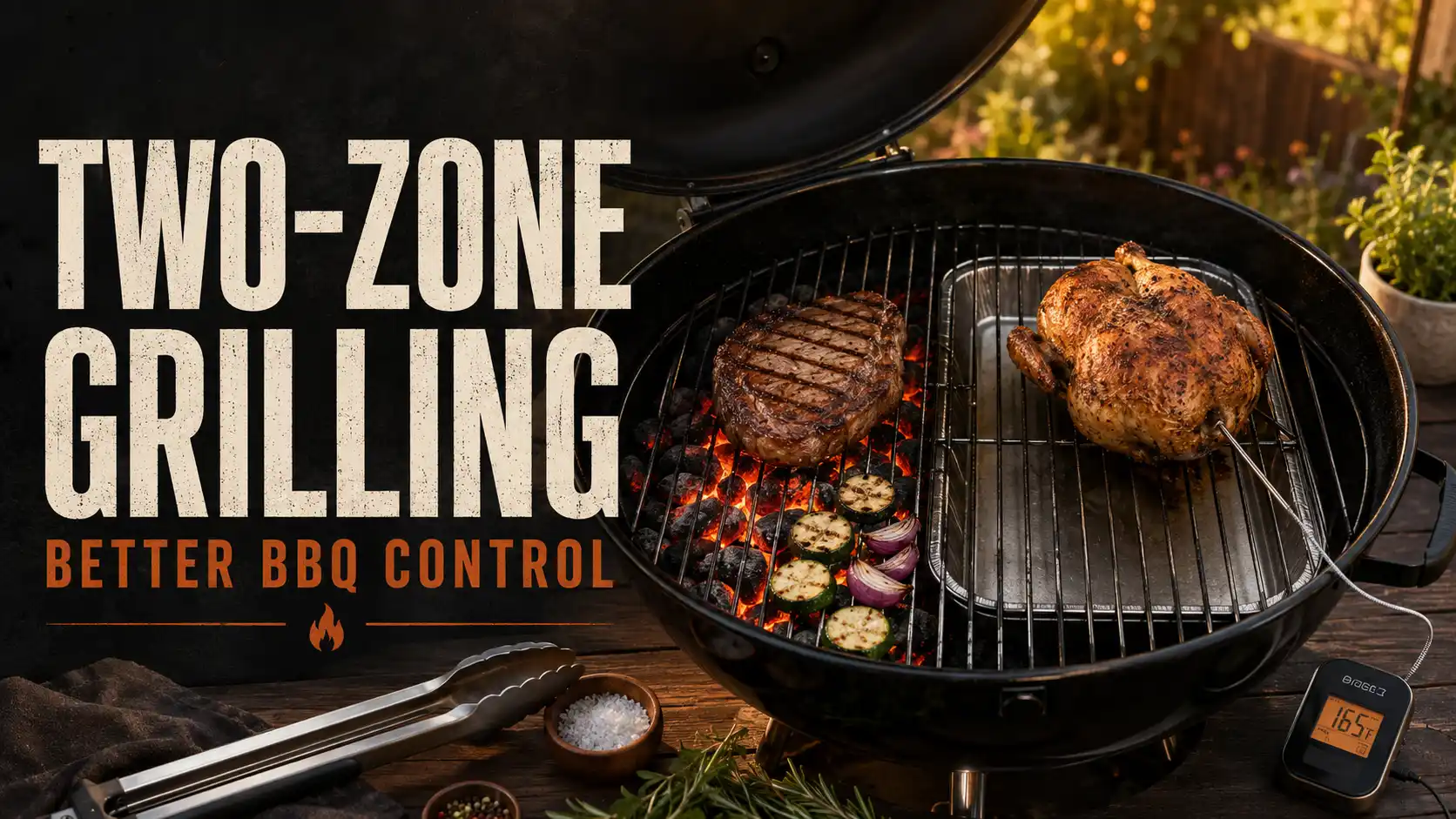
Two-Zone Grilling Methods: The Easy Secret to Juicier, Better-Controlled BBQ
Master direct and indirect heat to sear, finish, protect food from flare-ups, and cook thick cuts evenly—whether you use gas, charcoal, or a compact grill.
What Are Two-Zone Grilling Methods?
Two-zone grilling means setting up your grill with two different heat areas. One side sits over the flame, burner, or charcoal—the direct heat zone. The other side has no flame or coals directly underneath it—the indirect heat zone.
The method works because you are not trapped by one heat level. You can sear food over high heat, then move it away from the fire to finish slowly. This is especially helpful for thick cuts that need color outside but time to cook inside.
Direct heat zone
Food sits directly over the heat source. Use it for steaks, burgers, chicken skin, vegetables, buns, and final searing.
Indirect heat zone
Food sits away from the flame or charcoal. With the lid closed, circulating heat works more like an outdoor oven.
Why does the lid matter?
The lid makes indirect heat work. With it closed, heat circulates around the food. A useful rule is lid open for fast searing; lid closed for finishing, roasting, smoking, or melting.
Why Two-Zone Grilling Works Better Than One Hot Grill
Single-zone grilling puts everything over the same heat. That can work for thin foods, but thicker cuts can burn outside before the center is done. Two zones let you move food based on what it needs.
| Grilling method | How it works | Best for | Main risk |
|---|---|---|---|
| Single-zone direct | Whole grill is hot | Thin steaks, shrimp, hot dogs, flatbreads | Burning thicker foods |
| Single-zone indirect | Food cooks away from heat | Roasts, ribs, whole chicken | Weak sear or pale surface |
| Two-zone | One hot side + one cool side | Mixed grilling, thick cuts, chicken, burgers, sausages | Needs basic heat management |
How to Set Up Two-Zone Grilling on Any Grill
The goal is always the same: heat on one side, no direct heat on the other. The setup changes slightly by grill type.
Gas grill
- Two burners: light one burner medium-high/high and leave the second off.
- Three burners: light one side and leave another section off, or use two burners low/medium with one off.
- Four burners: light two burners on one side and leave two off on the other.
- Preheat with the lid closed, sear over the lit side, then finish over the unlit side.
Charcoal grill
- Light charcoal in a chimney starter.
- Wait until the coals are hot and mostly ashed over.
- Bank the coals on one side of the charcoal grate.
- Leave the other side empty and place the cooking grate over both zones.
- For longer cooks, place a drip pan under the indirect side.
Small grill
Push charcoal tightly to one side, keep fewer pieces of food on the grate, and treat the “cool zone” as a less-hot zone. Rotate food when needed because the two temperatures are physically close together.
Charcoal vents
More airflow generally makes a charcoal fire hotter; less airflow lowers it. Make small adjustments and allow time for the grill to respond. Do not close every vent during active cooking unless you intend to shut the fire down.
What Temperature Should Each Zone Be?
Exact grill temperature varies with fuel, weather, grill size, lid position, and airflow. These ranges are useful starting points rather than rigid rules.
| Zone | Approx. grill temperature | Best uses |
|---|---|---|
| Very hot direct | 500–600°F / 260–315°C | Fast searing, steak crust, final reverse sear |
| Hot direct | 450–500°F / 232–260°C | Burgers, chops, chicken skin, vegetables |
| Medium transition | 325–425°F / 163–218°C | Sausages, thicker vegetables, gentle browning |
| Indirect | 225–350°F / 107–177°C | Chicken, ribs, thick steaks, pork chops, roasts |
| Holding | 180–250°F / 82–121°C | Briefly keeping cooked food warm |
Common safe internal-temperature benchmarks
| Food | Safe minimum internal temperature |
|---|---|
| Beef, pork, lamb, veal steaks/chops/roasts | 145°F / 63°C plus rest time |
| Ground beef, pork, lamb, veal | 160°F / 71°C |
| Poultry | 165°F / 74°C |
| Fish | 145°F / 63°C |
| Leftovers and casseroles | 165°F / 74°C |
Best Foods for Two-Zone Grilling Methods
| Food | Start zone | Finish zone | Why it works |
|---|---|---|---|
| Thick steak | Direct or indirect | Opposite zone | Builds crust while controlling center doneness |
| Chicken thighs | Indirect | Direct near the end | Cooks through, then crisps skin |
| Chicken breast | Direct briefly | Indirect | Helps protect the outer meat from drying |
| Burgers | Direct | Indirect if thick | Browns outside and finishes gently |
| Sausages | Indirect | Direct briefly | Reduces splitting and burning |
| Ribs | Indirect | Direct briefly for sauce | Protects sauce from scorching |
| Pork chops | Direct | Indirect | Helps avoid dry, burnt edges |
| Fish fillets | Indirect or medium direct | Usually indirect | Protects delicate flesh |
| Vegetables | Direct or indirect | Depends on size | Chars outside and softens inside |
| Corn on the cob | Indirect | Direct for color | Cooks evenly before charring |
Two-Zone Recipe Cards
Two-Zone Reverse-Seared Steak
- 1 thick steak
- Salt and black pepper
- High-heat cooking oil
- Set up a hot direct zone and a cooler indirect zone.
- Season the steak and place it over indirect heat with the lid closed.
- Cook gently until it is approaching your desired internal temperature.
- Move it to the hottest zone and sear both sides quickly.
- Rest before slicing.
Juicy Two-Zone Chicken
- Chicken thighs or breasts
- Your preferred seasoning
- Optional finishing sauce
- Preheat the grill and create the two zones.
- Start bone-in chicken on the indirect side.
- Close the lid and cook until nearly done.
- Move to direct heat briefly to crisp and brown.
- Verify the center reaches a safe internal temperature.
Split-Free Grilled Sausages
- Fresh sausages
- Optional mustard or finishing sauce
- Warm the sausages gently over indirect heat with the lid closed.
- Move them to direct heat once the inside is nearly ready.
- Brown the casing on all sides without scorching it.
- Check internal temperature before serving.
Steaks, Chicken, Burgers, Sausages & Vegetables
Are steaks better with two-zone grilling?
Thick steaks are excellent candidates. Use either sear-first or reverse-sear. Thin steaks may cook perfectly well over direct heat alone.
Is two-zone grilling good for chicken?
Yes. Start bone-in chicken on the indirect side so it cooks through without burning the skin, then move it to direct heat near the end for crisping. Boneless breasts can be seared briefly and finished indirectly.
Should burgers use two-zone grilling?
Most burgers start over direct heat for browning. Thick burgers can move to the indirect side to finish without burning. You can also use the cool side to melt cheese and briefly hold cooked burgers.
Why are sausages better over indirect heat first?
Starting gently reduces the chance of a casing that splits from intense heat. A brief direct-heat finish provides browning and a better bite.
Can vegetables use two-zone grilling?
Absolutely. Direct heat is useful for asparagus, zucchini, peppers, mushrooms, and onion slices. Indirect heat is useful for potatoes, corn, thick carrots, large cauliflower pieces, and dense squash before a final char.
Sear-First vs. Reverse Sear: Which Should You Use?
| Method | How it works | Best for | Main benefit |
|---|---|---|---|
| Sear-first | Hot zone first, indirect zone second | Burgers, pork chops, chicken breast, medium steaks | Fast browning and simple workflow |
| Reverse sear | Indirect zone first, hot zone second | Thick steaks, tomahawks, tri-tip, thick pork chops | More even doneness and a strong final crust |
A Simple Two-Zone Grilling Workflow
When should sauce be added?
Add sugary barbecue sauce near the end. Cook the food mostly through first, brush on sauce during the final few minutes, and use indirect heat to set it gently. A short direct-heat finish can add caramelization, but watch closely.
Common Two-Zone Grilling Mistakes
Too much heat
Excess heat causes burning, flare-ups, dry meat, and harsh char. Move food to the indirect zone immediately and reduce fuel or burner intensity.
Opening the lid too often
Every opening releases heat. Open only to flip, move, sauce, or check temperature.
Overcrowding
Crowding lowers effective grate heat and traps steam. Leave room between pieces or cook in batches.
Guessing doneness
Smoke, marinades, sauces, and grill marks can fool your eyes. Use an instant-read thermometer, especially for poultry, burgers, pork, and thick cuts.
Ignoring flare-ups
Fat or marinade can ignite. Move food to the cool zone and let the flames settle. Do not use water on a dangerous grease fire.
Forcing food off the grate
Food may stick when the grate is dirty, insufficiently preheated, or the food is flipped too early. Clean and preheat well, then let food release naturally.
Pro Tips for Better Two-Zone Grilling
Beginner wins
- Keep one side clearly hot and one clearly cool.
- Preheat before cooking.
- Use the lid for indirect cooking.
- Move food before it burns.
- Keep a thermometer nearby.
- Add sauce near the end.
- Rest meat before slicing.
Advanced control
- Use a probe thermometer for thick cuts.
- Place a drip pan beneath the indirect side.
- Use wood chunks on charcoal for light smoke.
- Rotate food if one side runs hotter.
- Use reverse sear for thick steaks.
- Create a medium transition area on larger grills.
What is the 2026 grilling update?
Modern grilling is increasingly temperature-focused, with wireless thermometers, smart grill controls, smoke accessories, and improved charcoal setups. These tools can improve consistency, but they do not replace the fundamental skill: controlling where and how much heat reaches the food.
Safety Box: Grill Smarter
- Keep a clean plate for cooked food; never return cooked food to a plate that held raw meat.
- Use a thermometer for internal temperature instead of relying on color.
- Move food away from flare-ups rather than fighting flames directly over them.
- Never use water on a dangerous grease fire.
- Keep the grill in a safe, well-ventilated outdoor location and follow the manufacturer’s instructions.
- When in doubt about food safety, use the more conservative temperature/time guidance from a trusted food-safety authority.
Quick Summary: Key Takeaways
Sear, brown, crisp, and char.
Finish thick foods gently and control flare-ups.
Measure internal temperature instead of guessing.
Protect sugary sauces from scorching.
FAQs About Two-Zone Grilling Methods
What is the two-zone grilling method?
It divides the grill into direct and indirect heat areas so you can sear, finish, hold, and recover from flare-ups without being locked into one temperature.
Is two-zone grilling good for beginners?
Yes. The indirect side acts as a safety and control zone when food cooks too quickly or flames flare up.
Can you use two-zone grilling on a gas grill?
Yes. Light burners on one side and leave burners on the other side off. Close the lid for indirect cooking.
Can you use two-zone grilling on a charcoal grill?
Yes. Bank hot coals on one side and leave the other side coal-free.
What foods are best for two-zone grilling?
Thick steaks, chicken pieces, pork chops, sausages, burgers, ribs, roasts, fish, corn, potatoes, and dense vegetables all benefit from the flexibility of two zones.
What foods may not need two-zone grilling?
Very thin or fast-cooking foods such as shrimp, thin skirt steak, hot dogs, thin asparagus, and flatbreads can often cook fully over direct heat with close attention.
Should I keep the lid open or closed?
Open for quick searing when needed; close for indirect cooking, thick cuts, melting cheese, roasting, smoking, or gentle finishing.
How hot should the direct zone be?
For searing, a direct zone around 450–600°F is a useful starting range. Moderate grilling may need less heat. Let the food and desired browning determine the exact setting.
Why does two-zone grilling prevent burning?
It gives you somewhere to move food away from direct flames while allowing it to keep cooking.
Is two-zone grilling the same as indirect grilling?
Not exactly. Indirect grilling focuses on the cool side; two-zone grilling deliberately maintains both direct and indirect areas so you can move food between them.
Conclusion
Two-Zone Grilling Methods are one of the most useful skills any backyard cook can learn. With one hot side and one cooler side, your grill becomes easier to control. You can sear steaks, crisp chicken skin, finish thick cuts gently, manage flare-ups, and cook different foods at the same time.
The method also makes grilling less stressful. If food starts to burn, you have a safe place to move it. If it needs more color, return it to direct heat. If it needs more time, the indirect zone can finish the job without exposing the outside to harsh heat.
Start with a simple setup: heat on one side, no direct heat on the other. Use a thermometer, keep the lid closed when finishing food, and practice moving food between zones. Once you master this method, your grill becomes more flexible, forgiving, and reliable.