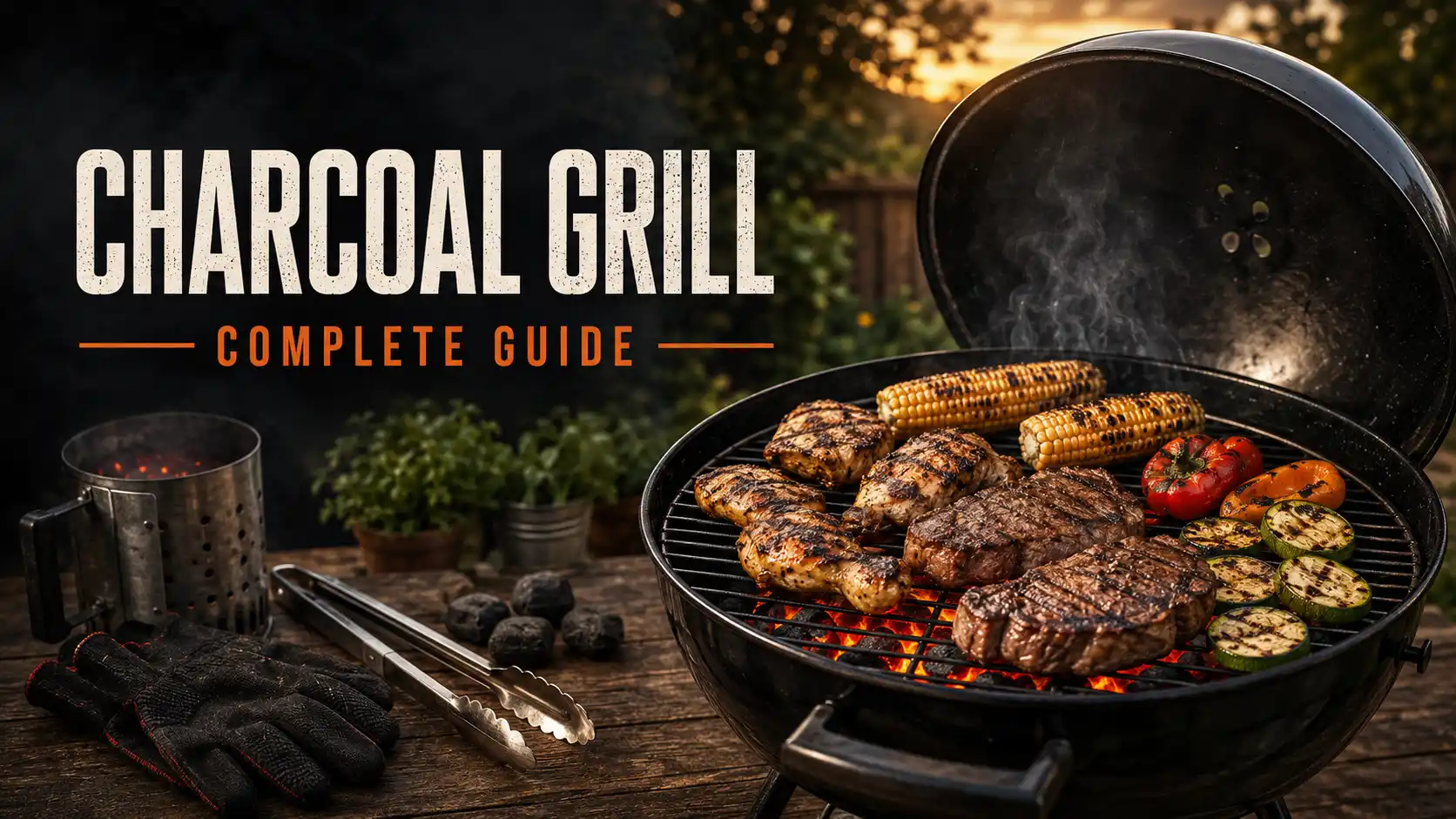
Charcoal Grill Guide: How to Light, Control & Master Smoky BBQ
Learn the simple fire-control skills that turn a charcoal grill from intimidating to reliable—covering fuel, vents, two-zone cooking, safe temperatures, troubleshooting, cleanup, and choosing the right grill.
What Is a Charcoal Grill?
A charcoal grill is an outdoor cooking grill that uses burning charcoal as its heat source. Food cooks through direct radiant heat, indirect heat, hot air, and smoke.
Charcoal grate
Holds the burning fuel below the cooking surface.
Air vents
Bottom vents feed oxygen into the fire; top vents exhaust hot air and smoke.
Cooking grate
Provides the surface for direct searing and indirect cooking.
Lid
Turns the grill into a small outdoor oven when closed and helps manage heat and smoke.
Charcoal Grill vs. Gas Grill: Which Is Better?
Neither is universally better. Charcoal suits people who want smoky flavor, high-heat searing, and hands-on cooking; gas is often better for speed and convenience.
| Feature | Charcoal grill | Gas grill |
|---|---|---|
| Flavor | Smokier, richer live-fire character | Cleaner, lighter flavor |
| Startup | Takes more time | Faster |
| Temperature control | Vents, charcoal amount, lid | Burner knobs |
| Cleanup | Requires ash removal | Usually easier |
| Best for | BBQ flavor, steaks, burgers, smoking | Quick meals and convenience |
| Learning curve | Moderate | Easy |
Choosing the Best Charcoal Grill for Your Needs
The best charcoal grill is the one that fits your cooking style, space, budget, and comfort level—not necessarily the most expensive model.
What size should you buy?
For many families, a 22-inch kettle-style grill is a practical starting point because it offers enough space for burgers, chicken, vegetables, and a two-zone fire. Go smaller for solo cooking, camping, or limited space; larger for frequent gatherings and bigger indirect cooks.
What features matter most?
- Adjustable top and bottom vents
- Tight-fitting lid
- Sturdy cooking grate
- Ash catcher
- Stable legs or cart base
- Enough room for two-zone grilling
- Easy access for adding charcoal
| Grill type | Best for | Main benefit |
|---|---|---|
| Kettle | Most beginners | Affordable and versatile |
| Kamado | Serious BBQ fans | Excellent heat retention |
| Barrel | Larger cooks | More cooking space |
| Portable | Camping and travel | Easy to move |
| Gravity-fed | Convenience-focused cooks | More automated heat management |
Charcoal Types: Briquettes vs. Lump Charcoal
| Charcoal type | Best for | Pros | Cons |
|---|---|---|---|
| Briquettes | Burgers, chicken, ribs, longer cooks | Even shape and steady burn | More ash |
| Lump charcoal | Steaks and high heat | Lights fast, burns hot, less ash | Uneven pieces; can burn faster |
| Instant-light | Convenience | Easy to ignite | Can affect flavor if not burned cleanly |
| Hardwood chunks | Smoke flavor | Adds aroma | Usually a supplement, not the main fuel |
For beginners, briquettes are often easier to manage because they burn more uniformly. Lump charcoal is useful when you want high heat and a more natural live-fire experience.
Safety First: Prepare the Grill Before Lighting
- Empty old ash.
- Check that vents move freely.
- Remove excessive grease buildup.
- Keep children and pets away from the cooking area.
- Have heat-safe gloves and long tongs ready.
- Keep appropriate fire-safety equipment nearby.
A cautious setup is part of good grilling, not an afterthought.
How to Light a Charcoal Grill
Best beginner method: chimney starter
A chimney starter is a reliable way to light charcoal without lighter fluid. Fill it with charcoal, place newspaper or a suitable fire starter underneath, ignite from below, and wait until the upper coals are partly covered with gray ash.
Lighter fluid
If you use lighter fluid, use only charcoal starter fluid and follow its label. Never add lighter fluid to hot or burning coals. Let the flames die down and the fuel burn cleanly before cooking.
Electric charcoal starter
An electric starter uses concentrated heat instead of lighter fluid. It can be convenient, but use it only with a safe outdoor power setup and keep the hot element away from combustible materials.
Direct Heat, Indirect Heat & Two-Zone Cooking
| Heat zone | How it works | Best foods |
|---|---|---|
| Direct | Food sits over hot coals | Burgers, steaks, hot dogs, shrimp, vegetables |
| Indirect | Food sits away from coals | Chicken, ribs, roasts, thick pork chops |
| Two-zone | One hot side + one cooler side | Most grilling, especially beginners |
| Three-zone | Hot, medium, and cool areas | Large meals and mixed foods |
What is a two-zone fire?
Bank most of the lit charcoal on one side of the grill and leave the other side without charcoal. The hot side sears; the cooler side finishes food, holds cooked food briefly, or provides an escape route during flare-ups.
How to Control Temperature on a Charcoal Grill
A charcoal grill has no burner knobs, so temperature is controlled with airflow, charcoal quantity, and lid position.
| Goal | What to do |
|---|---|
| Raise heat | Open vents wider |
| Lower heat | Partly close vents |
| Keep smoke moving | Keep the top vent partly open |
| Shut grill down | Close all vents |
| Stop a flare-up | Move food to indirect heat |
Make small vent changes and wait for the grill to respond. Closing vents too aggressively can make the fire smolder and produce poor heat.
Lid on or off?
Use the lid on for thicker foods, indirect cooking, smoke flavor, and even heat. Use it off for quick searing or thin foods that need close watching.
How to Cook on a Charcoal Grill: Step by Step
Safe Internal Temperatures for Grilled Food
Insert an instant-read thermometer into the thickest part of the food without touching bone, gristle, or the grate.
| Food | Safe minimum internal temperature |
|---|---|
| Poultry | 165°F / 74°C |
| Ground beef, pork, lamb, veal | 160°F / 71°C |
| Beef, pork, veal, lamb steaks/chops/roasts | 145°F / 63°C plus 3-minute rest |
| Fish | 145°F / 63°C |
| Fresh ham | 145°F / 63°C plus 3-minute rest |
Best Beginner Foods for a Charcoal Grill
| Food | Why it is beginner-friendly | Best heat approach |
|---|---|---|
| Burgers | Fast and easy to monitor | Direct |
| Hot dogs & sausages | Simple and forgiving | Direct, then indirect if needed |
| Chicken thighs | Juicier and forgiving | Direct, then indirect |
| Thick pork chops | Good two-zone practice | Sear, then indirect |
| Corn | Handles heat well | Direct or indirect |
| Vegetable skewers | Quick and colorful | Direct |
| Steak | Great searing practice | Direct, then rest |
Easy Charcoal Grill Recipe Cards
Two-Zone Charcoal Burgers
- Ground-beef patties
- Salt and pepper
- Buns and toppings
- Build a two-zone fire with a hot direct side and cooler side.
- Season patties and sear over direct heat.
- Move thick patties to indirect heat if the outside browns too quickly.
- Check internal temperature with a thermometer.
- Toast buns briefly over direct heat and assemble.
Juicy Charcoal Chicken Thighs
- Chicken thighs
- Your preferred seasoning
- Optional finishing sauce
- Set up a two-zone fire and preheat.
- Start chicken on the indirect side with the lid closed.
- Cook until nearly done, checking temperature as needed.
- Move to direct heat to crisp the skin.
- Verify safe internal temperature before serving.
Charcoal-Grilled Corn & Vegetable Skewers
- Corn
- Bell peppers, zucchini, onion or mushrooms
- Oil and seasoning
- Preheat the direct zone.
- Lightly oil and season vegetables.
- Grill, turning as needed, until browned and tender.
- Move larger pieces toward indirect heat if the surface darkens too quickly.
- Serve immediately.
Practical Tips for Better Charcoal Grilling
Build habits
- Use a chimney starter.
- Keep bottom vents clear of ash.
- Build a two-zone fire.
- Preheat before adding food.
- Use long-handled tools.
Improve consistency
- Close the lid for thicker food.
- Add smoke wood lightly.
- Use a thermometer.
- Rest meat before slicing.
- Note vent positions and cook times.
Good grillers do not chase perfect heat every second. They make small changes, wait for the grill to respond, and adjust again.
Common Charcoal Grill Mistakes to Avoid
Cooking too early
Wait for glowing coals partly covered with ash rather than cooking over tall flames.
Only using direct heat
A cooler zone protects thicker foods and gives you a place to escape flare-ups.
Closing vents too much
Starving the fire of oxygen can cause smoldering and poor heat.
Adding too much wood
Heavy smoke can taste bitter. Start small and add more only if needed.
Flipping constantly
Let food develop a crust before turning. If it sticks, it may need more time.
Skipping the thermometer
Temperature is a much better doneness test than guessing by color or time.
Charcoal Grill Troubleshooting
| Problem | Likely cause | Quick fix |
|---|---|---|
| Fire will not stay lit | Blocked vents or damp charcoal | Clear ash, open vents, use dry fuel |
| Grill is too hot | Too much charcoal or airflow | Partly close vents and use indirect heat |
| Grill is too cool | Not enough charcoal or airflow | Open vents or add lit charcoal |
| Food is sticking | Dirty grate or insufficient preheat | Clean and preheat the grate |
| Food tastes bitter | Too much smoke or unclean-burning fuel | Use less wood and let fuel burn cleanly |
| Flare-ups keep happening | Fat dripping over coals | Move food to indirect heat |
| Outside burns, inside is raw | Heat is too direct | Sear, then finish indirectly |
How to Shut Down a Charcoal Grill Safely
When cooking is done, close the lid and fully close the top and bottom vents. This cuts off oxygen and helps the coals die out.
Once everything is completely cold, place ash in a suitable metal or non-combustible container and dispose of it according to local rules.
Cleaning & Maintaining a Charcoal Grill
A clean grill is easier to control and safer to use.
Before each cook
- Empty ash.
- Check vents.
- Scrape the cooking grate.
- Remove excessive grease buildup.
- Confirm the grill is stable.
Deep cleaning
Deep clean several times each season, or more often if you grill frequently. Remove ash, scrape the lid and interior, clean grates as appropriate, check hardware, and cover the grill when dry.
Charcoal Grill Safety Checklist
- Grill outdoors only.
- Keep the grill on a flat, stable surface.
- Keep it away from walls, railings, branches, and roofs.
- Keep children and pets at least three feet away from the grilling area.
- Never leave a lit grill unattended.
- Use heat-resistant gloves.
- Use only approved charcoal starter fluid if using fluid.
- Never add lighter fluid to lit or hot coals.
- Keep appropriate fire-safety equipment nearby.
- Let ashes cool fully before disposal.
Quick Summary: Key Takeaways
Use charcoal quantity and airflow to manage heat.
Keep a hot side and a cooler side for flexibility.
Use an instant-read thermometer instead of guessing.
Grill outdoors and let coals and ash cool completely.
Charcoal Grill FAQs
How long should charcoal burn before cooking?
Often around 15–20 minutes, depending on fuel and conditions. Wait until coals are glowing and partly covered with gray or white ash rather than cooking over tall flames.
Should charcoal grill vents be open or closed?
Opening vents feeds the fire with oxygen and generally raises heat. Partly closing them reduces heat. During cooking, keep the exhaust vent sufficiently open for clean airflow; close all vents only when shutting the grill down.
Is lump charcoal better than briquettes?
Lump charcoal can light quickly and burn hot, making it useful for steaks and high heat. Briquettes have a more uniform shape and are often easier for beginners to manage.
Can you reuse charcoal?
Yes. Completely cool, dry, unburned pieces can often be reused. Close the vents after cooking and mix saved pieces with fresh charcoal for the next cook.
Do you grill with the lid open or closed?
Use the lid closed for thicker foods, indirect cooking, smoke flavor, and heat control. Use it open for quick searing or thin foods that cook rapidly.
How do you stop flare-ups?
Move food to the indirect side and reduce the fire’s oxygen exposure as appropriate. Never pour water onto a grease fire; it can spread burning grease.
What is the safest way to put out charcoal?
Close the lid and shut the vents. Let the grill cool completely before handling ash. Dispose of cold ash in a suitable non-combustible container according to local requirements.
What should beginners cook first on a charcoal grill?
Burgers, sausages, chicken thighs, pork chops, corn, and vegetable skewers are forgiving choices that teach direct heat, indirect heat, turning, and resting.
Conclusion
A charcoal grill can feel intimidating at first, but the basics are simple: clean the grill, use dry charcoal, maintain good airflow, and create a safe outdoor setup. Light with a chimney starter, build a two-zone fire, and preheat before cooking. Then use direct heat for searing and indirect heat for finishing thicker foods.
The biggest upgrade you can make is using a thermometer. It helps you cook safely and avoid dry, overdone results. With practice, you will learn how your grill responds to vent changes, charcoal amounts, weather, and different foods.
Start simple with burgers, chicken thighs, sausages, corn, or vegetable skewers. Once you feel confident, move on to ribs, pork shoulder, whole chicken, and smoke-kissed BBQ meals. Fire control improves every time you grill.