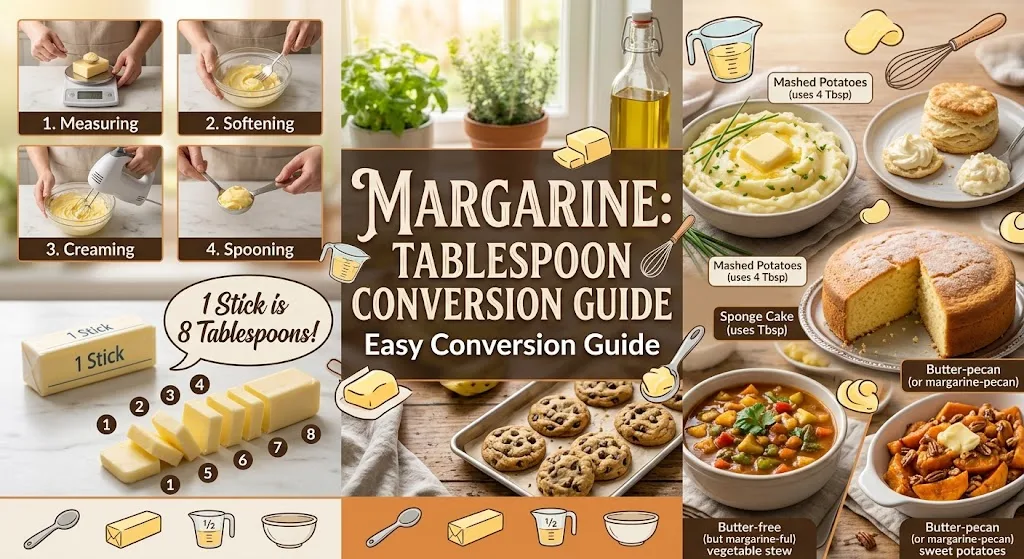
Wondering how much margarine to use in a recipe? A standard U.S. stick of margarine equals 8 tablespoons, or ½ cup. Use this simple guide to convert margarine between tablespoons, cups, ounces, and grams without guessing.
That’s also ½ cup, 4 ounces, or about 113 grams in the standard U.S. measurement system.
per stick
If you’re wondering how many tablespoons are in a stick of margarine, the quick answer is simple: one stick of margarine equals 8 tablespoons. In U.S. measurements, that also means ½ cup, 4 ounces, or about 113 grams.
This standard stick size is the same basic format used for butter, making margarine tablespoon conversion especially easy when baking or cooking. Many stick packages also include tablespoon markings directly on the wrapper, so you can cut the amount you need without using a kitchen scale.
Margarine Measurement Breakdown
In the United States, a standard stick of margarine equals ½ cup. Because 1 U.S. cup contains 16 tablespoons, half a cup contains exactly 8 tablespoons.
That gives you the most useful everyday conversion: 1 stick = 8 tablespoons = ½ cup = 4 ounces ≈ 113 grams.
Most U.S. stick margarine packages also have tablespoon lines printed on the wrapper. These markings make it easy to cut a stick into precise portions.
Quick Margarine Conversion Chart
Use this chart when you need to convert margarine between sticks, tablespoons, cups, ounces, and grams.
| Margarine Amount | Tablespoons | Cups | Ounces | Grams (Approx.) |
|---|---|---|---|---|
| ¼ stick | 2 tbsp | ⅛ cup | 1 oz | 28 g |
| ½ stick | 4 tbsp | ¼ cup | 2 oz | 57 g |
| 1 stick | 8 tbsp | ½ cup | 4 oz | 113 g |
| 2 sticks | 16 tbsp | 1 cup | 8 oz | 226 g |
| 1 cup | 16 tbsp | 1 cup | 8 oz | 226 g |
Why Accurate Margarine Measurement Matters in Baking
Accurate margarine measurement in baking matters because margarine is a fat that contributes to texture, moisture, structure, and tenderness.
The right amount can help cakes remain soft, cookies stay tender, and pastries develop the desired texture. Too little fat can produce dry or crumbly results, while too much can make some baked goods greasy or overly dense.
Margarine vs. Butter: Are the Measurements the Same?
In most U.S. recipes, margarine and butter use the same basic volume measurements. A standard stick of either is commonly treated as 8 tablespoons or ½ cup.
That means a recipe calling for 1 stick of butter can often be converted to 1 stick of margarine by volume. However, the ingredients themselves are not identical.
Different margarines can have different fat and water contents, while butter also has its own characteristic fat and water composition. These differences can influence flavor and texture, particularly in delicate cookies, pastries, and other baking recipes.
How Many Tablespoons Are in Half a Stick of Margarine?
If you need only half a stick, the conversion is straightforward: ½ stick of margarine equals 4 tablespoons.
How Many Sticks Are in 1 Cup of Margarine?
In standard U.S. measurements, 2 sticks of margarine equal 1 cup. Since each stick equals ½ cup, two sticks make a full cup.
That’s also 16 tablespoons, or approximately 226 grams.
How to Measure Margarine Without a Scale
You don’t always need a kitchen scale to measure margarine accurately. For everyday cooking and baking, measuring spoons and package markings are convenient options.
Using Tablespoon Measures
Measure margarine with a tablespoon and level the top. Avoid pressing it excessively into the spoon, because packing can make volume measurements less consistent.
Using the Wrapper Marks
Many stick packages include tablespoon markings. If your package has these lines, simply cut the stick at the marking corresponding to the amount required by the recipe.
Using a Kitchen Scale
A digital kitchen scale is an excellent option when a recipe provides measurements in grams. It eliminates much of the variation that can occur with volume measurements.
Stick Margarine vs. Tub Margarine Measurements
Stick margarine is convenient because a standard U.S. stick is commonly divided into tablespoon portions. Tub margarine does not have the same built-in format.
Why Tub Margarine Can Be Less Precise
Soft margarine from a tub can be difficult to portion perfectly by eye. Scooping can also introduce differences in how much product is packed into a spoon.
How to Measure Tub Margarine
Use a measuring tablespoon and level it carefully. For larger quantities, a kitchen scale provides an even more consistent measurement.
Baking vs. Cooking
Small measurement differences may be less noticeable in many savory dishes. Baking is less forgiving because ingredient ratios can strongly influence the final texture.
Margarine by Weight vs. Volume
Margarine can be measured by volume, such as tablespoons and cups, or by weight, such as grams and ounces. For precise baking, weight is generally the more consistent approach.
Tablespoons vs. Grams
| Amount | Approximate Weight |
|---|---|
| 1 tablespoon | 14 g |
| 2 tablespoons | 28 g |
| 4 tablespoons | 57 g |
| 8 tablespoons / 1 stick | 113 g |
| 16 tablespoons / 1 cup | 226 g |
Simple Conversion Formula
For example, 8 tablespoons × 14 gives approximately 112 grams. The commonly used rounded reference for a U.S. stick is 113 grams.
International Margarine Packaging Differences
The phrase “one stick” is most useful when you’re working with a U.S.-style package. Margarine packaging can differ significantly between countries, so international recipes are often easier to follow using grams.
U.S. Standard
A standard U.S. stick is commonly treated as 113 grams, 8 tablespoons, or ½ cup.
Canada
Margarine is commonly available in larger blocks or tubs, including packages around 454 grams. Packaging markings vary by brand.
UK and Europe
Margarine is commonly sold in metric blocks such as 250 g or 500 g. Recipes frequently use grams rather than U.S.-style sticks.
Australia
Metric package sizes such as 250 g and 500 g are common, making weight-based measurement particularly useful.
| Weight | Approx. U.S. Sticks | Approx. Tablespoons* |
|---|---|---|
| 113 g | 1 stick | 8 tbsp |
| 226 g | 2 sticks | 16 tbsp |
| 250 g | 2.2 sticks | 17–18 tbsp |
| 500 g | 4.4 sticks | 35–36 tbsp |
*Approximate conversions based on the 113 g U.S. stick reference. For international baking, weighing the actual product is preferable to converting by stick.
Common Margarine Measurement Mistakes to Avoid
1. Overpacking Tablespoons
Avoid forcing soft margarine tightly into a measuring spoon. A gently filled and leveled tablespoon gives a more consistent volume measurement.
2. Melting Before Measuring
If a recipe calls for solid margarine, measure it in the form specified by the recipe. Melting first can change how the ingredient is incorporated into the recipe.
3. Confusing Solid and Liquid Measurements
Margarine is normally measured as a solid using tablespoons, cups designed for solid ingredients, package markings, or weight. If the recipe specifically calls for melted margarine, follow the recipe’s instructions for the melted state.
4. Not Leveling Tablespoons
An overflowing spoon can add more margarine than intended. Level the top with the straight edge of a knife for a more consistent tablespoon.
Easy Margarine Conversion Example
Recipe Calls for 1½ Sticks
Here’s how to convert the amount into familiar kitchen measurements.
Since one stick contains 8 tablespoons:
This is a handy way to convert recipes that use sticks when your kitchen measurements are easier to work with in tablespoons or grams.
Printable Margarine Conversion Cheat Sheet
Save These Margarine Measurements
- ¼ stick = 2 tbsp = ⅛ cup = 28 g
- ½ stick = 4 tbsp = ¼ cup = 57 g
- 1 stick = 8 tbsp = ½ cup = 113 g
- 2 sticks = 16 tbsp = 1 cup = 226 g
- 1 tbsp ≈ 14 g
- 1 cup = 16 tbsp
Frequently Asked Questions About Margarine Measurements
Can I substitute margarine for butter 1:1?
In many recipes, margarine and butter can be substituted by equal volume, such as 1 stick for 1 stick. However, differences in fat, water, salt, and flavor can affect the final result, particularly in delicate baked goods.
How many grams are in a stick of margarine?
A standard U.S. stick is commonly treated as about 113 grams. That’s also 8 tablespoons or ½ cup.
Is a stick of margarine always 8 tablespoons?
In the standard U.S. stick format, yes: one stick equals 8 tablespoons. However, packaging conventions can vary internationally, so check the package when using non-U.S. products.
Does salted margarine change the measurement?
No. Salted margarine still has the same volume measurement. One standard stick remains 8 tablespoons. What changes is the amount of salt contained in the product.
What if my margarine isn’t sold in sticks?
Measure tub margarine with a tablespoon, use package markings if available, or weigh it in grams. For baking, weighing can provide the most consistent result.
How many tablespoons are in a 250 g European margarine block?
Using the approximate U.S. reference of 14 grams per tablespoon, 250 grams works out to roughly 18 tablespoons. Because actual margarine composition can vary, weighing the amount specified by the recipe is the better approach.
How many tablespoons are in half a stick?
Half a stick equals 4 tablespoons. It is also ¼ cup, 2 ounces, or approximately 57 grams.
How many sticks of margarine are in one cup?
Two standard U.S. sticks equal 1 cup, which is 16 tablespoons or approximately 226 grams.