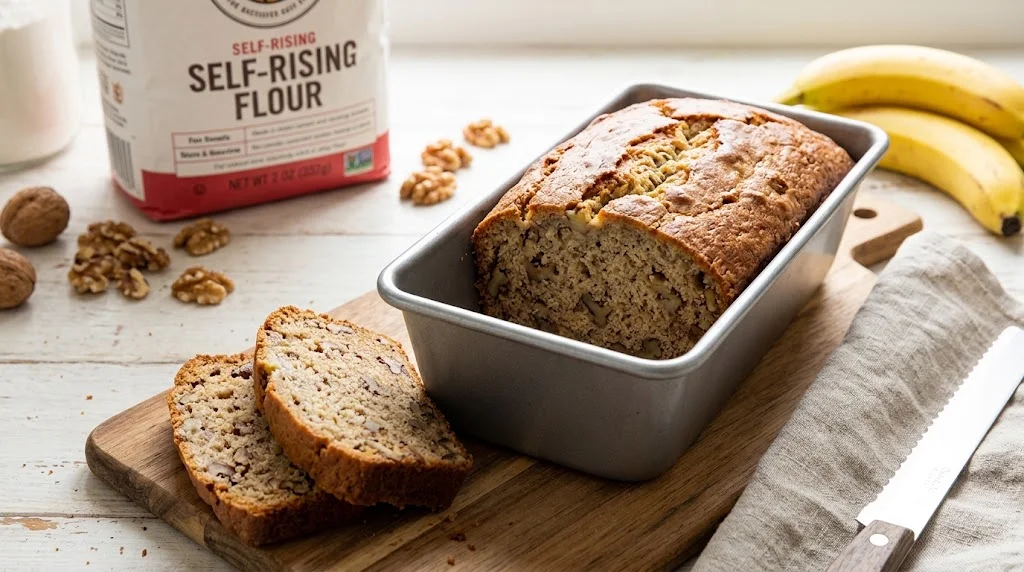
Turn very ripe bananas and self-rising flour into a tender, nutty loaf with melted butter, eggs, walnuts or pecans, and a beautifully golden crust. This beginner-friendly recipe keeps the ingredient list simple while focusing on the details that prevent a gummy center.
If you have ripe bananas and self-rising flour, you can make a tender, nutty banana bread without measuring separate baking powder and salt. This version uses melted butter, ripe bananas, eggs, sugar, self-rising flour, and walnuts or pecans for a classic loaf with a soft center and crisp, toasted nuts.
The key to good banana nut bread is moisture control. Very ripe bananas add flavor and tenderness, but too much banana can leave the center gummy. Use the recipe as written, avoid overmixing, and check the center before taking the loaf from the oven.
Yes. Self-rising flour works very well for banana nut bread because it already contains flour, baking powder, and salt. That means this recipe doesn’t need additional baking powder or salt.
For the most consistent loaf, use very ripe bananas, measure the mashed banana, mix the batter gently, and bake until the center is fully set. A digital thermometer is especially useful; King Arthur Baking recommends about 200°F to 205°F in the center of baked banana bread.
Source note: King Arthur Baking, guidance on determining when banana bread is done.
Banana Nut Bread Recipe at a Glance
| Recipe Detail | Information |
|---|---|
| Yield | 1 loaf, about 10–12 slices |
| Prep time | 15 minutes |
| Bake time | 55–65 minutes |
| Total time | About 1 hour 15 minutes |
| Oven temperature | 350°F |
| Pan | 9×5-inch loaf pan |
| Difficulty | Beginner-friendly |
| Main flour | Self-rising flour |
| Nuts | Walnuts or pecans |
| Best bananas | Very ripe and heavily spotted |
🍌 Banana Nut Bread With Self-Rising Flour
A simple one-bowl loaf with ripe bananas, buttery flavor, and plenty of nutty crunch.
Ingredients
- 3 medium very ripe bananas, mashed, about 1½ cups
- ½ cup unsalted butter, melted and cooled slightly
- ¾ cup granulated sugar
- 2 large eggs, preferably room temperature
- 1 teaspoon vanilla extract
- 2 cups self-rising flour
- ½ teaspoon ground cinnamon, optional
- ¾ cup chopped walnuts or pecans
- 2 tablespoons additional nuts, optional, for topping
Do not add extra baking powder or salt unless your particular flour package specifically indicates that it is not standard self-rising flour. Self-rising flour formulations can vary by brand, so check the package label.
Instructions
Why Self-Rising Flour Works in Banana Bread
Self-rising flour is convenient because the leavening and salt are already incorporated into the flour. That makes it particularly useful for quick bread when you want a shorter ingredient list.
It also means you shouldn’t treat self-rising flour exactly like ordinary all-purpose flour. If you add the same baking powder and salt that an all-purpose-flour recipe calls for, you can change the loaf’s texture and flavor.
Self-Rising Flour vs. All-Purpose Flour
| Feature | Self-Rising Flour | All-Purpose Flour |
|---|---|---|
| Flour | Yes | Yes |
| Baking powder | Included | Usually not included |
| Salt | Included | Usually not included |
| Best for this recipe | Yes | Requires reformulation |
| Measuring convenience | High | Requires more ingredients |
For this recipe, use self-rising flour as listed. If converting an all-purpose-flour banana bread recipe, don’t simply substitute cup for cup without accounting for the recipe’s existing baking powder and salt.
How Ripe Should Bananas Be?
The best bananas for banana bread are very ripe bananas with plenty of brown or black spots. They are softer, sweeter, and more intensely flavored than firm yellow bananas.
Banana is also one of the biggest sources of moisture in the loaf. That’s why measuring mashed banana is more reliable than simply counting bananas.
Look for Bananas That Are:
What If Your Bananas Aren’t Very Ripe?
You can still bake with yellow bananas, but the finished bread may have less banana flavor and less natural sweetness.
Some published techniques use oven-roasting to intensify banana flavor and soften less-ripe fruit. For this recipe, however, naturally ripe bananas are the simplest option whenever available.
Brown or black spots are normal signs of ripeness. However, discard bananas showing mold or clear signs of spoilage rather than trying to bake with them.
Walnuts vs. Pecans for Banana Nut Bread
Walnuts and pecans are both excellent choices, but they give the loaf different personalities.
| Nut | Flavor | Texture | Good Pairing |
|---|---|---|---|
| Walnuts | Earthy and slightly bitter | Firm, crisp | Classic banana bread |
| Pecans | Rich and buttery | Tender, crunchy | Brown sugar and cinnamon |
| Walnut + pecan | Balanced | Mixed texture | Holiday or brunch loaf |
How to Toast the Nuts
For more pronounced nut flavor, spread chopped nuts in a single layer on a baking sheet and bake at 350°F for about 5–10 minutes. Watch closely because nuts can move quickly from toasted to burnt.
Allow the nuts to cool completely before folding them into the batter.
How to Make Banana Nut Bread Without Overmixing
The batter doesn’t need to be perfectly smooth. Trying to eliminate every small lump can actually lead to overmixing.
Once flour is added, gluten development begins. Too much stirring can produce a tougher, heavier quick bread.
- Mash the bananas.
- Whisk in butter, sugar, eggs, and vanilla.
- Add self-rising flour.
- Fold gently until the dry flour disappears.
- Fold in the nuts.
- Stop mixing.
The moment you no longer see dry flour, put the spatula down.
How to Tell When Banana Nut Bread Is Done
The crust can look finished while the middle is still underbaked. This is especially common with banana bread because the fruit adds substantial moisture.
Use These Doneness Checks
Don’t judge doneness from crust color alone. An instant-read thermometer gives you a more reliable indication of whether the center has finished baking.
If the top becomes dark before the center finishes, loosely tent the loaf with foil and continue baking.
What Pan Should You Use?
A 9×5-inch loaf pan works well for this amount of batter. Pan size changes the depth of the batter, which changes how quickly heat reaches the center.
A smaller 8×4-inch pan produces a taller loaf and may require additional baking time. Pan material also affects baking speed.
- Use a 9×5-inch metal loaf pan.
- Place it on the center oven rack.
- Avoid opening the oven repeatedly.
- Begin checking near the end of the stated baking time.
- Use internal temperature rather than time alone to judge doneness.
Why Is My Banana Bread Gummy in the Middle?
A gummy center usually points to too much moisture, insufficient baking, or both.
Bananas vary considerably in size. If you use very large bananas without measuring them, you can add substantially more moisture than the recipe expects.
| Common Cause | What Happens | What to Do |
|---|---|---|
| Too much mashed banana | Excess moisture slows the center from setting | Measure the mashed banana |
| Underbaking | Crust browns before the middle finishes | Continue baking and check the center |
| Overmixing | Can make the crumb heavier | Fold gently and stop when flour disappears |
| Wrong pan size | Deeper batter takes longer to bake | Use the specified 9×5-inch pan |
| Cutting too soon | Crumb hasn’t finished firming | Cool before slicing |
If your loaf is browned but still wet inside, put it back in the oven rather than accepting a raw or gummy center. Continue baking until the center is properly set.
Can You Make It With Two Bananas?
Yes, but don’t simply remove one banana from this recipe. Banana contributes sweetness, moisture, structure, and flavor.
For consistent results, either:
- Scale the entire recipe proportionally, or
- Use a separate recipe formulated and tested for two bananas.
Don’t compensate for missing banana by randomly adding milk, applesauce, or extra butter. Those changes alter the moisture and fat balance.
What If You Have Frozen Bananas?
Frozen bananas work well for banana bread. Thaw them completely before measuring. Frozen bananas can release considerable liquid as they defrost, so don’t automatically pour every drop into the batter if the fruit has separated into a very watery mixture.
Easy Banana Nut Bread Variations
🍂 Cinnamon Banana Nut Bread
Increase the cinnamon slightly for a warmer spice profile. Pecans pair especially well with cinnamon, while walnuts provide more contrast.
🍯 Brown Sugar Banana Nut Bread
Replace some granulated sugar with light brown sugar for a deeper, caramel-like flavor. Don’t increase the total sugar unnecessarily.
🍫 Chocolate Chip Banana Nut Bread
Fold in ½ cup semi-sweet chocolate chips with the nuts. Mini chips distribute especially well through the loaf.
🥜 Double-Nut Banana Bread
Combine walnuts and pecans instead of choosing just one for a more varied nutty texture.
🍫 Chocolate-Walnut Banana Bread
Combine walnuts with semi-sweet chocolate chips for an earthy, chocolate-rich loaf.
🌿 Nut-Free Banana Bread
Simply omit the nuts if desired. If avoiding nuts because of an allergy, also consider cross-contact from utensils, pans, containers, and packaged ingredients.
Dairy-Free Banana Nut Bread
The butter can be replaced with a neutral-flavored plant oil for a dairy-free variation.
Oil changes the character of the loaf. Butter contributes a distinct dairy flavor, while neutral oil can produce a softer-feeling crumb.
Before making a dairy-free variation, check every packaged ingredient for dairy ingredients or allergen statements.
Also remember that self-rising flour is generally wheat-based. Making the recipe dairy-free does not make it gluten-free.
Can You Make It Gluten-Free?
Not by simply replacing the self-rising flour with ordinary gluten-free flour.
Gluten-free flour blends differ substantially in starches, protein substitutes, and added gums. A successful gluten-free banana bread needs a tested gluten-free formulation, including the correct leavening and liquid balance.
For the most predictable result, use a gluten-free banana bread recipe specifically developed and tested for the flour blend you are using.
How to Store Banana Nut Bread
Allow the loaf to cool completely before wrapping it. Wrapping a hot loaf traps steam and can make the crust damp.
| Storage Method | How to Store | Recommended Quality Window |
|---|---|---|
| Room temperature | Keep tightly wrapped or in an airtight container | About 3 days |
| Freezer | Wrap individual slices tightly and place in a freezer-safe bag or container | Up to 3 months for best quality |
How to Freeze Individual Slices
- Cool the loaf completely.
- Slice it.
- Wrap individual slices tightly.
- Place them in a freezer-safe bag or container.
- Label with the date.
- Freeze for up to 3 months for best quality.
Thaw slices at room temperature, then warm them briefly if desired.
Common Banana Nut Bread Problems and Fixes
| Problem | Likely Cause | What to Do |
|---|---|---|
| Gummy center | Too much moisture or underbaking | Measure banana and bake until the center is set |
| Dense loaf | Overmixing or excessive moisture | Fold gently and measure banana |
| Dry loaf | Too much flour or overbaking | Weigh flour and check earlier |
| Burned top | Excessive browning before center is done | Tent loosely with foil |
| Sunken middle | Center wasn’t fully baked | Check internal temperature before removing |
| Uneven nuts | Nuts weren’t distributed well | Fold them through the batter gently |
| Crumbly slices | Cut while too warm | Cool completely before slicing |
| Weak banana flavor | Bananas weren’t ripe enough | Use heavily spotted ripe bananas |
Best Serving Ideas
Fresh banana nut bread needs very little to make a satisfying breakfast or snack.
Bake the loaf the day before for cleaner, easier slicing.
Frequently Asked Questions
Do I need baking soda with self-rising flour?
Not for this recipe. Self-rising flour already contains a leavening agent and salt, so additional baking soda isn’t necessary here.
Do I need baking powder with self-rising flour?
No, not in this recipe. Adding extra baking powder changes the amount of leavening and can affect the finished loaf. Always check your flour label.
Can I use walnuts instead of pecans?
Absolutely. Walnuts have a more earthy flavor and firmer crunch, while pecans are richer and more buttery. Use the same amount either way.
Why did my banana bread sink after baking?
A sunken center can happen when the middle hasn’t developed enough structure before removal. Underbaking, excessive moisture, or an unusually deep batter can contribute.
Can I use brown bananas that have been frozen?
Yes. Thaw them completely and measure the mashed banana before adding it. If thawing produces a large amount of watery liquid, don’t automatically add all of it.
Can I freeze banana nut bread?
Yes. Wrap cooled slices tightly and freeze them in a freezer-safe container or bag. For best quality, use within about 3 months.
How do I know when banana nut bread is fully baked?
The center should be set rather than wet, and a tester shouldn’t show raw batter. An instant-read thermometer should register approximately 200°F–205°F in the center.
Can I use only two bananas?
Yes, but don’t simply remove one banana from this recipe. Scale the recipe proportionally or use a formula specifically developed for two bananas.
Final Tips for Better Banana Nut Bread
The best results come from controlling the variables that matter most: banana quantity, flour measurement, mixing, pan size, and doneness.
Once the base loaf works for you, try cinnamon, brown sugar, or chocolate chips to create your own variation.
Conclusion
This banana nut bread with self-rising flour is built around a simple idea: let ripe bananas provide the flavor and moisture while self-rising flour simplifies the dry ingredients.
The result is a classic quick bread with a tender crumb and plenty of nutty crunch. Start with the walnut version, measure your mashed bananas carefully, and use the center temperature as your final doneness check.
Once you’ve mastered the basic loaf, experiment with pecans, cinnamon, brown sugar, or chocolate chips to make it your own.
Read More :