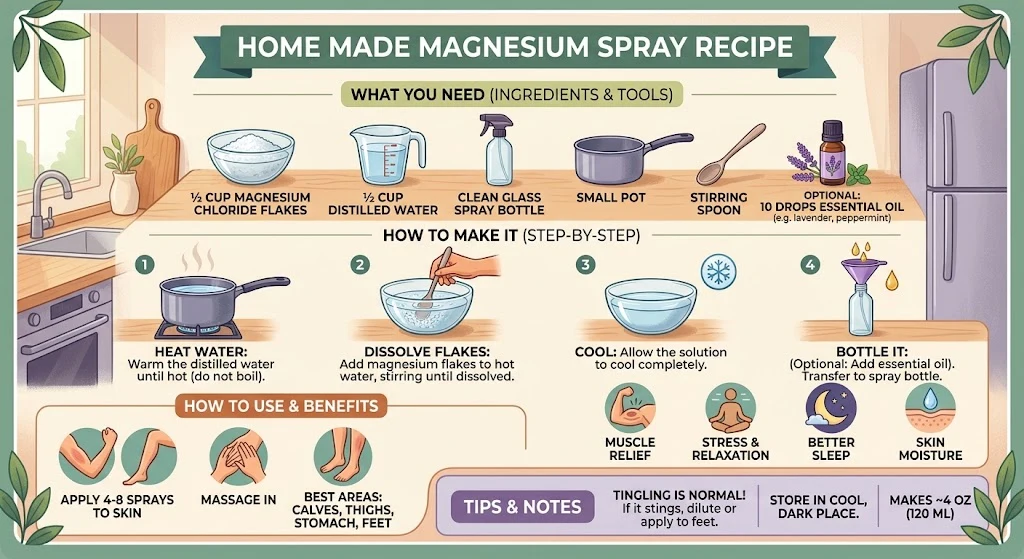
Learn how to make magnesium spray with magnesium chloride flakes and distilled water, including the right DIY ratio, dilution options, skin-safety tips, storage guidance, and what current research says about magnesium absorption through the skin.
To make a basic magnesium spray, combine magnesium chloride flakes and distilled water, commonly using a 1:1 volume ratio. Warm the water, stir in the flakes until fully dissolved, allow the solution to cool, and transfer it to a clean spray bottle. Start with a small amount on intact skin and dilute the mixture if it stings or irritates.
This is a DIY topical preparation, not a medically standardized magnesium treatment. Current evidence does not establish homemade topical magnesium spray as a reliable way to raise whole-body magnesium levels.
What Is Magnesium Spray?
Magnesium spray is a water-based solution made by dissolving a magnesium salt, usually magnesium chloride, in water. It is commonly sprayed onto intact skin and is often called “magnesium oil”, even though the finished liquid contains no actual oil.
The “oil” name comes from the slick feel of a concentrated magnesium chloride solution. It should not be confused with a true oil-based product. Magnesium chloride is also different from magnesium sulfate, the compound commonly sold as Epsom salt.
Simple Magnesium Spray Recipe
A straightforward two-ingredient DIY formulation for a small home batch.
Ingredients
- ½ cup magnesium chloride flakes
- ½ cup distilled water
Equipment
- Heat-safe glass measuring cup or bowl
- Spoon or glass stirrer
- Clean spray bottle
- Small funnel, if needed
- Label for the bottle
How to Make Magnesium Spray
- Measure the magnesium chloride flakes into a clean heat-safe container.
- Measure the distilled water separately.
- Warm the water until hot, but avoid handling it while extremely hot.
- Pour the water over the magnesium chloride flakes.
- Stir until the flakes completely dissolve.
- Let the solution cool to room temperature.
- Transfer it to a clean spray bottle.
- Label the bottle with the date and recipe ratio.
How Strong Should Magnesium Spray Be?
A 1:1 flakes-to-water ratio by volume is common in DIY recipes, but “stronger” does not automatically mean “better.” The exact concentration also depends on the physical characteristics and composition of the magnesium chloride product.
A More Dilute Option
If concentrated magnesium chloride feels harsh, make a gentler mixture:
- ¼ cup magnesium chloride flakes
- ½ cup distilled water
This produces a more diluted spray than the basic 1:1 formula. For a first experiment, making a small batch is more practical than preparing a large bottle.
What Type of Magnesium Chloride Should You Use?
The ingredient matters more than the label on the finished bottle. Look for a magnesium chloride product with:
- Clearly listed ingredients
- A reputable manufacturer or supplier
- Appropriate quality information
- No unnecessary fragrances or additives
- Instructions that identify its intended use
Also remember that magnesium chloride flakes are not the same as Epsom salt.
Magnesium Chloride vs. Epsom Salt
Magnesium chloride and magnesium sulfate are different magnesium salts. Epsom salt is magnesium sulfate, while the standard recipe here uses magnesium chloride.
| Ingredient | Chemical Form | Use in This Recipe |
|---|---|---|
| Magnesium chloride | Magnesium chloride | Yes |
| Epsom salt | Magnesium sulfate | No direct substitution |
| Table salt | Sodium chloride | No |
How to Use Magnesium Spray
Apply the finished spray only to intact skin. Start with a small area rather than covering your entire body with a concentrated solution.
Applying magnesium to skin is not the same as proving that enough magnesium enters the bloodstream to change magnesium status.
A Simple Application Routine
- Spray a small amount onto clean, intact skin.
- Allow it to dry naturally if comfortable.
- Wash the area if the sensation becomes unpleasant.
- Use a diluted formula if the concentrated version irritates your skin.
- Avoid eyes, mucous membranes, cuts, and damaged skin.
- Don’t apply it over significant rashes or active irritation.
- Patch-test a new formulation before regular use.
Does Magnesium Spray Absorb Through the Skin?
The study also found much greater permeation when the skin barrier had been experimentally disrupted. That does not mean you should intentionally damage your skin to increase absorption.
This does not mean a homemade spray is useless as a personal-care product. It does mean you should not assume that spraying magnesium chloride on your skin reliably raises whole-body magnesium levels.
The skin’s outer stratum corneum is an important barrier. Damaging that barrier can change penetration, which is one reason intentionally applying concentrated magnesium solution to broken or irritated skin is not a sensible strategy.
Magnesium Spray vs. Oral Magnesium
These are different ways of using magnesium and should not be treated as interchangeable.
Oral Magnesium
Oral magnesium has substantially more established information about absorption, dietary requirements, supplement forms, and intake. Magnesium from food is absorbed through the gastrointestinal tract.
Topical Magnesium
Topical magnesium faces the skin barrier, and current evidence does not establish homemade magnesium spray as a reliable method for increasing whole-body magnesium levels.
Why Does Magnesium Spray Sting?
A concentrated magnesium chloride solution can produce tingling, stinging, or irritation, particularly when applied to dry, cracked, freshly shaved, or already irritated skin.
If Your Spray Stings
- Wash the area with water if the sensation is strong.
- Try a more diluted formula next time.
- Use less product.
- Avoid freshly shaved skin.
- Avoid cracked heels and damaged areas.
- Leave essential oils out of your first batch.
- Don’t keep using a product that causes persistent irritation.
- Seek medical advice for severe or continuing skin reactions.
Magnesium Spray for Sensitive Skin
Sensitive skin usually benefits from fewer ingredients and lower exposure.
Instead of adding essential oils, carrier oils, or fragrances immediately, start with plain magnesium chloride and distilled water. This makes it easier to identify what causes irritation if your skin reacts.
A Simple Sensitive-Skin Approach
- Make a small diluted batch.
- Apply a tiny amount to intact skin.
- Wait and observe the area.
- Don’t apply it immediately after shaving.
- Stop if you develop significant redness, burning, swelling, or persistent itching.
Should You Add Essential Oils?
You don’t need essential oils to make magnesium spray.
Leaving them out creates a simpler formula and reduces the number of ingredients that could cause a skin reaction. Essential oils also don’t automatically make magnesium more effective.
How Long Does Homemade Magnesium Spray Last?
There is no scientifically validated universal shelf life for every homemade magnesium spray.
Some DIY websites claim that their formulations last for months, but a homemade water-based product without a validated preservation system should not automatically be assigned a long shelf life.
Practical Storage Checklist
- Make small batches.
- Use a clean bottle.
- Keep the bottle closed.
- Avoid touching the spray opening.
- Store it in a cool, clean location.
- Label the preparation date.
- Discard it if its appearance, smell, or texture changes.
- Make a fresh batch rather than trying to preserve a large quantity indefinitely.
Common Magnesium Spray Mistakes
Ingredient & Formula Mistakes
- Using Epsom salt instead of magnesium chloride
- Assuming a 1:1 ratio is medically standardized
- Using industrial material with unclear quality
- Adding essential oils without proper dilution
- Measuring a large batch without considering product differences
Application & Storage Mistakes
- Applying concentrated spray to freshly shaved skin
- Spraying over cuts or damaged skin
- Filling the bottle while the mixture is extremely hot
- Making a large batch that sits unused for months
- Treating skin stinging as proof of effectiveness
Can Magnesium Spray Help With Sleep?
That doesn’t prevent someone from including an unscented spray in a personal-care routine if their skin tolerates it. It simply keeps the claim within what the available evidence supports.
Can You Use Magnesium Spray on Your Feet?
You can apply a topical product to the intact skin of your feet if your skin tolerates it, but there is no good reason to claim that feet are a special absorption route.
Avoid applying concentrated spray to cracked heels, cuts, blisters, or irritated skin. Those areas have a compromised barrier and may sting considerably more.
Can You Use Magnesium Spray After Exercise?
A post-exercise shower can be a convenient time for a personal-care routine, but magnesium spray should not be presented as a treatment for muscle injury, significant pain, or other medical conditions.
- Wait until the skin is clean and dry.
- Avoid abrasions and chafed areas.
- Use a small amount.
- Don’t apply it over sunburn.
- Stop if it causes persistent irritation.
Magnesium and Your Diet
If your goal is to support adequate magnesium intake, food provides an established dietary source.
Magnesium-Rich Foods
- Pumpkin seeds
- Chia seeds
- Almonds
- Spinach
- Cashews
- Black beans
- Edamame
- Whole grains
For adults, recommended magnesium intake varies by age and sex. NIH lists adult recommended amounts ranging from 310 to 420 mg per day.
That context is useful because a homemade topical spray shouldn’t be treated as a substitute for meeting dietary needs.
Magnesium Spray Safety
Avoid
- Eyes
- Mouth
- Open wounds
- Freshly shaved skin
- Severely irritated skin
- Large amounts on sensitive areas
- Products with unclear ingredient quality
Use Extra Caution
People with medical conditions that affect magnesium handling, particularly kidney problems, should speak with a healthcare professional before trying to manage magnesium status themselves.
Safety information for oral magnesium supplements cannot simply be transferred to a homemade topical spray.
How to Make a Smaller Batch
Small 1:1 Magnesium Spray Batch
A practical option if you’re testing the formula for the first time.
Ingredients
- 2 tablespoons magnesium chloride flakes
- 2 tablespoons distilled water
Method
- Heat the distilled water.
- Pour it over the flakes.
- Stir until completely dissolved.
- Cool the mixture.
- Transfer it to a clean spray bottle.
- Label the bottle with the date.
How to Make Magnesium Spray Without Heating
Heating is mainly a convenience for helping the flakes dissolve. You can dissolve magnesium chloride in room-temperature distilled water with thorough stirring, but it may take longer.
There is no need to boil the finished mixture. For a simple home preparation, warm water plus complete dissolution is usually the easiest approach.
Frequently Asked Questions
Is magnesium spray the same as magnesium oil?
No. Most homemade “magnesium oil” recipes are actually magnesium chloride dissolved in water. The name refers to the slippery feel rather than the presence of an actual oil.
What is the best magnesium spray recipe?
A common homemade formulation uses equal volumes of magnesium chloride flakes and distilled water. However, this is a DIY recipe ratio rather than a clinically established topical dose.
Can I use Epsom salt to make magnesium spray?
Not as a direct substitute. Epsom salt is magnesium sulfate, while this recipe uses magnesium chloride. They are different magnesium salts with different properties.
Does magnesium spray raise magnesium levels?
Current evidence does not establish homemade magnesium spray as a reliable way to raise whole-body magnesium levels. A September 2026 ex-vivo study found minimal magnesium permeation through intact skin from a simple aqueous solution.
Why does magnesium spray burn?
Concentrated magnesium chloride can irritate skin, especially when the skin is dry, cracked, freshly shaved, or already inflamed. Diluting the mixture and avoiding damaged skin can make it more comfortable.
Can I use magnesium spray every day?
There is no universally established schedule for a homemade topical formulation. If you choose to use it, prioritize skin tolerance, use clean preparation practices, and stop if irritation develops.
Is magnesium spray good for sleep?
There isn’t good evidence that topical magnesium spray reliably improves sleep. Mayo Clinic Press reports that magnesium absorption through skin is probably low and does not recommend topical magnesium spray for sleep.
The Bottom Line
A magnesium spray recipe can be remarkably simple: magnesium chloride flakes, distilled water, a clean bottle, and a few minutes of preparation. The commonly used 1:1 ratio is a practical DIY starting point, but it should not be mistaken for a medically validated concentration.
The bigger takeaway is about expectations. Current 2026 research suggests that intact skin is a significant barrier to magnesium delivery, so homemade spray should not be promoted as a proven way to correct magnesium deficiency or treat sleep problems.
If you want to try it as a simple topical body-care product, make a small unscented batch, patch-test it, avoid damaged skin, and dilute it if needed. If your real goal is improving magnesium intake, start with magnesium-rich foods and discuss supplements or testing with a healthcare professional when appropriate.
Read More :