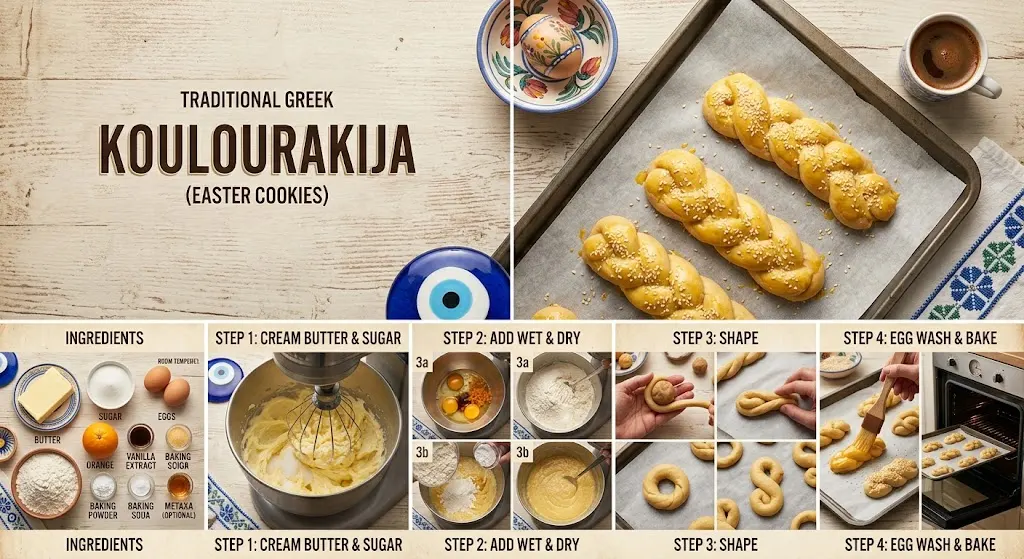
Make tender, lightly crisp Greek koulourakia with buttery flavor, bright orange zest, vanilla, and classic hand-twisted shapes. This beginner-friendly recipe includes step-by-step shaping instructions, variations, storage tips, and troubleshooting for a reliable homemade batch.
Koulourakia are traditional Greek shaped cookies commonly associated with Greek Easter. This version uses butter, eggs, sugar, orange zest, vanilla, milk, flour, and baking powder to create cookies with tender centers and lightly golden edges. For the best texture, add flour gradually, avoid overmixing, shape the cookies evenly, and don’t overbake them.
| Cuisine | Greek |
| Category | Cookie / Dessert |
| Yield | About 36 cookies |
| Prep Time | About 30 minutes |
| Bake Time | About 15–18 minutes |
| Oven Temperature | 350°F |
| Difficulty | Beginner-friendly |
| Main Flavors | Butter, vanilla, orange |
What Are Koulourakia?
Koulourakia are traditional Greek cookies made in many shapes, including twists, rings, braids, coils, and S shapes. Common versions use butter, eggs, flour, sugar, vanilla, citrus zest, and a leavening agent.
Their exact formula varies from family to family. Some recipes use orange juice, milk, olive oil, brandy, or specialty flavorings such as mahlepi. That variation is part of what makes Greek home baking so interesting.
Koulourakia are closely linked with Greek Easter, but they’re not limited to the holiday. Their firm shape and lightly sweet flavor make them especially enjoyable with coffee and tea.
What Makes a Good Koulourakia Recipe?
A good koulourakia recipe should produce dough that rolls smoothly without cracking but remains firm enough to hold its shape. Too much flour can make the cookies hard, while excessively soft dough can spread during baking.
The finished cookies should also have enough flavor to stand on their own. Orange zest and vanilla provide a simple combination that works particularly well for a first batch.
The Texture to Look For
- Soft but not sticky
- Pliable rather than crumbly
- Easy to roll between your palms
- Firm enough to form a rope
- Smooth without feeling greasy
- Able to hold a twist without immediately relaxing
Koulourakia Ingredients and Why They Matter
The ingredient list is fairly simple, but each ingredient affects the final cookie. Weighing flour is especially helpful because packed cups can produce a drier dough.
Traditional Koulourakia
Buttery Greek cookies with orange zest, vanilla, and a golden egg-wash finish.
Ingredients
- 3 cups (360 g) all-purpose flour
- ¾ cup (170 g) unsalted butter, softened
- ¾ cup (150 g) granulated sugar
- 2 large eggs, room temperature
- ¼ cup (60 ml) whole milk
- 2 teaspoons vanilla extract
- 1 tablespoon finely grated orange zest
- 2 teaspoons baking powder
- ¼ teaspoon fine salt
For the Egg Wash
- 1 egg yolk
- 1 teaspoon milk
- Sesame seeds, optional
Why These Ingredients Work
- Butter: Provides richness and helps create a tender crumb.
- Eggs: Add structure, richness, moisture, and browning.
- Sugar: Provides sweetness while helping the edges become lightly crisp.
- Orange zest: Adds concentrated citrus aroma without much extra liquid.
- Vanilla: Rounds out the citrus and butter flavors.
- Baking powder: Provides gentle lift without making the cookies cake-like.
- Milk: Helps create a soft, workable dough.
- Egg wash: Gives the cookies a characteristic golden sheen.
Classic Koulourakia Recipe
This recipe makes approximately 36 medium cookies, depending on how large you shape them. Keep the cookies similar in size so they bake evenly.
Step 1: Prepare the Oven and Pans
Step 2: Cream the Butter and Sugar
Step 3: Add the Eggs and Flavorings
Step 4: Mix the Dry Ingredients
Step 5: Check the Dough
- If extremely sticky, add flour one tablespoon at a time.
- If crumbly, stop adding flour and let the dough rest for several minutes before reassessing.
Step 6: Shape the Koulourakia
Step 7: Add the Egg Wash
Step 8: Bake
Step 9: Cool
How to Shape Koulourakia
The shape is one of the defining features of koulourakia. You don’t need complicated pastry skills to make attractive cookies. Traditional recipes use many forms, and shaping methods vary considerably.
The Easiest Shapes for Beginners
How to Get Golden, Tender Koulourakia
The difference between a good batch and a disappointing batch often comes down to flour, butter temperature, shaping, and baking time.
- Use softened, not melted, butter.
- Measure flour carefully.
- Add flour gradually.
- Don’t overmix after flour is incorporated.
- Keep cookie sizes consistent.
- Use a fully preheated oven.
- Brush the egg wash thinly.
- Avoid crowding the baking sheet.
- Watch the cookies during the final minutes.
- Cool completely before judging texture.
Orange Koulourakia With Bright Citrus Flavor
Orange zest is one of the easiest ways to make koulourakia more aromatic. It adds concentrated citrus flavor without making the dough wet.
Easy Orange Variations
- Add a little more orange zest for stronger aroma.
- Combine orange and lemon zest for layered citrus flavor.
- Add orange juice only when using a formula designed for the extra liquid.
- Pair orange with vanilla for a classic flavor.
- Add a pinch of cinnamon for a warmer cookie.
- Use sesame seeds for a nutty contrast.
- Serve orange koulourakia with strong coffee.
- Use fresh zest instead of bottled flavoring when possible.
Sesame, Mahlepi, and Anise Variations
Sesame seeds are a traditional-style topping found in many koulourakia recipes. Other versions use aromatic ingredients such as mahlepi or anise.
Mahlepi, also spelled mahlab or mahlebi, is made from the kernels of a type of cherry and has a distinctive warm, almond-like aroma.
| Variation | Main Flavor | Best For |
|---|---|---|
| Sesame | Toasty and nutty | Traditional-style trays |
| Mahlepi | Warm and aromatic | Special-occasion baking |
| Anise | Light licorice note | Stronger Greek bakery flavor |
| Orange | Bright and citrusy | Spring and Easter |
| Lemon | Fresh and sharp | Tea-time cookies |
| Orange + Cinnamon | Warm and citrusy | Holiday cookie trays |
Koulourakia vs. Other Greek Cookies
Greek baking includes many famous cookies, and they aren’t interchangeable.
| Cookie | Main Character | Typical Occasion |
|---|---|---|
| Koulourakia | Buttery, lightly sweet, shaped cookies | Easter and year-round |
| Kourabiedes | Rich, crumbly, powdered-sugar cookies | Christmas and celebrations |
| Melomakarona | Spiced cookies soaked in syrup | Christmas |
| Koulouria | Ring-shaped baked goods with many regional forms | Everyday or festive baking |
If you’re looking for a shaped Greek butter cookie, koulourakia are the style described by this recipe.
Can You Make Koulourakia With Olive Oil?
Yes, but an olive-oil koulourakia recipe should be treated as its own formula, not a simple butter-for-oil swap.
Butter contains both fat and water, while olive oil is almost entirely fat. Changing the fat can therefore affect dough consistency, spread, tenderness, and flavor.
If You Want an Olive-Oil Version
- Start with a recipe specifically developed for olive oil.
- Choose a mild olive oil.
- Pair it with orange zest.
- Expect a different flavor from butter-based cookies.
- Don’t assume a direct 1:1 substitution will work.
- Test a small batch before making a large holiday batch.
How to Make Koulourakia Without Alcohol
Some Greek cookie recipes use brandy, cognac, or another spirit. Others don’t. You do not need alcohol to make koulourakia.
For a family-friendly batch, use a formula that doesn’t require alcohol rather than making an uncertain substitution.
Alcohol-Free Flavor Choices
Common Koulourakia Problems and Fixes
Why Is My Dough Cracking?
The dough may contain too much flour or may be too cold. Let chilled dough soften slightly and try rolling it again. If it still crumbles, reassess the flour rather than immediately adding more liquid.
Why Are My Cookies Spreading?
The dough may be too soft or warm. Check that the butter was softened rather than melted. If the dough becomes very soft while shaping, chill it briefly before continuing.
Why Are My Koulourakia Hard?
Too much flour and overbaking are common causes of dry cookies. Measure flour carefully and remove the cookies once they are set with lightly golden edges.
Why Are the Cookies Pale?
Check that the oven was fully preheated and that the egg wash was applied evenly. A very thin coating can also produce less color than a fuller but still even coating.
Why Did the Bottoms Get Too Dark?
Try moving the baking sheet to the middle rack and checking your oven temperature. A dark baking sheet can also brown cookie bottoms faster than a lighter one.
Why Did My Twists Lose Their Shape?
The dough may be too soft. Use slightly smaller portions and avoid overworking the dough. If necessary, chill it briefly before shaping.
How to Store Koulourakia
Let the cookies cool completely before storing them. Place them in an airtight container at room temperature in a cool, dry area.
- Cool completely before sealing.
- Use an airtight container.
- Keep the container away from heat and humidity.
- Separate strongly flavored cookie varieties.
- Place parchment between delicate layers.
- Don’t refrigerate simply for the sake of storage.
- Freeze extras when you need longer storage.
- Discard cookies showing unusual odor, moisture, or visible spoilage.
Can You Freeze Koulourakia?
Yes. Koulourakia can be frozen either before or after baking, depending on your preferred workflow.
For a first batch, freezing fully baked and cooled cookies is the simplest option.
To Freeze Baked Cookies
- Cool the cookies completely.
- Arrange them in a freezer-safe container.
- Separate layers with parchment.
- Seal tightly.
- Label with the date.
- Thaw at room temperature while still covered.
- Serve once completely thawed.
To Freeze Shaped Dough
Freeze shaped cookies on a lined tray until firm. Transfer them to a freezer-safe container and label the date. If baking directly from frozen, follow the tested instructions for your specific dough rather than guessing at additional baking time.
Serving Koulourakia With Coffee and Tea
Koulourakia have enough sweetness for dessert without being so rich that they overwhelm a drink. They’re especially good alongside Greek coffee, espresso, black tea, or milk.
Koulourakia for Greek Easter and Beyond
Greek Easter is the best-known occasion for koulourakia, but the cookies don’t need to disappear after the holiday. Their dough is practical for family baking, and their shapes make them appealing for gatherings.
| Occasion | Serving Idea |
|---|---|
| Greek Easter | Make a large mixed-shape batch for the holiday table. |
| Spring Brunch | Serve with coffee, tea, and fresh fruit. |
| Family Gatherings | Offer different shapes on a shared platter. |
| Cookie Exchanges | Make smaller, uniform cookies for easy sharing. |
| Homemade Gifts | Pack cooled cookies in a decorative airtight box. |
| Afternoon Coffee | Pair two or three cookies with a strong coffee. |
Dietary Substitutions and Allergy Notes
Traditional koulourakia commonly contain wheat, eggs, and dairy. Sesame may also be used as a topping.
| Need | Practical Approach |
|---|---|
| Dairy-Free | Use a formula specifically developed with olive oil or another suitable dairy-free fat. |
| Egg-Free | Use a tested egg-free cookie recipe rather than guessing at an egg replacement. |
| Sesame-Free | Omit sesame from the topping and check packaged ingredients for cross-contact if needed. |
| Gluten-Free | Use a recipe specifically developed and tested with gluten-free flour. |
| Alcohol-Free | Choose a formula that doesn’t require alcohol. |
Recipe Notes for Better Results
The most useful lesson with koulourakia is that dough feel matters as much as the ingredient list.
Two kitchens can measure the same flour differently, especially when flour is scooped directly from the bag. Use the stated weight when available and rely on dough texture as a secondary check.
Before You Start
- Bring the butter to a soft, cool room temperature.
- Measure flour by weight when possible.
- Grate the orange before beginning the dough.
- Prepare the baking sheets first.
- Keep cookie sizes consistent.
- Don’t add flour simply because the dough feels soft.
- Shape a few cookies before deciding whether the dough needs adjustment.
- Bake a small test batch if you’re unfamiliar with your oven.
Frequently Asked Questions About Koulourakia
What Does Koulourakia Mean?
Koulourakia is the plural form associated with Greek koulouri-style baked goods. The cookies are recognized by their many hand-shaped forms, including twists, rings, and braids. They are especially associated with Greek Easter, although they’re enjoyed throughout the year.
How Do You Pronounce Koulourakia?
A common English approximation is koo-loo-RAH-kee-ah. Greek pronunciation follows Greek sounds more closely than English spelling can show.
Are Koulourakia Supposed to Be Soft or Crunchy?
Texture varies by recipe. Many versions aim for lightly crisp edges with a tender center, while other formulas produce a firmer, more biscuit-like cookie. Ingredient ratios and baking time make a noticeable difference.
Why Do Koulourakia Recipes Have Different Amounts of Flour?
There isn’t one universal koulourakia formula. Published recipes use different amounts of butter, eggs, milk, sugar, leavening, and liquid, so their flour requirements also vary. Choose one tested formula and follow it rather than combining measurements from several recipes.
Do Koulourakia Need Sesame Seeds?
No. Sesame is optional in many versions. It adds toasted flavor and an attractive finish, but the cookies are still recognizable as koulourakia without it.
Can I Make Koulourakia Without Butter?
Yes, but use a recipe specifically developed with olive oil or another dairy-free fat. Butter and oil behave differently in cookie dough, so a direct substitution may change the texture.
Can I Make Koulourakia Ahead of Easter?
Yes. You can prepare dough ahead, freeze shaped dough when the formula supports it, or bake the cookies ahead and freeze them after cooling. Fully baked and cooled cookies are a straightforward make-ahead option.
Final Thoughts
This koulourakia recipe combines buttery dough, orange zest, vanilla, golden egg wash, and classic hand-shaped twists for a traditional-style Greek cookie that’s approachable for beginners.
The key is keeping the dough soft enough to roll while avoiding excess flour. Start with simple twists, bake a small test batch, and judge the final texture only after the cookies cool.
Master the basic butter-and-orange dough first, then experiment with sesame, lemon, mahlepi, cinnamon, or a dedicated olive-oil formula to create your own favorite Greek cookie variation.
Read More :