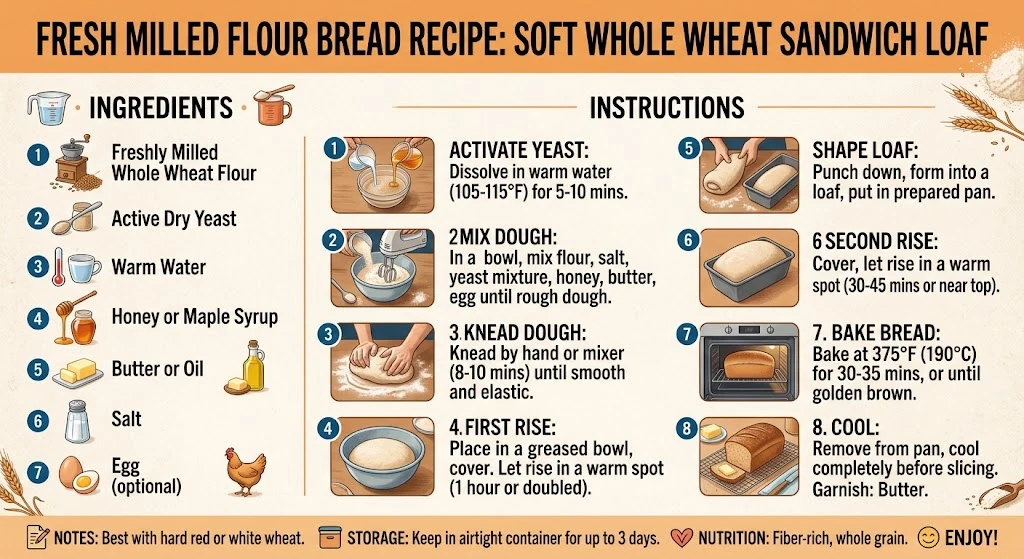
If you’re new to baking with freshly milled wheat, this fresh milled flour bread recipe gives you a practical place to start: a soft, sliceable sandwich loaf made with hard white wheat. Learn how to mill the grain, hydrate the dough, develop gluten, judge fermentation, bake the loaf, and troubleshoot common fresh-milled bread problems.
The easiest place to start is a 100% fresh-milled hard white wheat sandwich loaf made with instant yeast. Use a fine grind, weigh your ingredients, give the flour time to hydrate, and judge fermentation by the dough rather than the clock.
This recipe makes one soft 9 × 5-inch loaf with a lightly sweet flavor and a sturdy crumb for sandwiches, toast, grilled cheese, and French toast.
Fresh Milled Flour Bread at a Glance
Why Fresh Milled Flour Makes Different Bread
Freshly milled whole wheat contains all three parts of the wheat berry: bran, germ, and endosperm. The bran contributes fiber and texture, the germ contains much of the grain’s oil, and the endosperm supplies most of the starch and gluten-forming proteins.
That whole-grain structure affects bread in practical ways. Whole-grain dough can feel stickier, absorb liquid gradually, and produce a tighter crumb than refined-flour bread. Bran can also interfere with the gluten network that helps bread rise.
Don’t try to make fresh-milled wheat behave exactly like refined white bread flour. The goal is to build enough strength and hydration for a soft, well-risen whole-grain loaf.
What Makes This Recipe Beginner-Friendly?
- Hard white wheat provides a mild, approachable wheat flavor.
- Instant yeast removes the extra timing demands of sourdough.
- A short hydration rest gives the flour time to absorb water.
- Honey adds mild sweetness and supports browning.
- Olive oil helps keep the crumb tender.
- A loaf pan provides support for a tall sandwich loaf.
- The instructions rely on dough cues, not one rigid fermentation schedule.
Choosing Wheat Berries for Bread
The wheat you mill has a major effect on the finished loaf. For yeast bread, hard wheat is generally a better starting point than soft wheat because hard wheat contains more protein capable of forming a strong gluten network.
| Wheat | Best Use | Flavor & Characteristics |
|---|---|---|
| Hard White Wheat | First fresh-milled bread | Mild, slightly sweet, lighter-colored crumb |
| Hard Red Wheat | Hearty whole-wheat bread | Deeper grain flavor and darker crumb |
| Soft White Wheat | Cakes, cookies, biscuits, muffins | Lower gluten-forming potential; better for tender baking |
Hard White Wheat
Best for: First-time fresh-milled bread bakers.
- Mild, slightly sweet wheat flavor
- Lighter-colored crumb
- Good choice for sandwich bread
- Works well with sweet or savory toppings
Hard Red Wheat
Best for: A stronger whole-wheat flavor.
- Deeper grain flavor
- Darker crumb
- Excellent for hearty sandwiches
- Works well with soups and stews
Soft White Wheat
Best for: Cakes, cookies, biscuits, muffins, and other tender baked goods. Soft wheat has less gluten-forming potential than hard wheat, making it less suitable as the sole flour for a tall yeast loaf.
Spelt, Einkorn, and Khorasan
These grains can make interesting breads, but they shouldn’t automatically be substituted gram-for-gram into this formula. Their protein, dough behavior, and water requirements differ.
If you’re learning fresh-milled bread, start with hard white or hard red wheat before experimenting with specialty grains.
How to Mill Wheat for Bread
You don’t need to mill an entire pantry of flour before starting. For one loaf, mill only what the recipe requires and keep the process simple.
A fine grind is generally easier to work with for sandwich bread than a very coarse grind because large bran particles can make gluten development more difficult.
🌾 Milling Checklist
- Weigh your wheat berries before milling.
- Mill the berries on a fine setting suitable for bread.
- Check that the flour looks reasonably fine and even.
- Let unusually warm flour cool before mixing.
- Weigh the finished flour when preparing the recipe.
- Avoid relying on cups of freshly milled flour for precise baking.
- Mill only what you need when practical.
- Store extra flour airtight and cold to protect quality.
Freshly milled whole-grain flour contains the germ and its natural oils, which makes it more perishable than refined flour.
Fresh Milled Flour vs. Store-Bought Whole Wheat Flour
Both can be whole-grain flours, but they aren’t necessarily interchangeable in every recipe. Freshly milling your own wheat gives you control over the grain, grind, and timing. Store-bought whole-wheat flour offers convenience and more consistent behavior from bag to bag.
| Feature | Fresh-Milled Flour | Store-Bought Whole Wheat |
|---|---|---|
| Grain control | You choose the wheat berries | Usually predetermined |
| Freshness | Mill immediately before use | Already milled |
| Grind | Adjustable on some mills | Set by manufacturer |
| Flavor | Fresh grain aroma | More familiar whole-wheat flavor |
| Storage | Needs careful protection | Usually easier |
| Hydration | May need adjustment | More predictable |
| Equipment | Requires a grain mill | No mill needed |
Freshly milled does not automatically mean every dough needs more water. Whole-grain flour hydrates over time, and the exact behavior depends on the grain, grind, formula, and conditions.
Fresh Milled Flour Bread Recipe
100% fresh-milled hard white wheat sandwich loaf with instant yeast.
🥣 Ingredients
- 500g freshly milled hard white wheat flour
- 360g lukewarm water
- 30g honey
- 25g olive oil
- 7g instant yeast
- 9g fine salt
🧰 Equipment
- Grain mill
- Digital kitchen scale
- Large mixing bowl
- Stand mixer or sturdy wooden spoon
- Dough scraper
- 9 × 5-inch loaf pan
- Cooling rack
- Instant-read thermometer
Bake at 375°F until the loaf is deeply golden and fully baked. For a more reliable doneness check, use an instant-read thermometer. A sandwich loaf is generally ready when the center reaches roughly 190°F or higher.
How to Make It
- Mill the wheat. Mill enough hard white wheat berries to produce 500g of fine whole-wheat flour. If your mill produces extra, weigh the amount required for the recipe.
- Make the hydration rest. Place the flour in a mixing bowl. Add about 330g of the water and mix until no dry flour remains. Cover and rest for 20–30 minutes.
- Add the remaining ingredients. Add the honey, olive oil, instant yeast, salt, and remaining water as needed. Mix until cohesive.
- Develop the dough. Knead on low to medium-low speed, or knead by hand using repeated folds. Aim for a dough that is soft, elastic, cohesive, and slightly tacky.
- Let it rise. Place the dough in a lightly greased bowl, cover, and let it rise in a comfortably warm, draft-free place until it has clearly expanded and feels lighter and aerated.
- Shape the loaf. Turn the dough onto a lightly greased surface. Gently flatten into a rectangle, roll tightly into a loaf, pinch the seam closed, and place seam-side down in a greased 9 × 5-inch pan.
- Proof the shaped loaf. Cover and let the dough rise again until visibly puffy and rising toward or slightly above the rim of the pan. Avoid allowing it to become fragile and over-expanded.
- Bake. Heat the oven to 375°F. Bake for approximately 35–45 minutes, adjusting as needed for your oven and pan. Tent loosely with foil if the top browns too quickly.
- Cool completely. Remove the bread from the pan and cool on a rack before slicing. Cutting hot bread too early can compress the crumb and make it appear gummy.
What the Dough Should Look Like
Immediately After Mixing
- Rough
- Slightly sticky
- Uneven
- Less elastic than expected
After the Hydration Rest
- More moisture absorption
- Less surface roughness
- Better cohesion
- Easier kneading
After Kneading
- Elastic
- Soft
- More resistant to tearing
- Able to hold a loose ball
After the First Rise
- Increased volume
- Visible bubbles
- Lighter feel
- Slightly domed surface
How Much Water Does Fresh Milled Flour Need?
There isn’t one universal hydration number for every fresh-milled loaf. Wheat variety, grind size, bran particles, flour temperature, dough temperature, and recipe structure all affect how the dough behaves.
If Your Dough Is Too Stiff
- Stop mixing.
- Cover the dough.
- Let it rest for 10–15 minutes.
- Knead again.
- Add reserved water in very small amounts if it still feels unusually firm.
If Your Dough Is Extremely Sticky
- Let it rest before changing the formula.
- Knead briefly.
- Grease your hands.
- Use a dough scraper.
- Check whether the dough is gaining strength.
A slightly tacky dough can be easier to bake into a tender loaf than a stiff dough loaded with extra flour. Give the flour time to hydrate before making major adjustments.
Why Fresh Milled Bread Can Turn Out Dense
| Possible Cause | What Happens |
|---|---|
| Too little water | Dough remains stiff and fermentation can suffer. |
| Too much added flour | Effective hydration drops. |
| Weak gluten development | Dough cannot hold fermentation gases effectively. |
| Under-proofing | The loaf enters the oven before enough gas has developed. |
| Over-proofing | The dough loses structural strength. |
| Unsuitable wheat | Soft wheat may not provide enough structure for a tall loaf. |
| Coarse milling | Large bran particles can interfere with gluten development. |
| Cutting too soon | Hot bread can appear gummy and compressed. |
How to Get a Taller, Softer Loaf
- Use hard white wheat for a mild first loaf.
- Mill the flour finely.
- Give flour and water time to hydrate.
- Don’t bury sticky dough under extra flour.
- Knead until the dough develops strength.
- Keep the dough comfortably warm during fermentation.
- Shape firmly enough to create surface tension.
- Don’t over-proof the shaped loaf.
- Bake thoroughly.
- Cool completely before slicing.
Should You Use Vital Wheat Gluten?
Optional means optional. Vital wheat gluten can strengthen some whole-grain formulas because it adds additional gluten-forming protein.
However, don’t add it automatically to this recipe. Start with hard wheat and learn how your flour behaves. If you consistently get a weak loaf despite correct hydration and fermentation, a tested formula using vital wheat gluten may be worth exploring.
Fresh Milled Flour Sourdough Bread
Once you’re comfortable with yeast bread, sourdough is a natural next step. A fresh-milled sourdough loaf typically uses freshly milled flour, water, active sourdough starter, and salt.
🥖 Beginner Fresh-Milled Sourdough Formula
- 500g hard white wheat flour
- 350g water
- 100g active sourdough starter
- 12g salt
This is a separate formula. Do not simply add starter to the yeast recipe without recalculating the flour and water.
Yeast Bread
Easier to schedule and usually faster.
Sourdough
More fermentation variables, with a different flavor and texture.
Fresh Milled Flour Bread Machine Recipe
A bread machine can simplify the process by handling mixing, kneading, rising, and baking. However, bread machines vary enough that one universal fresh-milled formula should not be assumed to fit every machine.
- Use a recipe designed for your machine’s loaf size.
- Weigh the flour.
- Choose a whole-wheat cycle when appropriate.
- Watch the dough during the first mixing phase.
- Avoid adding large amounts of flour.
- Follow your machine manufacturer’s ingredient-order instructions.
- Check the finished loaf for complete baking.
- Cool it on a rack before slicing.
Fresh Milled Flour Dinner Rolls and Hamburger Buns
The sandwich-bread concept can be adapted into smaller shapes, but rolls and buns deserve their own formula because their size changes baking and shaping.
Good Uses for Fresh-Milled Roll Dough
- Dinner rolls for holiday meals
- Hamburger buns for cookouts
- Slider buns for parties
- Breakfast rolls with butter and jam
- Sandwich buns for packed lunches
Shaping Tips
For burger buns, shape the dough into smooth rounds and flatten them slightly before the final proof. For dinner rolls, place pieces closer together when you want soft pull-apart sides.
Fresh Milled Flour Focaccia
Focaccia is an excellent way to use fresh-milled wheat when you don’t need a tall sandwich loaf. A wetter dough works well because the bread is baked in an oiled pan rather than shaped into a freestanding loaf.
🌿 Focaccia Flavor Ideas
- Rosemary and flaky salt
- Garlic and olive oil
- Cherry tomatoes and basil
- Olives and oregano
- Caramelized onions
- Parmesan and herbs
Use generous olive oil in the pan, let the dough relax, then press deep dimples into the surface with oiled fingertips.
Fresh Milled Flour Pizza Dough
Fresh-milled wheat can give pizza dough a more pronounced grain flavor. Hard white wheat is a useful starting point because its flavor is relatively mild compared with hard red wheat.
- Mill the flour finely.
- Give the flour time to hydrate.
- Keep the dough soft enough to stretch.
- Avoid excessive toppings.
- Preheat the oven and baking surface thoroughly.
- Allow refrigerated dough to warm before shaping.
- Handle the dough gently.
- Use a little less whole-grain flour if you’re still learning its behavior.
Fresh Milled Flour Cinnamon Swirl Bread
Fresh-milled hard white wheat works especially well in lightly sweetened breakfast bread. The main challenge is keeping the cinnamon filling contained.
🍂 For a Clean Cinnamon Swirl
- Roll the dough into an even rectangle.
- Spread the filling in a thin layer.
- Leave a small border around the edges.
- Roll firmly from one short side.
- Pinch the seam closed.
- Place seam-side down in the pan.
- Proof until visibly puffy.
- Cool before slicing.
Fresh Milled Flour Substitutions
Bread dough doesn’t tolerate unlimited substitutions. Changing the flour, liquid, fat, sweetener, and yeast at the same time makes the recipe much harder to predict.
| Original | Possible Substitute | What to Expect |
|---|---|---|
| Honey | Maple syrup | Another liquid sweetener with a similar role |
| Olive oil | Melted butter | Richer flavor and dairy in the loaf |
| Olive oil | Neutral oil | Less olive flavor |
| Water | Milk | Richer, softer loaf with a changed formula |
| Hard white wheat | Hard red wheat | Stronger wheat flavor and darker loaf |
Don’t automatically replace hard wheat with soft white wheat, pastry flour, rye, einkorn, 100% spelt, or gluten-free flour. Each changes dough structure and hydration requirements.
Is Fresh Milled Flour Bread Gluten-Free?
No. Wheat naturally contains gluten, so bread made from freshly milled wheat is not gluten-free.
If you need a gluten-free loaf, use a recipe specifically formulated with gluten-free grains and a suitable binder. Do not simply substitute gluten-free flour into this wheat recipe.
Wheat is a major food allergen. Anyone avoiding wheat or gluten should use an appropriately formulated recipe rather than adapting this wheat-based loaf.
Fresh Milled Flour Storage
Fresh-milled flour contains the entire wheat berry, including the oil-rich germ. That makes storage more important than it is for highly refined flour.
🌾 Storing Fresh-Milled Flour
- Use an airtight container.
- Keep small amounts at room temperature only when using them soon.
- Refrigerate or freeze larger quantities.
- Protect flour from moisture and odors.
- Discard flour with an obvious rancid or otherwise off smell.
🍞 Storing Baked Bread
- Cool completely before wrapping.
- Slice before freezing for convenient portions.
- Wrap tightly to limit freezer exposure.
- Freeze for longer-term storage.
- Avoid refrigerating bread simply to extend its life because refrigeration can accelerate staling.
Fresh Milled Bread Troubleshooting Guide
| Problem | Likely Cause | What to Change Next Time |
|---|---|---|
| Dense loaf | Under-proofing, weak dough, too little water | Check fermentation and dough strength |
| Dry crumb | Too much flour or overbaking | Hold back added flour and check doneness |
| Gummy center | Underdone or sliced hot | Bake fully and cool completely |
| Collapsed loaf | Over-proofing or weak structure | Shorten final proof and strengthen dough |
| Very sticky dough | High hydration or insufficient rest | Rest before adding flour |
| Flat loaf | Weak gluten or poor fermentation | Try hard wheat and improve dough development |
| Crumbly loaf | Weak structure or overly dry dough | Check hydration and fermentation |
| Hard crust | Excessive baking or dry environment | Check bake time and cooling |
| Pale crust | Insufficient browning | Verify oven temperature and baking time |
| Strong wheat flavor | Hard red wheat or high whole-grain character | Try hard white wheat or blend the grains |
Change one variable at a time. If your first loaf is dense, don’t simultaneously change the wheat, hydration, yeast, kneading, pan, and oven temperature. Fix the most likely problem first so your next loaf actually teaches you something.
Serving Ideas for Fresh Milled Bread
☀️ Breakfast
- Butter and honey
- Peanut butter and banana
- Egg and cheese toast
- French toast
- Avocado toast
- Cinnamon toast
🥪 Lunch
- Turkey and cheddar
- Tuna salad
- Grilled cheese
- Chicken salad
- Peanut butter and jelly
- Hummus and vegetables
🍲 Dinner
- Serve alongside soup
- Pair with stews
- Toast for garlic bread
- Make homemade breadcrumbs
- Serve with pasta
- Pair with roasted vegetables
Fresh Milled Flour Bread: Common Questions
Can I use fresh-milled flour immediately?
Yes. Milling shortly before baking is a practical way to use the flour while its flavor is fresh. If you mill extra, store it airtight and keep it cool because whole-grain flour contains the germ and its oils.
Do I have to use hard white wheat?
No. Hard red wheat also makes excellent bread. Hard white wheat is simply a convenient starting point because it has a lighter color and milder flavor.
Why does my fresh-milled bread taste bitter?
A bitter or stale-oil flavor can indicate that whole-grain flour has lost freshness. Because the germ contains oil, whole-grain flour is more perishable than refined flour. Store extra fresh flour airtight and cold.
Should I sift fresh-milled flour?
You don’t have to. If your goal is a 100% whole-grain loaf, keeping the bran and germ means using the complete wheat berry. Sifting changes the flour’s composition and therefore changes how the dough behaves.
Can I make this bread without honey?
Yes. Honey contributes sweetness and browning, but it isn’t essential to the basic structure of the loaf. Because honey is a liquid ingredient, removing it changes the dough balance and may require adjustment.
Why does fresh-milled bread need a hydration rest?
Whole-grain flour absorbs water gradually, and bran can make dough feel sticky during initial mixing. A short rest gives the flour time to hydrate before you develop the dough.
Can I freeze fresh-milled bread?
Yes. Cool the loaf completely, slice it if convenient, wrap it airtight, and freeze it. Freezing is a practical way to preserve homemade bread when you won’t finish the loaf quickly.
Final Thoughts
A successful fresh milled flour bread recipe doesn’t depend on forcing whole wheat to behave like refined white flour. It depends on choosing suitable wheat, giving the flour enough time to hydrate, developing sufficient dough strength, and recognizing when the loaf is properly fermented.
Start with hard white wheat and the sandwich loaf in this guide. Once that dough becomes familiar, move on to hard red wheat, sourdough, dinner rolls, pizza, focaccia, or cinnamon bread.
The best next step is simple: mill enough hard white wheat for one loaf, weigh your ingredients, and pay attention to what the dough tells you at every stage.
Source notes: The article references King Arthur Baking for whole-grain dough behavior, wheat characteristics, hydration-rest guidance, and bread doneness; USDA guidance is referenced for bread storage. The original source links should be retained in the published article where appropriate.
Read More :