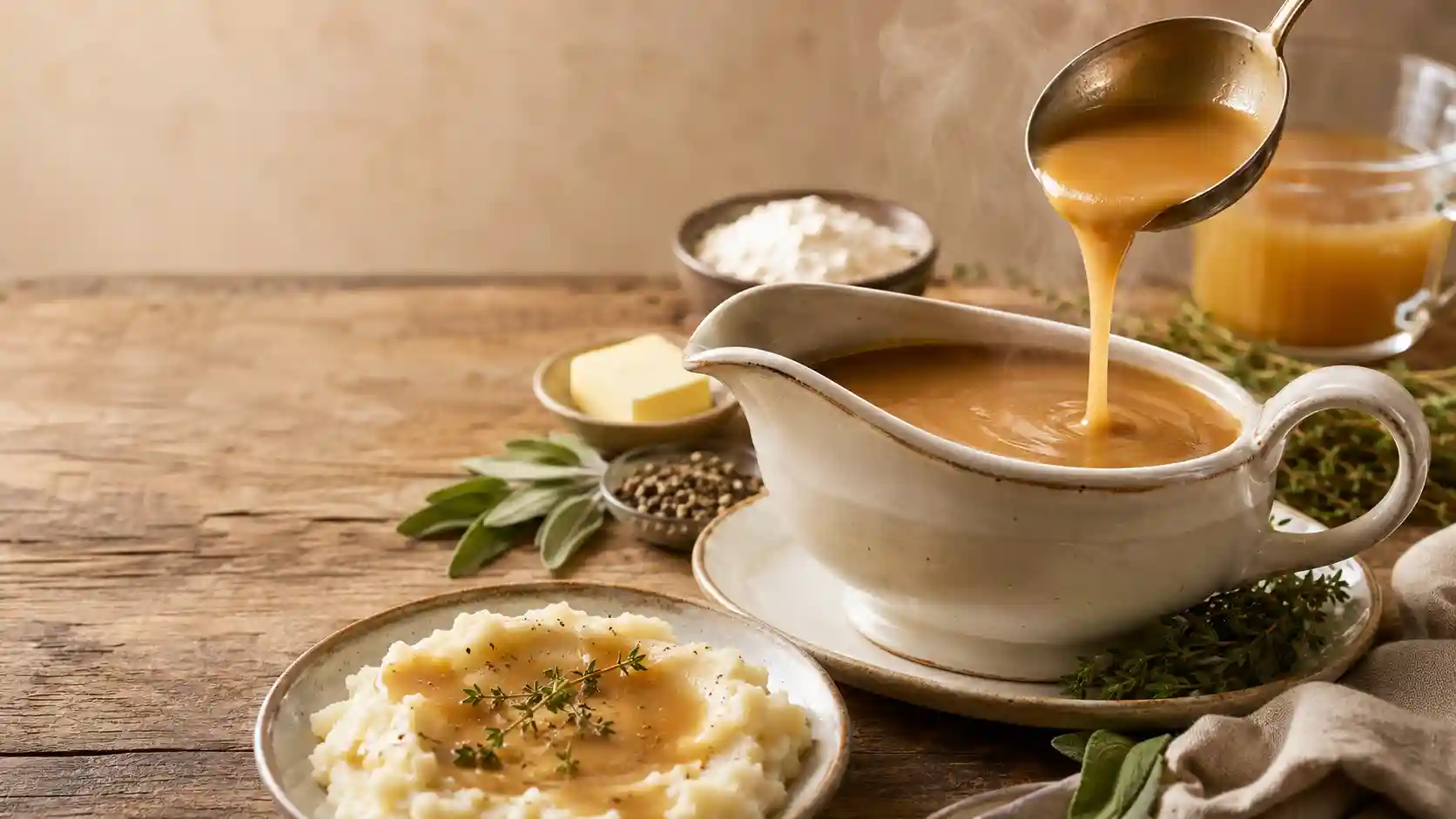
Make delicious homemade turkey gravy without pan drippings using butter, flour, turkey stock or chicken broth, and classic poultry herbs. It is an easy solution for smoked turkey, fried turkey, turkey breast, and stress-free Thanksgiving meals.
Need Turkey Gravy Without Drippings that still tastes rich, smooth, and homemade? This easy recipe uses butter, flour, turkey stock or chicken broth, and simple poultry herbs. You do not need pan juices from a roasted turkey, making it especially useful when the drippings were not saved.
The secret is building flavor from the beginning. A lightly cooked roux gives the gravy body, while good broth and classic herbs create the savory taste people expect from Thanksgiving gravy.
This method takes about 15 minutes and also gives you practical ways to prevent lumps, fix thin gravy, make it ahead, freeze leftovers, and adapt the recipe for gluten-free, dairy-free, or low-sodium meals.
You can make Turkey Gravy Without Drippings by whisking butter and flour into a roux, slowly adding turkey stock or chicken broth, then seasoning with poultry herbs, pepper, garlic, and onion. Simmer for 5 to 8 minutes until smooth and thick. The complete recipe takes about 15 minutes.
Recipe Snapshot
| Detail | Best Option |
|---|---|
| Prep time | 5 minutes |
| Cook time | 10 minutes |
| Total time | 15 minutes |
| Yield | About 2 cups gravy |
| Servings | 6 to 8 |
| Best broth | Turkey stock |
| Easy substitute | Low-sodium chicken broth |
| Skill level | Beginner |
| Best for | Thanksgiving, turkey breast, smoked turkey, fried turkey, mashed potatoes |
Why This Turkey Gravy Without Drippings Works
This recipe replaces turkey pan drippings with three simple flavor-building elements: fat, thickener, and seasoned broth.
Butter
Replaces the richness and cooking fat normally supplied by pan drippings.
Flour
Creates the roux that gives gravy its smooth, silky body.
Good Broth
Provides the savory liquid foundation and turkey flavor.
Poultry Herbs
Sage, thyme, rosemary, and poultry seasoning recreate classic holiday flavor.
Another advantage is control. You can prepare the gravy before the turkey is finished, adjust the salt level, choose the thickness, and avoid last-minute scraping of a roasting pan.
Ingredients You Need
What are the main ingredients?
You only need a handful of pantry staples to make homemade gravy without drippings.
| Ingredient | Amount | Metric Approx. | Purpose |
|---|---|---|---|
| Unsalted butter | 4 tablespoons | 56 g | Adds richness |
| All-purpose flour | 1/4 cup | 31 g | Thickens the gravy |
| Turkey stock or chicken broth | 2 cups | 480 ml | Creates the savory base |
| Poultry seasoning | 1/2 teaspoon | 1 g | Classic turkey flavor |
| Garlic powder | 1/4 teaspoon | 0.8 g | Savory depth |
| Onion powder | 1/4 teaspoon | 0.8 g | Rounds out flavor |
| Dried thyme or sage | 1/4 teaspoon | 0.3 g | Holiday herb flavor |
| Black pepper | 1/4 teaspoon | 0.6 g | Adds warmth |
| Salt | To taste | — | Balances the flavor |
Which broth tastes best?
Turkey stock gives the most traditional turkey flavor. If you cannot find it, low-sodium chicken broth is a convenient substitute that works well year-round.
For holiday meals, choose turkey stock when available. For everyday dinners, chicken broth is perfectly practical. If the broth tastes mild, a small amount of turkey base, chicken bouillon, Worcestershire sauce, or soy sauce can add more savory depth.
Should you use salted or unsalted butter?
Unsalted butter gives you better control because broth, bouillon, turkey base, Worcestershire sauce, and soy sauce can all contribute salt. Salted butter is still fine; simply wait until the end before adding additional salt.
Optional Flavor Boosters
These ingredients are optional, but a small amount can make the gravy taste deeper and more roasted even without turkey drippings.
| Add-In | Amount | Best For |
|---|---|---|
| Turkey base or chicken bouillon | 1/2 to 1 teaspoon | Stronger turkey flavor |
| Worcestershire sauce | 1/2 teaspoon | Savory depth |
| Soy sauce | 1/4 to 1/2 teaspoon | Umami and color |
| Dry white wine | 2 tablespoons | More complex flavor |
| Fresh thyme | 1 teaspoon | Fresh herb aroma |
| Fresh sage | 1 teaspoon | Classic Thanksgiving flavor |
| Extra butter | 1 tablespoon | Glossy finish |
How to Make Turkey Gravy Without Drippings
How do you make a lump-free roux?
Melt the butter in a medium saucepan over medium heat. Add the flour and whisk constantly for 2 to 3 minutes.
The mixture should look smooth, thick, and lightly golden. It may develop a slightly nutty aroma. Cooking the roux helps remove the raw flour taste and creates a better-tasting gravy.
How do you add broth without lumps?
Slowly pour in the turkey stock or chicken broth while whisking continuously. Start with a thin stream and keep the whisk moving.
The gravy may become very thick when the first splash of broth reaches the roux. Keep whisking and gradually add the remaining liquid until the sauce becomes smooth.
How long should gravy simmer?
Bring the gravy to a gentle simmer and cook for 5 to 8 minutes, stirring often. It is ready when it coats the back of a spoon and pours smoothly.
Remember that gravy thickens as it cools. Remove it from the heat when it is slightly looser than your desired final consistency.
When should you season the gravy?
Season near the end. Add poultry seasoning, garlic powder, onion powder, thyme or sage, black pepper, and salt after the broth has simmered.
This makes it easier to control the final salt level, especially when using broth or bouillon that already contains sodium.
Easy 15-Minute Turkey Gravy Recipe
Classic homemade gravy without turkey pan drippings.
Ingredients
- 4 tablespoons unsalted butter
- 1/4 cup all-purpose flour
- 2 cups turkey stock or low-sodium chicken broth
- 1/2 teaspoon poultry seasoning
- 1/4 teaspoon garlic powder
- 1/4 teaspoon onion powder
- 1/4 teaspoon dried thyme or dried sage
- 1/4 teaspoon black pepper
- Salt, to taste
- Optional: 1/2 teaspoon Worcestershire sauce
- Optional: 1/2 to 1 teaspoon turkey base or chicken bouillon
Instructions
Melt the butter
Place a medium saucepan over medium heat. Add the butter and let it melt completely.
Make the roux
Whisk in the flour. Cook for 2 to 3 minutes, whisking often, until lightly golden.
Add the broth slowly
Pour in the stock or broth gradually while whisking constantly. Continue until smooth.
Season
Add poultry seasoning, garlic powder, onion powder, thyme or sage, black pepper, and optional flavor boosters.
Simmer
Cook for 5 to 8 minutes, stirring often, until the gravy reaches your preferred thickness.
Taste and serve
Taste before adding salt. Serve warm over turkey, mashed potatoes, stuffing, biscuits, or roasted vegetables.
Best Roux Ratio for Turkey Gravy
A classic gravy formula is easy to remember: use roughly equal parts fat and flour, then adjust the liquid for your preferred thickness.
| Gravy Amount | Butter | Flour | Stock or Broth |
|---|---|---|---|
| 2 cups | 4 tbsp | 1/4 cup | 2 cups |
| 4 cups | 8 tbsp | 1/2 cup | 4 cups |
| 6 cups | 12 tbsp | 3/4 cup | 6 cups |
| 8 cups | 1 cup | 1 cup | 8 cups |
For thinner gravy, add more broth. For thicker gravy, simmer longer or start with slightly less liquid.
How to Adjust the Texture
Too Thick?
Whisk in warm broth 1 to 2 tablespoons at a time. Stir after every addition until the gravy reaches the desired consistency.
Too Thin?
Simmer for a few more minutes. If needed, mix 1 teaspoon cornstarch with 1 teaspoon cold water and whisk the slurry into the simmering gravy.
Lumpy?
Whisk firmly for 30 to 60 seconds. If lumps remain, strain the gravy through a fine-mesh strainer.
Too Thick After Refrigerating?
Reheat gently and whisk in warm broth a little at a time until smooth and pourable again.
Troubleshooting Table
| Problem | Likely Cause | Quick Fix |
|---|---|---|
| Lumpy gravy | Broth added too fast | Whisk firmly or strain |
| Too thick | Too much flour or over-simmering | Add warm broth slowly |
| Too thin | Not simmered long enough | Simmer longer or add cornstarch slurry |
| Bland flavor | Weak broth | Add turkey base, herbs, or a little Worcestershire |
| Too salty | Salty broth or bouillon | Dilute with unsalted broth and adjust seasoning |
| Raw flour taste | Roux not cooked enough | Cook the roux properly before adding broth |
| Greasy texture | Too much fat | Whisk in a little more broth |
| Dark or burned specks | Roux or garlic burned | Start over for the best flavor |
How to Make It Taste Like Traditional Turkey Gravy
How do you add roasted flavor without drippings?
Use one or two savory boosters. Turkey base, bouillon, Worcestershire sauce, soy sauce, and sautéed shallots can all add depth.
For extra homemade flavor, sauté finely minced onion or shallot in the butter before adding the flour. This adds another layer of savory flavor to the finished gravy.
Should you add herbs?
Absolutely. Sage gives gravy a classic Thanksgiving character, thyme provides a fresher herbal note, and rosemary adds a stronger holiday aroma.
Dried herbs are concentrated, so start with a small amount. Fresh herbs can be added near the end for a brighter flavor.
Can you add pan drippings later?
Yes. If turkey drippings become available later, whisk a small amount into the finished gravy. Start with about 1/4 cup, taste, and adjust.
Recipe Variations
Can you make gluten-free turkey gravy without drippings?
Yes. Skip the flour roux and use cornstarch instead. Heat the broth with butter and seasonings, then mix 2 tablespoons cornstarch with 2 tablespoons cold water. Whisk the slurry into the hot broth and simmer until thick.
Can you make dairy-free turkey gravy?
Yes. Replace butter with olive oil, vegan butter, or another suitable cooking fat. Vegan butter gives the closest classic gravy character.
Can you make low-sodium gravy?
Yes. Start with unsalted butter and low-sodium broth. Avoid regular bouillon unless it fits your sodium needs. Build flavor with black pepper, thyme, sage, onion powder, and garlic powder, then add salt only if needed.
Can you make extra-rich holiday gravy?
Whisk in 1 tablespoon of butter at the end for a glossy finish. Turkey stock, a small amount of turkey base, and a tiny splash of Worcestershire sauce can also deepen the flavor.
Make-Ahead Tips
Can you make this gravy before Thanksgiving?
Yes. Prepare it 1 to 2 days ahead, cool it, refrigerate it, and gently reheat it before the meal.
Make the gravy slightly thinner than your ideal serving consistency because it will thicken considerably when chilled.
How do you reheat gravy without breaking it?
Warm the gravy in a saucepan over low to medium heat and whisk frequently. If it becomes too thick, add warm broth a splash at a time.
Can you keep it warm for a holiday meal?
Yes. Keep it warm over very low heat and stir occasionally. A slow cooker on its warm setting can also be useful for a short serving window.
How to Store, Freeze, and Reheat
Cool leftover gravy promptly and transfer it to an airtight container. For the best quality, use refrigerated gravy within a few days and freeze anything you will not use soon.
| Storage Method | How Long | Best Tip |
|---|---|---|
| Refrigerator | 3 to 4 days | Store in an airtight container |
| Freezer | Best texture within 2 to 3 months | Freeze in small containers or freezer bags |
| Reheating | Until hot and smooth | Whisk in broth if the gravy is too thick |
For the smoothest texture, thaw frozen gravy in the refrigerator overnight. Reheat slowly on the stove and whisk thoroughly.
What to Serve with Turkey Gravy Without Drippings
This gravy is more versatile than a Thanksgiving-only sauce. Use it with turkey dinners, comfort-food meals, and leftovers.
Turkey & Chicken
Roast turkey, smoked turkey breast, fried turkey, roast chicken, and turkey leftovers.
Classic Sides
Mashed potatoes, stuffing, roasted carrots, green bean casserole, and other holiday sides.
Comfort Foods
Buttermilk biscuits, meatloaf, fries, and poutine-style potatoes.
Leftover Ideas
Open-faced turkey sandwiches and easy leftover holiday plates.
For a simple dinner, spoon the gravy over mashed potatoes and sliced turkey breast. For a holiday table, serve it in a warmed gravy boat.
International Ingredient Notes
Ingredient names can vary by country. These equivalents can make the recipe easier to follow for readers in the USA, UK, Australia, Canada, and Germany.
| USA Term | UK / AU / CA / Germany Note |
|---|---|
| All-purpose flour | Plain flour |
| Cornstarch | Cornflour in the UK/Australia |
| Turkey stock | Turkey broth or poultry stock |
| Chicken broth | Chicken stock may be used |
| Poultry seasoning | Thyme, sage, marjoram, rosemary, and pepper can be combined |
| Butter | Unsalted butter is preferred |
| Gravy boat | Sauce jug also works |
If using stock cubes or bouillon powder, dissolve them completely and taste the gravy before adding salt.
Common Mistakes to Avoid
Skipping the roux
A properly cooked roux gives the gravy its smooth body. Cook the butter and flour for at least about 2 minutes to reduce the raw flour taste.
Adding broth too quickly
Pour the liquid slowly while whisking. This is one of the easiest ways to prevent lumps.
Using full-sodium broth without tasting
Broths and bouillons can contain significant amounts of sodium. Taste before adding extra salt.
Boiling too hard
A gentle simmer gives you better control than a hard boil and helps prevent the gravy from reducing too quickly.
Forgetting that gravy thickens as it cools
Remove the gravy from the heat while it is slightly looser than your desired final consistency.
Overloading the herbs
Sage and rosemary can become overpowering quickly. Start with a small amount and add more only if needed.
Practical Tips for the Best Results
- Use turkey stock for the most classic flavor.
- Choose low-sodium broth for better salt control.
- Cook the roux until it smells lightly nutty.
- Add broth slowly while whisking.
- Taste near the end before adding salt.
- Keep extra broth nearby for thinning.
- Strain the finished gravy for an especially smooth texture.
- Add fresh herbs at the end for a brighter flavor.
- Make the gravy ahead to reduce holiday-meal stress.
Quick Summary: Key Takeaways
- Turkey Gravy Without Drippings can be made in about 15 minutes.
- The basic formula is butter, flour, broth, and seasoning.
- Turkey stock gives the deepest turkey flavor, while chicken broth works well as a substitute.
- A slow pour and steady whisk help prevent lumps.
- Season after simmering so you can control the final salt level.
- Use cornstarch instead of flour for a gluten-free version.
- Refrigerate leftovers promptly and use refrigerated gravy within 3 to 4 days.
Frequently Asked Questions
Can I make turkey gravy without drippings?
Yes. Use butter, flour, and turkey stock or chicken broth. The butter and flour form a roux, while the broth supplies the savory liquid base.
Is turkey stock better than chicken broth?
Turkey stock provides a more direct turkey flavor. Chicken broth is convenient and still makes excellent gravy, especially when it is low in sodium.
How do I make gravy without flour?
Use cornstarch. Mix it with cold water to create a slurry, then whisk it into hot seasoned broth and simmer until thick.
Why is my gravy lumpy?
Lumps usually develop when broth is added too quickly. Whisk firmly or strain the gravy through a fine-mesh strainer.
How do I thicken turkey gravy?
Simmer it for a few more minutes. If it remains thin, use a small cornstarch slurry and cook until thickened.
How do I thin out thick gravy?
Whisk in warm turkey stock or chicken broth a few tablespoons at a time until the gravy reaches the consistency you want.
Can I make this gravy ahead of time?
Yes. Make it 1 to 2 days ahead, refrigerate it, and reheat it gently. Add a splash of broth if it becomes too thick.
Can I freeze turkey gravy without drippings?
Yes. Cool it, transfer it to freezer-safe containers, and freeze it. For best texture, use it within about 2 to 3 months.
What herbs are best for turkey gravy?
Sage, thyme, rosemary, parsley, and poultry seasoning all work well. Sage and thyme give the most familiar Thanksgiving-style flavor.
Conclusion
Making Turkey Gravy Without Drippings is one of the easiest ways to save time and reduce stress during a holiday meal. You do not need roasted turkey juices to make gravy that tastes smooth, savory, and homemade.
With butter, flour, good broth, and the right seasonings, you can build classic turkey flavor in about 15 minutes. The recipe is also flexible: use turkey stock for deeper flavor, chicken broth for convenience, cornstarch for a gluten-free version, or fresh herbs for a brighter finish.
Make it ahead for Thanksgiving, serve it with smoked turkey or turkey breast, or keep it as an easy comfort-food sauce for mashed potatoes and biscuits. Once you learn this simple roux-and-broth method, missing turkey drippings does not have to mean missing out on great gravy.
Read More :