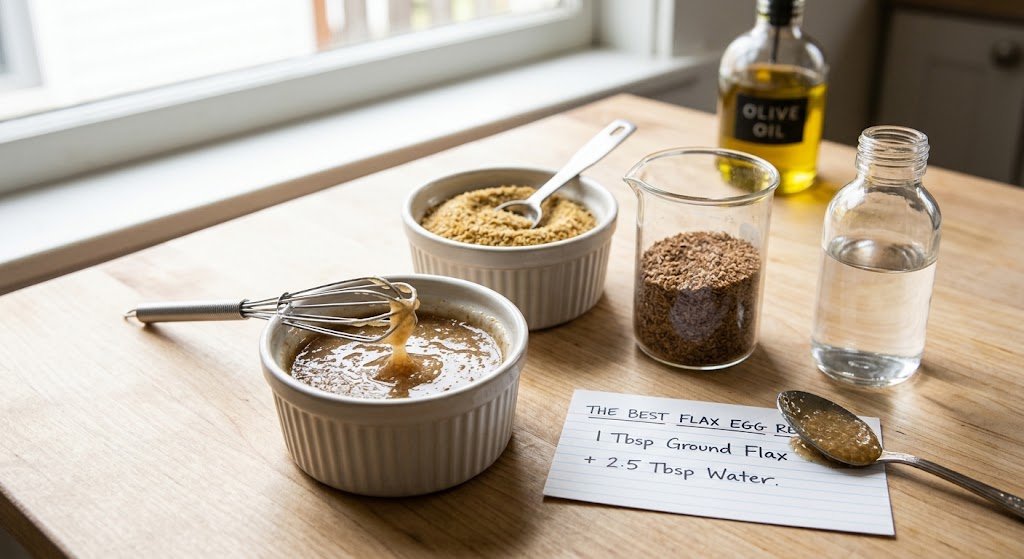
Learn how to make a flax egg with just ground flaxseed and water. This easy flax egg substitute is perfect for cookies, muffins, pancakes, brownies, and quick breads when you need a simple vegan egg replacement.
A flax egg is a mixture of ground flaxseed and water that forms a thick, gel-like mixture as it rests. The standard flax egg ratio is 1 tablespoon ground flaxseed + 3 tablespoons water. Let it stand for 5–10 minutes, then use it as a binding ingredient in many baked goods.
Flax Egg at a Glance
The standard ratio makes approximately one egg replacement. Scale the ingredients proportionally when a recipe calls for multiple eggs.
What Is a Flax Egg?
A flax egg is a simple egg substitute made by combining ground flaxseed and water. As the mixture rests, the flaxseed absorbs water and develops a thick, sticky consistency.
In baking, eggs can help with binding, moisture, structure, and other functions. A flax egg is especially useful when the egg’s primary job is binding ingredients together.
Flax eggs are popular in vegan and egg-free baking because they are inexpensive, easy to prepare, and require only two basic ingredients.
Flax Egg Ratio: The Perfect Measurement Guide
The Standard 1:3 Flax Egg Ratio
One simple measurement replaces one egg in many suitable baking recipes.
For 1 Flax Egg
- 1 tablespoon ground flaxseed
- 3 tablespoons water
- Rest for 5–10 minutes
Best Uses
- Cookies
- Muffins
- Pancakes
- Brownies
- Quick breads
| Eggs Needed | Ground Flaxseed | Water |
|---|---|---|
| 1 | 1 tablespoon | 3 tablespoons |
| 2 | 2 tablespoons | 6 tablespoons |
| 3 | 3 tablespoons | 9 tablespoons |
| 4 | 4 tablespoons | 12 tablespoons |
How to Make a Flax Egg Step by Step
Measure the Ground Flaxseed
Add 1 tablespoon of ground flaxseed to a small bowl. Use flaxseed meal rather than whole flaxseeds for the best gel formation.
Add the Water
Pour in 3 tablespoons of water. This creates the standard 1:3 flax egg ratio.
Stir Thoroughly
Stir or whisk the flaxseed and water until evenly combined and no large pockets of dry flaxseed remain.
Let It Rest for 5–10 Minutes
Allow the mixture to sit until it develops a noticeably thick, gel-like consistency.
Add It to Your Recipe
Once thickened, add the flax egg to your batter or dough as directed by the recipe.
Ground Flaxseed vs. Whole Flaxseed
Ground Flaxseed
- Best choice for flax eggs
- Absorbs water readily
- Forms the desired gel
- Mixes easily into batters and doughs
Whole Flaxseed
- Not ideal for making flax eggs
- Has an intact outer seed coating
- Does not form the same smooth gel
- Better ground before making a flax egg
How to Grind Flaxseed
If you have whole flaxseeds, grind them into a fine meal using a coffee grinder, blender, or food processor. Grind only what you need or prepare a small batch for future baking.
How to Store Flaxseed Meal
- Keep ground flaxseed in an airtight container.
- Refrigeration or freezing can help preserve freshness.
- Protect it from excessive heat, air, and light.
- Discard flaxseed if it develops an unpleasant rancid or bitter odor or taste.
Why Flax Eggs Work in Baking
Soluble Fiber and Gel Formation
Ground flaxseed contains water-absorbing components that create a viscous gel when hydrated. This sticky gel gives a flax egg its binding properties.
Mucilage
Flaxseed contains mucilage, a type of plant polysaccharide that contributes to the gel-like consistency that develops when ground flaxseed meets water.
Binding Properties
The resulting gel can help ingredients stick together, making flax eggs particularly useful in cookies, muffins, brownies, pancakes, and quick breads.
What a Flax Egg Cannot Do
A flax egg does not reproduce all the functions of a chicken egg. It generally does not provide the same foaming, aeration, or structural behavior required by recipes such as meringues, soufflés, and some very light cakes.
How Flax Eggs Affect Baking Texture
Moisture Retention
The hydrated flaxseed mixture can contribute moisture and help certain baked goods remain tender, particularly muffins, brownies, and quick breads.
Density
Because flax eggs do not provide the same aeration as beaten eggs, some baked goods may be slightly denser.
Crumb Structure
The gel can help hold ingredients together, producing a stable crumb that works particularly well in recipes that are naturally moist or dense.
Best Recipes That Work With Flax Eggs
| Recipe | Why It Works | Expected Texture |
|---|---|---|
| Muffins | Egg mainly contributes binding and moisture | Soft and tender |
| Pancakes | Works alongside baking powder or baking soda | Slightly denser but satisfying |
| Cookies | Provides useful binding and moisture | Chewy or tender depending on recipe |
| Brownies | Dense recipes pair well with flax’s binding properties | Rich and fudgy |
| Quick Breads | Moist batter does not depend entirely on egg structure | Moist and compact |
| Waffles | Can bind the batter effectively | May be somewhat denser than egg-based waffles |
Recipes Where Flax Eggs Do Not Work Well
Meringue
Meringue depends on whipped egg whites creating a stable foam. A flax egg cannot reproduce this structure.
Soufflés
Soufflés rely heavily on whipped egg proteins for their characteristic lift, making flax eggs unsuitable.
Omelets
A flax egg cannot reproduce the cooking and protein structure of a traditional egg omelet.
Scrambled Eggs
Flaxseed gel does not develop the same soft, fluffy texture as scrambled chicken eggs.
Very light cakes that depend heavily on eggs for aeration may also be poor candidates for a flax egg replacement.
Flax Egg vs. Chia Egg
| Feature | Flax Egg | Chia Egg |
|---|---|---|
| Texture | Soft, viscous gel | Typically thicker gel |
| Flavor | Mildly nutty | Generally mild |
| Best Uses | Cookies, muffins, brownies, quick breads | Dense baked goods and recipes needing a strong gel |
| Main Role | Binding and moisture | Binding and moisture |
Both can be useful plant-based egg substitutes. Choose based on the recipe, desired texture, and flavor.
Best Egg Substitutes for Baking
Flax eggs are only one option. Different egg substitutes perform different jobs, so the best choice depends on whether you need binding, moisture, structure, or aeration.
| Egg Substitute | Best Uses | Main Function |
|---|---|---|
| Flax Egg | Muffins, cookies, quick breads | Binding |
| Chia Egg | Dense baked goods | Binding |
| Applesauce | Cakes, muffins | Moisture |
| Mashed Banana | Pancakes, sweet breads | Moisture and binding |
| Aquafaba | Foam-based applications and selected desserts | Foaming and structure |
Nutrition and Health Benefits of Flaxseed
Ground flaxseed contributes fiber, plant-based omega-3 ALA, and other nutrients. Because a flax egg contains only a modest amount of flaxseed, the nutritional contribution per egg replacement is relatively small.
Omega-3 Fatty Acids
Flaxseed is a notable plant source of alpha-linolenic acid (ALA), an essential omega-3 fatty acid.
Fiber
Flaxseed provides dietary fiber, including components that help create the characteristic gel used in a flax egg.
Digestive Benefits
The fiber in flaxseed can contribute to overall dietary fiber intake and support normal digestive function when consumed as part of a balanced diet.
Heart Health
Flaxseed’s fiber, ALA, and other plant compounds make it a useful addition to a varied diet. However, a single flax egg should not be viewed as a treatment for any health condition.
Common Problems When Using Flax Eggs
Mixture Is Not Thickening
Check that you used ground flaxseed, followed the 1:3 ratio, and allowed enough resting time. Whole seeds are unlikely to create the same gel.
Baked Goods Are Too Dense
Flax eggs do not aerate batter like whipped eggs. Make sure the recipe has appropriate leavening agents and avoid expecting the same lift as a traditional egg-based recipe.
Flaxseed Tastes Bitter
A strong bitter or rancid flavor can indicate that the flaxseed has lost freshness. Store ground flaxseed properly and discard it if it smells or tastes rancid.
Common Mistakes When Making Flax Eggs
| Mistake | Why It Causes Problems | Better Approach |
|---|---|---|
| Using whole seeds | They do not hydrate into the same smooth gel | Use ground flaxseed meal |
| Wrong ratio | Too much water can leave the mixture thin | Use 1 tbsp flaxseed + 3 tbsp water |
| Skipping the resting time | The mixture has not fully hydrated | Wait 5–10 minutes |
| Poor mixing | Dry flaxseed may remain unhydrated | Stir thoroughly |
| Using it in the wrong recipe | Some recipes need egg foam or protein structure | Choose recipes suited to flax eggs |
Storage Tips for Flax Eggs
Refrigerator Storage
If prepared in advance, place a flax egg in a small airtight container and refrigerate it. Keep it covered to prevent odors and unnecessary moisture loss.
How Long Does a Prepared Flax Egg Last?
For best quality, use a prepared flax egg within 1–2 days when refrigerated. Freshly prepared flax eggs are generally the simplest choice when you want predictable texture.
Batch Preparation Tips
- Multiply the standard ratio according to the number of eggs required.
- Keep the prepared mixture in a sealed container.
- Label the container with the preparation date.
- Stir briefly before using if the mixture has separated.
Food Safety Note
Because a prepared flax egg is a water-containing food mixture, keep it refrigerated rather than leaving it at room temperature for prolonged periods. When in doubt about its freshness, make a new batch.
Expert Baking Tips for Using Flax Eggs
Add Leavening When Needed
Because flax eggs do not provide the same aeration as whipped eggs, recipes may rely more heavily on baking powder or baking soda for lift.
Combine With Other Substitutes Carefully
In some recipes, flax eggs can be paired with ingredients such as applesauce or mashed banana to contribute additional moisture.
Watch Moisture
A flax egg contributes both water and flaxseed solids. Follow the recipe proportions rather than automatically adding extra liquid.
Check Doneness
Some flax-based baked goods may need a little additional baking time. Check the recipe’s normal doneness indicators rather than relying only on the clock.
Easy Flax Egg Recipe Card
Easy Flax Egg Substitute
Two ingredients • Vegan • Egg-free • Ready in minutes
Ingredients
- 1 tablespoon ground flaxseed
- 3 tablespoons water
Best Uses
- Cookies
- Muffins
- Pancakes
- Brownies
- Quick breads
Instructions
- Add 1 tablespoon ground flaxseed to a small bowl.
- Add 3 tablespoons water.
- Stir thoroughly until evenly combined.
- Let the mixture rest for 5–10 minutes.
- Once thickened, use it as a flax egg in a suitable baking recipe.
Approximate Nutrition
One flax egg made with approximately 1 tablespoon of ground flaxseed provides roughly 35 calories, about 2 g of fiber, and approximately 1 g of protein. Exact values vary by flaxseed brand and measurement.
Frequently Asked Questions About Flax Eggs
What is the flax egg ratio?
The standard ratio is 1 tablespoon ground flaxseed + 3 tablespoons water. Let the mixture sit for 5–10 minutes until it thickens.
Can flax eggs replace eggs in cakes?
They can work in some cakes, particularly moist or dense cakes and quick breads. Very light cakes that rely heavily on eggs for aeration may not produce the same texture.
How long should a flax egg sit?
Allow the mixture to rest for approximately 5–10 minutes. It should become noticeably thicker and gel-like before being added to the recipe.
Are flax eggs healthy?
Flaxseed provides fiber, ALA omega-3 fatty acids, and other plant nutrients. A flax egg can be a useful addition to a balanced diet, although the amount used per recipe is relatively small.
Can flax eggs replace eggs in all recipes?
No. They work best where eggs primarily provide binding and moisture. They are generally unsuitable for recipes that depend on egg foam or unique egg protein structure, such as meringue, soufflés, and traditional omelets.
Can I use whole flaxseed to make a flax egg?
It is better to use ground flaxseed. Grinding exposes the seed’s interior and allows it to hydrate more effectively, producing the gel needed for a flax egg.
Why is my flax egg not thickening?
The most common reasons are using whole seeds, using the wrong ratio, or not allowing enough resting time. Use ground flaxseed, follow the 1:3 ratio, and wait at least several minutes for the gel to develop.
Final Thoughts
A flax egg is one of the easiest ways to create a homemade vegan egg substitute. With just ground flaxseed and water, you can make a useful binding ingredient for cookies, muffins, pancakes, brownies, and quick breads.
The key is remembering the simple 1:3 flax egg ratio: one tablespoon of ground flaxseed to three tablespoons of water. Give it 5–10 minutes to thicken, then add it to a recipe where eggs are primarily needed for binding.
While a flax egg cannot replace every function of a traditional egg, it is a practical choice for many vegan and egg-free baking recipes. Once you understand where it works best, this simple pantry staple can make plant-based baking much easier.
Read More :