Learn how to make authentic Italian Pettole from Puglia using a simple yeast dough, proper hydration, fermentation, and hot oil. These crispy Italian fried dough balls are airy inside, golden outside, and perfect for both sweet and savory holiday servings.
Quick Answer — What Are Italian Pettole?
Italian Pettole are traditional fried dough fritters associated with Puglia (Apulia), southern Italy. A simple dough made from flour, yeast, water, salt, and olive oil is fermented until airy, portioned into small irregular pieces, and deep-fried until golden and crisp.
Pettole are especially associated with Christmas Eve (La Vigilia) and other regional celebrations. They can be served sweet with honey or sugar, or savory with ingredients such as olives and anchovies.
🇮🇹 Authentic Puglia Pettole Recipe
Ingredients
For Sweet Pettole
For Savory Pettole
Method
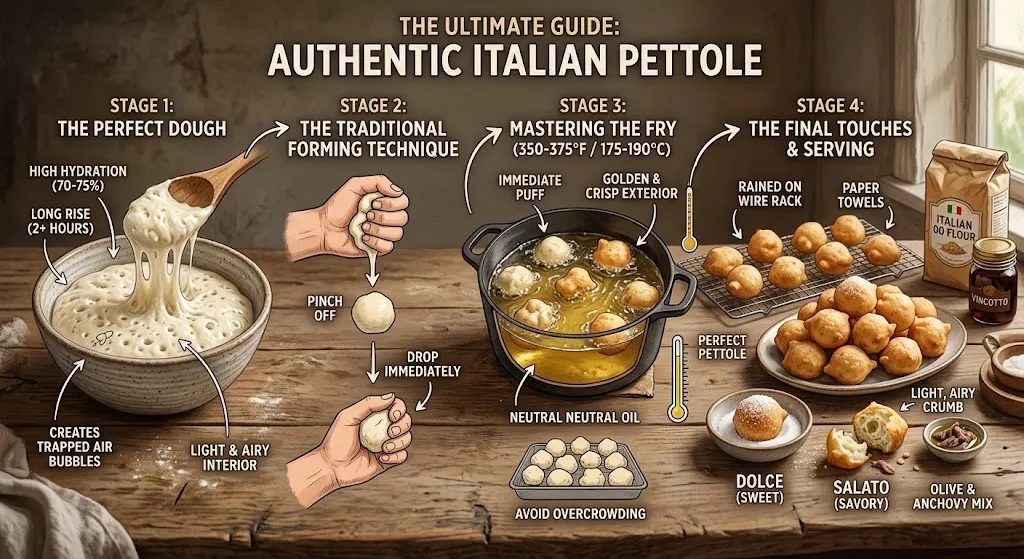
- Dissolve the yeast in warm water. The water should be comfortably warm rather than hot.
- Add the flour gradually, mixing continuously. Add the salt and olive oil. Mix until you have a very soft, sticky dough.
- Cover the bowl and let the dough rise in a warm, draft-free place for approximately 1½–2 hours, or until visibly doubled and bubbly.
- Heat neutral frying oil to approximately 350–375°F (175–190°C).
- Using two spoons or lightly wet hands, scoop small portions of dough and carefully drop them into the hot oil.
- Fry in small batches for approximately 2–3 minutes, turning as needed, until evenly golden brown and cooked through.
- Remove with a slotted spoon and drain on a wire rack or paper towels.
- Serve immediately while hot and crisp, either sweet or savory.
The Origin of Pettole in Puglia
Pettole are closely associated with Puglia (Apulia), a southern Italian region known for simple, ingredient-focused cooking. They have long been connected with festive occasions, including St. Martin’s Day on November 11 and La Vigilia, Christmas Eve.
Their rustic character reflects the broader tradition of making satisfying dishes from inexpensive pantry staples. Flour, yeast, water, salt, and frying oil are enough to create a celebratory food that can be shared with a crowd.
Depending on the local tradition and occasion, Pettole may be served plain, sweetened with honey or sugar, or made savory with ingredients such as olives and anchovies.
Why This Recipe Keeps the Dough Simple
A traditional-style Italian Pettole recipe does not need eggs, milk, or butter. The core dough is deliberately simple: flour, water, yeast, salt, and olive oil.
That simplicity allows the fermentation and frying technique to do most of the work. A properly fermented, highly hydrated dough can develop the characteristic soft interior and crisp fried exterior without enrichment from eggs or dairy.
Authentic Ingredients Breakdown
Flour — 00 vs. All-Purpose
Both all-purpose flour and Italian 00 flour can work well. A soft wheat flour is consistent with the simple character of many traditional preparations, while 00 flour can produce a particularly delicate interior.
Yeast — Fresh vs. Dry
You can use either fresh or dry yeast. For this recipe, approximately 3 g active dry yeast is used for 500 g flour. If substituting fresh yeast, use an appropriate equivalent according to the yeast manufacturer’s conversion guidance.
Water Temperature
Aim for approximately 95–105°F (35–40°C). Water that is excessively hot can damage yeast, while very cold water will slow fermentation.
Olive Oil
A tablespoon of extra virgin olive oil can be incorporated into the dough for flavor and tenderness. Use a separate neutral oil for deep frying.
Salt
Use approximately 8–10 g salt. Salt seasons the dough and influences fermentation, so it should be measured rather than added randomly.
Hydration Percentage
Hydration is calculated by dividing the weight of water by the weight of flour:
The formula is: Water ÷ Flour × 100 = Hydration Percentage.
A hydration level around 70–75% creates a noticeably soft and sticky dough. That high moisture level is useful for producing light fritters, although flour absorption can vary.
Why Sticky Dough Is Correct
A common mistake is adding extra flour because the dough feels wet. Resist the urge to turn it into a firm dough. The loose consistency helps the fermented mixture retain gas and contributes to a lighter crumb after frying.
The Science Behind Perfect Pettole
Dough Hydration
More hydrated dough generally feels softer and stickier. In this preparation, that moisture supports expansion during frying and helps produce the characteristic light interior.
Gluten Development
Flour and water naturally form gluten proteins when hydrated and mixed. You do not need to knead the mixture like a conventional bread dough; proper mixing and fermentation allow the dough to develop enough structure for frying.
Fermentation Timing
Yeast produces carbon dioxide during fermentation. Allowing the dough to rise until it is visibly doubled and bubbly provides a useful practical cue rather than relying on time alone.
Gas Retention and Airy Crumb
The fermented dough contains trapped gas. When a portion enters hot oil, water rapidly turns into steam and the existing gas expands. This contributes to the puffed structure of the finished fritter.
Oil Absorption
Frying temperature matters. Oil that is too cool can produce greasy fritters, while excessively hot oil can brown the exterior before the center cooks properly.
Why Oil Temperature Matters
At approximately 350–375°F (175–190°C), the dough can expand rapidly while the exterior browns. The surface develops color and crispness as browning reactions occur, while moisture inside turns to steam.
Texture Guide — What Perfect Pettole Should Look Like
Exterior Color
Finished Pettole should be golden brown. Pale fritters can indicate insufficient browning or a lower oil temperature, while very dark exteriors can indicate excessive heat or overcooking.
Interior Crumb
Break one open while warm. The interior should be soft, light, and irregular, rather than wet or doughy.
Air Pocket Size
Properly fermented Pettole should have visible pockets throughout the interior. A very tight crumb can indicate insufficient fermentation, while a fragile, collapsed structure can indicate over-fermentation or handling issues.
Proper Chew vs. Density
- ✔ Crisp outer shell
- ✔ Soft, airy interior
- ✔ Slight chew without rubberiness
- ✔ No excessive oily residue
- ✔ Irregular rustic shape
Oil Temperature & Frying Mastery
Ideal Temperature: 350–375°F (175–190°C)
Maintain the oil within this range as consistently as possible. Adding too much dough at once can cause the temperature to fall, so fry in small batches.
Best Oils for Frying
- Sunflower oil
- Peanut oil
- Canola oil
- Light vegetable oil
Choose an appropriate neutral frying oil with a suitable smoke point rather than relying on extra virgin olive oil for deep frying.
How to Check Oil Without a Thermometer
A thermometer is the most reliable option. If you don’t have one, a tiny piece of dough should begin bubbling promptly when placed into the oil. If it barely reacts, the oil is likely too cool; if it browns extremely rapidly, the oil may be too hot.
Traditional Spoon-Shaping Technique
The sticky dough can be shaped using two spoons. Scoop a portion with one spoon and use the second spoon to guide it gently into the oil. The result should be rustic rather than perfectly round.
Double Fry Method
A two-stage fry can produce a crisper exterior, but it is an optional modern technique rather than a requirement for making traditional Pettole.
Sweet vs. Savory Pettole
🍯 Sweet Pettole
Sweet versions can be finished with warm honey, granulated sugar, or powdered sugar. Honey is especially good when drizzled over freshly fried Pettole while they are still warm.
🫒 Savory Pettole
Savory versions may incorporate olives, anchovies, or other local additions. These ingredients provide saltiness and umami against the neutral fried dough.
🧀 Stuffed Variations
Some regional or family versions use fillings such as soft cheese, anchovy, or olive-based mixtures. These variations should be treated as regional adaptations rather than a single universal Pettole formula.
Pettole vs. Zeppole — What’s the Difference?
| Feature | Pettole | Zeppole |
|---|---|---|
| Regional association | Puglia / Apulia | Several Italian regions, including Campania |
| Dough | Often very soft and highly hydrated | Varies widely by region and recipe |
| Shape | Usually rustic and irregular | Can be round, ring-shaped, filled, or otherwise formed |
| Holiday associations | Christmas traditions and St. Martin’s Day in Puglia | Varies by region; some versions are associated with St. Joseph’s Day |
| Texture | Light, airy, crisp outside | Varies considerably |
The word zeppole itself covers multiple Italian preparations, so comparing Pettole to “Zeppole” requires considering the specific regional recipe.
Regional Variations Across Southern Italy
Salento
Salento, in southern Puglia, has its own Pettole traditions and serving customs. They may be served plain, salted, or finished with sweet toppings.
Bari and Surrounding Areas
Savory preparations featuring ingredients such as olives or anchovies can be found in Apulian home cooking.
Calabria
Calabria also has a strong tradition of fried dough foods. Similar-looking fritters should not automatically be classified as Pettole because local doughs and names vary.
Naples
Naples and Campania are strongly associated with different forms of Zeppole. The shared idea of fried dough connects the foods, but their regional traditions are distinct.
Common Mistakes That Ruin Pettole
Dough Too Dry
Adding too much flour creates a stiff mixture and can produce dense fritters. Keep the dough soft and sticky.
Underproofing
A dough that has not fermented sufficiently may produce a tight crumb and limited puffing. Look for visible bubbles and approximately doubled volume.
Overproofing
Excessive fermentation can weaken the dough. If it has risen dramatically and collapses easily, the structure may no longer have enough strength for ideal frying.
Oil Too Cold
Low oil temperature encourages excess oil absorption and produces pale, greasy fritters.
Oil Too Hot
Excessive heat can brown the outside before the center has properly cooked.
Overcrowding the Pot
Too many pieces at once can sharply reduce oil temperature. Work in small batches and allow the oil to return to temperature between batches.
Pettole Troubleshooting Chart
| Problem | Likely Cause | What to Do |
|---|---|---|
| Dense Pettole | Dough too dry or insufficient fermentation | Maintain a soft dough and allow a full rise. |
| Greasy Pettole | Oil too cool or overcrowded pot | Maintain 350–375°F and fry in small batches. |
| Exterior browns too quickly | Oil too hot | Reduce the heat and monitor temperature. |
| Flat fritters | Insufficient fermentation or weak dough structure | Allow the dough to rise fully before frying. |
| Large collapsed gaps | Over-fermentation or weak structure | Shorten fermentation and handle gently. |
| Uneven browning | Uneven oil temperature or overcrowding | Fry fewer pieces at a time. |
Can You Make Pettole Healthier?
Traditional Pettole are deep-fried, and that frying method is part of their classic character. If you want a lighter alternative, you can experiment with baking or air frying, but the resulting texture will not be identical.
Air-Fryer Version
Small portions of dough can be lightly oiled and air fried at approximately 375°F. The exterior will generally be less like a traditionally deep-fried Pettole.
Baked Version
Baking at approximately 400°F (200°C) can produce a bread-like alternative. Expect a softer crust rather than the characteristic fried shell.
Partial Whole-Wheat Version
Replacing up to about 30% of the white flour with whole-wheat flour can add more whole-grain character while preserving a relatively light dough. Higher substitutions may produce a heavier result.
Reducing Excess Oil
- Keep the frying temperature consistent.
- Do not overcrowd the pot.
- Drain thoroughly after frying.
- Use a wire rack when possible to allow airflow around the fritters.
Nutritional Overview
Pettole are a fried flour-based food, so their nutritional values vary according to dough size, frying method, oil absorption, and toppings. Exact calories should be calculated from the actual ingredients and final yield.
| Nutritional Factor | What Influences It |
|---|---|
| Carbohydrates | Primarily from flour |
| Fat | Frying oil and any toppings or fillings |
| Protein | Primarily flour, with more if cheese or other fillings are added |
| Sugar | Mostly from sweet toppings such as honey or sugar |
How to Serve Pettole Traditionally
Christmas Eve Seafood Table
Pettole are associated with La Vigilia, Christmas Eve in Italy. In households following seafood-focused Christmas Eve traditions, savory Pettole can appear alongside fish, seafood, and vegetable dishes.
As an Appetizer
Serve warm savory Pettole with olives, anchovies, or a simple pinch of salt.
As a Dessert
Sweet Pettole can be finished with honey or sugar and served warm.
Wine Pairings
If serving wine, a crisp Italian white can complement savory Pettole, while a suitable dessert wine can accompany sweet versions.
Modern Serving Ideas
- Chocolate drizzle
- Fruit and honey
- Coffee alongside sweet Pettole
- Mini savory Pettole platters
- Olive or anchovy variations
Storage, Reheating & Freezing Guide
Can You Freeze the Dough?
Yeasted Pettole dough can be frozen, although freezing may affect its fermentation performance and final texture. If freezing, use an airtight container and thaw slowly in the refrigerator before allowing the dough to continue fermenting as needed.
Best Reheating Method
Reheat already fried Pettole in a preheated 350°F (175°C) oven for several minutes until warmed through. An air fryer can also help restore some crispness.
Why Avoid the Microwave?
Microwaving tends to soften the fried exterior and can make the interior chewy. Oven or air-fryer reheating is better when crispness matters.
Storage Safety
Because Pettole are a prepared food, storage time depends on the ingredients and handling conditions. Refrigerate leftovers promptly in a covered container and reheat thoroughly before serving. For the best texture, freshly fried Pettole are strongly preferred.
FAQs About Italian Pettole
Can you bake Pettole instead of frying?
Yes, but baked Pettole will have a different texture. Traditional Pettole are deep-fried, which gives them their characteristic crisp exterior and soft center.
Why are my Pettole greasy?
The most common causes are oil that is too cool and overcrowding the pot. Maintain approximately 350–375°F and fry in small batches.
How long should Pettole dough rise?
Start with approximately 1½–2 hours, but use the dough itself as your guide. It should be visibly expanded, approximately doubled, and show bubbles before frying.
Can I make Pettole without yeast?
Yeast is important for the traditional fermented texture. Baking-powder versions may produce a different type of fritter, but they will not have exactly the same flavor and airy structure.
What flour is best for Pettole?
Both all-purpose flour and Italian 00 flour work well. The most important factors are dough hydration, fermentation, and frying technique.
Are Pettole vegan?
The basic dough is naturally free of eggs and dairy and can be vegan when made with plant-based ingredients. Note that honey is not vegan, so use sugar or another plant-based sweetener for a vegan sweet topping.
Expert Tips for Authentic Puglia Pettole
- ✅ Keep the dough sticky: Don’t add unnecessary flour just because the mixture feels wet.
- ✅ Watch the rise, not just the clock: Fermentation speed changes with room temperature and yeast activity.
- ✅ Use a thermometer: Maintaining the frying temperature makes the biggest difference in consistent results.
- ✅ Fry in small batches: This prevents a major oil-temperature drop.
- ✅ Drain immediately: A wire rack helps preserve the crisp exterior.
- ✅ Serve fresh: Pettole are at their best shortly after frying.
Final Thoughts — Why Pettole Are a Puglia Classic
Italian Pettole show how a handful of humble ingredients can become something deeply connected to regional food culture. A soft fermented dough, carefully controlled frying temperature, and simple sweet or savory toppings are all you need to create these iconic Puglian fried dough treats.
The most important techniques are straightforward: maintain the high-hydration dough, allow it to ferment properly, fry at the right temperature, and avoid overcrowding the pot.
Whether you serve them with honey on Christmas Eve, make a savory version with olives or anchovies, or simply enjoy them warm from the fryer, Pettole are a delicious example of southern Italian cooking at its most rustic and comforting.
Read More :