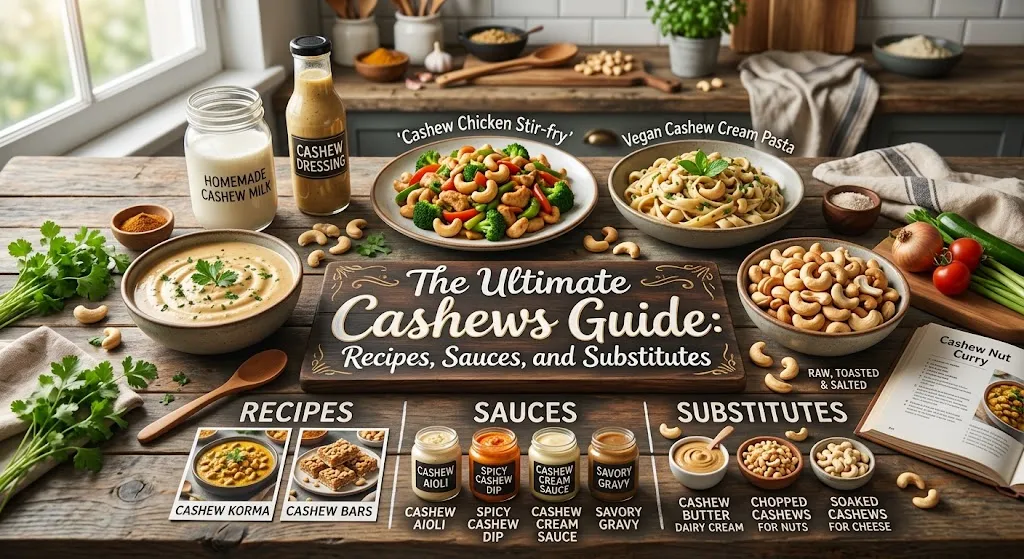
Cashews are more than a convenient snack. These creamy cashew nuts come from the tropical cashew tree (Anacardium occidentale) and are prized for their rich flavor, smooth texture, and versatility in cooking. From cashew nutrition and potential health benefits to cashew cream, vegan cheese, storage, soaking, and cashew substitutes, this guide covers the practical details you need to know.
Are Cashews Healthy? (Quick Summary)
Cashews can be part of a healthy, balanced diet. They provide unsaturated fats, plant-based protein, magnesium, copper, zinc, and other nutrients. They are also calorie-dense, so portion size matters. Unsalted or lightly salted cashews are generally a practical choice when you want to keep added sodium lower.
Main Benefits
- Provide unsaturated fats and plant-based protein.
- Supply important minerals including magnesium and copper.
- Can be incorporated into balanced eating patterns.
- Work especially well in creamy sauces, dairy-free spreads, and desserts.
- Can provide satiety when eaten in sensible portions.
What Are Cashews?
The cashew tree, scientifically known as Anacardium occidentale, is a tropical evergreen native to northeastern Brazil. It is now cultivated widely across tropical regions, particularly in parts of Asia and Africa.
Cashew Apple vs. Cashew Nut
The edible cashew seed develops inside a hard shell attached to the bottom of the cashew apple. The apple itself is also edible and is used in beverages, preserves, and other foods in regions where cashews are grown.
Are Cashews Actually Nuts?
Botanically, the part commonly eaten as the cashew “nut” is a seed. In everyday nutrition and food labeling, however, cashews are grouped with tree nuts.
Why “Raw” Cashews Aren’t Truly Raw
Cashew shells contain cashew nut shell liquid, which contains compounds related to the irritant urushiol. Commercial cashews sold as “raw” have undergone processing to remove the shell and make the kernels suitable for consumption.
How Cashews Grow: From Tree to Table
Flower → Cashew Apple → Nut
Small flowers develop on the cashew tree.
The swollen cashew apple develops after pollination.
The cashew seed develops externally beneath the apple.
The nuts are harvested, dried, processed, shelled, peeled, graded, and packaged.
Toxic Shell Oil
The hard shell surrounding the edible kernel contains irritating compounds. Proper processing therefore plays an important role in turning harvested cashews into the familiar food sold in stores.
Why Are Cashews Expensive?
Cashews require multiple processing stages, including shell removal, peeling, grading, and careful handling. The shell is difficult to remove safely, and the edible kernel is fragile. These factors contribute to the price of processed cashews.
Where Are Cashews Grown?
Cashew trees thrive in warm tropical and subtropical environments. Major producing regions include parts of Vietnam, India, Côte d’Ivoire, Nigeria, and Brazil.
| Growing Factor | Preferred Conditions |
|---|---|
| Climate | Warm tropical or subtropical conditions |
| Temperature | Generally warm conditions around 20–35°C are suitable |
| Soil | Well-drained soil |
| Harvesting | A defined dry period can help harvesting and post-harvest handling |
Environmental & Ethical Concerns
The global cashew industry involves both agricultural production and labor-intensive processing. Responsible sourcing is therefore an important consideration when choosing products.
Labor Conditions
Shelling requires careful handling because of the irritating compounds in the shell. Working conditions, protective equipment, wages, and labor standards can vary between producing and processing regions.
Fair Trade & Responsible Sourcing
Certifications and transparent sourcing programs can provide additional information about how a product was sourced. When available, look for credible certification or supply-chain information rather than relying solely on marketing language.
Environmental Considerations
As with other agricultural commodities, cashew production can affect soil, water, biodiversity, and land use. Farming practices that protect soil and use resources efficiently can help improve long-term sustainability.
Cashew Nutrition Facts
A typical 1-ounce (28 g) serving of raw cashews provides approximately the following nutrition profile. Exact values vary by product and preparation.
| Nutrient | Approx. Amount per 1 oz | Why It Matters |
|---|---|---|
| Calories | ~157 kcal | Provides concentrated energy |
| Protein | ~5 g | Supports tissue maintenance and satiety |
| Fat | ~12–13 g | Mostly unsaturated fat |
| Carbohydrates | ~9 g | Provides dietary energy |
| Fiber | ~1 g | Contributes to digestive health |
| Magnesium | ~80 mg | Important for muscle and nerve function |
| Copper | ~0.6 mg | Supports connective tissue and energy metabolism |
| Zinc | ~1.6 mg | Supports immune and cellular functions |
Healthy Fats: MUFA vs. PUFA
Cashews contain predominantly unsaturated fats, including monounsaturated and polyunsaturated fatty acids. Their overall fat profile makes them a useful addition to eating patterns that emphasize unsaturated rather than saturated fats.
Antioxidants & Plant Compounds
Cashews contain a range of plant compounds, including phenolic compounds and other antioxidants. These contribute to the nutritional value of the food, although eating cashews should not be treated as a substitute for medical treatment.
Cashews vs. Other Nuts
| Food | Notable Strength | Cooking Advantage |
|---|---|---|
| Cashews | Creamy texture, copper and magnesium | Excellent for sauces, creams, and vegan cheese |
| Almonds | More fiber and vitamin E | Great for baking and crunchy toppings |
| Walnuts | Rich source of plant omega-3 ALA | Excellent in salads and baked goods |
| Peanuts | Protein-rich and economical | Useful in sauces, snacks, and baking |
Health Benefits of Cashews
Heart & Cholesterol Support
Cashews contain unsaturated fats, and replacing foods higher in saturated fat with foods rich in unsaturated fats can support a heart-healthy dietary pattern. Cashews also contribute minerals such as magnesium and copper.
Blood Sugar & Metabolic Health
Cashews provide fat, protein, and some fiber, which can make a meal or snack more filling. Their relatively low sugar content also makes them different from many sweet snack foods. People managing diabetes should still account for their carbohydrate and calorie content.
Weight Management
Nuts are calorie-dense, but their combination of fat, protein, and texture can contribute to satiety. Eating cashews does not automatically cause weight gain; overall calorie intake and eating pattern matter most.
Brain & Nervous System Support
Magnesium, copper, and healthy fats all contribute to normal nervous-system and cellular functions. However, claims that cashews directly prevent or treat cognitive disease go beyond what can be established from eating the food alone.
Bone & Mineral Support
Cashews provide magnesium, copper, phosphorus, and zinc, nutrients involved in normal bone and connective-tissue functions. They can contribute to an overall nutrient-rich diet.
Digestive Health
Cashews provide some dietary fiber, although they are not among the highest-fiber nuts. Including a variety of nuts, seeds, fruits, vegetables, legumes, and whole grains is a stronger strategy for overall fiber intake.
Cashew Risks, Allergies & Side Effects
Cashew Allergies
Cashews are a recognized tree-nut allergen. Reactions can be serious, including anaphylaxis. Anyone with a known cashew or tree-nut allergy should avoid cashews and follow the allergy-management plan provided by their healthcare professional.
Cashew & Pistachio Cross-Reactivity
Cashews and pistachios are botanically related, and cross-reactivity can occur. People with known allergies should discuss individual risks with an allergist rather than assuming one nut is safe because they tolerate another.
Oxalates & Kidney Stones
Cashews contain oxalates. For most people this is not a reason to eliminate them, but individuals with a history of certain kidney stones may be advised to moderate high-oxalate foods.
Sodium in Salted Cashews
Salted and flavored cashews can contain considerably more sodium than unsalted varieties. If sodium intake is a concern, compare nutrition labels and choose unsalted or lightly salted cashews.
Overeating
Because cashews are energy-dense, regularly eating large portions can make it easier to consume more calories than intended. Digestive discomfort can also occur in some people.
How to Choose High-Quality Cashews
| Choice | Best For | What to Look For |
|---|---|---|
| Whole cashews | Snacking and presentation | Fresh aroma, intact kernels, no rancid smell |
| Cashew pieces | Sauces, baking, blending | Good value and freshness |
| Unsalted | Everyday eating and recipes | Lower added sodium |
| Dry roasted | Snacking | Deeper roasted flavor |
| Organic | Personal sourcing preference | Look for recognized organic certification |
| Fair trade | Ethical sourcing preference | Look for a credible certification |
Raw vs. Roasted
Commercial “raw” cashews have already undergone processing to make them safe to eat. Dry-roasted cashews have a deeper flavor and crispier texture. For recipes such as cashew cream, choose unsalted cashews without added seasonings.
How to Store Cashews Properly
Cashews contain unsaturated fats that can eventually oxidize. Heat, light, oxygen, and moisture can accelerate quality loss.
| Storage Method | Practical Quality Window | Best Practice |
|---|---|---|
| Cool pantry | Short-term use | Airtight container away from heat and sunlight |
| Refrigerator | Several months | Use a tightly sealed container |
| Freezer | Up to about 12 months for best quality | Protect from freezer moisture and odors |
Signs Cashews Have Gone Bad
- Strong sour or paint-like odor
- Unpleasant bitter or rancid taste
- Visible mold or moisture damage
- Noticeably stale or deteriorated texture
Budget & Smart Buying Tips
Buy Pieces
Cashew pieces are often less expensive and work perfectly for blending, baking, and sauces.
Compare Unit Prices
Compare the price per ounce or pound rather than the package price alone.
Protect Bulk Purchases
Bulk buying only saves money if the cashews are stored properly before they become stale.
How to Soak Cashews Properly
Soaking softens cashews and makes them much easier to blend into smooth creams and sauces. It is especially useful when your blender is not powerful enough to process dry nuts smoothly.
Quick-Soak Method
- Place cashews in a heat-safe bowl.
- Cover with hot water.
- Let them stand for approximately 15–20 minutes.
- Drain and rinse thoroughly.
Overnight Method
- Cover cashews with plenty of cool water.
- Soak for approximately 6–8 hours.
- Drain and rinse before blending.
No-Soak Alternative
A powerful blender can often produce a smooth sauce from cashews blended directly with hot liquid. The result depends on the blender and the recipe, so soaking remains the safer choice when an especially silky texture is important.
Best Cashew Substitutes
The best substitute for cashews in recipes depends on what the cashews are doing. A sauce needs creaminess, while a cookie may need crunch. The following chart makes the choice easier.
| Substitute | Flavor | Texture | Best For | Starting Ratio | Nut-Free? |
|---|---|---|---|---|---|
| Almonds | Mild, slightly sweet | Firm; creamy when blended | Sauces, baking | 1:1 | No |
| Macadamias | Rich, buttery | Very creamy | Vegan cheese, sauces | 1:1 | No |
| Sunflower seeds | Mild, earthy | Smooth when soaked | Nut-free sauces | 1:1 | Yes |
| Pine nuts | Soft, buttery | Creamy | Pesto | 1:1 | No |
| Pumpkin seeds | Nutty | Thick and creamy when blended | Dips, queso | 1:1 | Yes |
| Hemp seeds | Mild, earthy | Slightly grainy | Sauces | Adjust to texture | Yes |
| Silken tofu | Neutral | Very creamy | Cream sauces | Replace by volume | Yes |
| Oats | Neutral | Thick, less creamy | Cream bases | Adjust to texture | Yes |
Closest Creamy Match
Macadamia nuts are especially useful when you want rich, buttery creaminess.
Best Nut-Free Choice
Sunflower seeds are versatile for sauces, dips, and creamy plant-based recipes.
Budget Choice
Oats, tofu, or sunflower seeds can reduce the cost of creamy recipes.
Cashew Substitutes for Sauces & Vegan Cheese
Cream Sauce: Sunflower Seed Alternative
- 1 cup soaked sunflower seeds
- ¾ cup water
- 1 tablespoon lemon juice
- Pinch of salt
Blend until smooth, adding a little more water if needed. This works well as a nut-free cashew substitute for cream sauce.
Alfredo-Style Substitute: Silken Tofu
- 1 cup silken tofu
- 1 garlic clove
- 2 tablespoons nutritional yeast
- ½ cup unsweetened plant milk
Blend until smooth and heat gently. Adjust the plant milk until the sauce reaches the desired consistency.
Dairy-Free Queso: Pumpkin Seeds
- 1 cup soaked pumpkin seeds
- ½ cup water
- 2 tablespoons nutritional yeast
- 1 teaspoon chili powder
Blend until creamy, then warm gently before serving.
Vegan Cheese
Macadamia nuts or almonds can replace cashews in many blended vegan cheese preparations. Because different nuts absorb liquid differently, adjust water gradually rather than assuming every recipe will require exactly the same amount.
Pesto
Pine nuts are the classic choice for pesto, while sunflower seeds are useful when you need a nut-free alternative.
Cashew Substitutes for Baking
| Recipe | Good Substitute | Starting Point |
|---|---|---|
| Cookies | Almonds or sunflower seeds | 1:1 for chopped cashews |
| Cheesecake crust | Almond flour, oats, or pumpkin seeds | Adjust to desired binding |
| Muffins | Chopped almonds or hemp seeds | Start with 1:1 by volume |
| Energy balls | Sunflower seed butter, oats, or peanut butter | Adjust for binding |
Easy Cashew Recipes
Easy Cashew Cream
A versatile creamy base for sauces, soups, pasta, and desserts.
Ingredients
- 1 cup cashews
- ¾–1 cup water
- Pinch of salt
Method
- Soak the cashews using either the quick or overnight method.
- Drain and rinse thoroughly.
- Blend with water until smooth.
- Add more water gradually to reach the desired consistency.
Homemade Vegan Cashew Cheese
A thick, savory spread for sandwiches, wraps, and dairy-free dips.
Ingredients
- 1 cup soaked cashews
- 2 tablespoons nutritional yeast
- 1 tablespoon lemon juice
- ½ teaspoon garlic powder
- Salt to taste
Method
Blend until thick and creamy. Refrigerate to firm the mixture before serving.
Simple Cashew Milk
A creamy homemade plant-based milk that requires no straining.
Ingredients
- 1 cup soaked cashews
- 3–4 cups water
- Optional dates or vanilla
Method
Blend for approximately 1–2 minutes until very smooth. Refrigerate promptly and use within approximately 4 days for best quality.
Homemade Cashew Butter
Rich, naturally creamy cashew butter made with minimal ingredients.
- Lightly roast cashews if you want a deeper flavor.
- Add them to a food processor.
- Process for approximately 5–8 minutes, scraping the sides as needed.
- Continue until the natural oils produce a smooth butter.
- Add a small amount of salt if desired.
Roasted Cashew Snack Variations
Simple flavor combinations for a crunchy homemade snack.
- Honey-roasted cashews
- Chili-lime cashews
- Garlic-herb cashews
- Cinnamon-spice cashews
Common Mistakes When Using Cashews
| Mistake | What Happens | Better Approach |
|---|---|---|
| Not soaking enough | Grainy sauces | Soak longer or use hot-water quick soaking |
| Using salted nuts in desserts | Unexpectedly salty flavor | Use unsalted cashews |
| Over-blending | Heat can build up | Blend in intervals if necessary |
| Improper storage | Stale or rancid flavor | Use airtight, cool storage |
FAQs About Cashews
Are cashews nuts or seeds?
Botanically, the edible cashew is a seed that develops inside a shell attached to the cashew apple. In nutrition and food labeling, cashews are classified with tree nuts.
Do cashews grow underground?
No. Cashews grow on trees. The seed develops outside the cashew apple, unlike peanuts, which develop underground.
Why are cashews expensive?
Cashews require careful, labor-intensive processing because the shell contains irritating compounds and the edible kernel is delicate. Harvesting, shelling, peeling, grading, and transportation all contribute to the final price.
How many cashews should you eat per day?
A practical serving is approximately 1 ounce (28 g). The exact amount that fits your diet depends on your calorie needs, overall eating pattern, and individual health needs.
Are raw cashews safe?
Commercial cashews labeled “raw” have undergone processing to make the kernels safe for consumption. Truly unprocessed cashews in their shells should not be eaten because of the irritating compounds in the shell.
Are cashews keto-friendly?
Cashews contain more carbohydrates than some lower-carb nuts, so portion size matters on a ketogenic diet. Whether they fit depends on your individual carbohydrate target.
Can people with nut allergies eat cashews?
People with a known cashew or tree-nut allergy should avoid cashews unless their allergist has specifically advised otherwise. Sunflower seeds or pumpkin seeds may work as recipe substitutes, depending on the individual’s allergies.
What is the best substitute for cashews?
It depends on the recipe. Macadamias work well for rich creamy sauces, sunflower seeds are useful for nut-free recipes, almonds work well in baking, and silken tofu can replace cashews when creaminess is the main goal.
Can I substitute cashews 1:1?
Many nuts and seeds can start at a 1:1 ratio by volume, particularly when replacing chopped cashews. Cream sauces may require adjustments because different ingredients absorb water differently.
The Bottom Line on Cashews
Cashews are nutrient-dense, versatile, and exceptionally useful in the kitchen. They provide unsaturated fats, plant protein, magnesium, copper, and zinc while adding a naturally creamy texture to sauces, spreads, desserts, and dairy-free recipes.
The smartest approach is simple: choose fresh cashews, watch portions, prefer unsalted varieties when appropriate, store them away from heat and moisture, and take tree-nut allergies seriously. When cashews are unavailable, sunflower seeds, macadamias, almonds, tofu, pumpkin seeds, and oats can each fill different culinary roles.
Read More :