Learn how to make plain chicken and rice for dogs, the commonly used 2:1 rice-to-chicken ratio, safe cooking and storage practices, portion considerations, and why this simple meal should not replace a complete and balanced canine diet.
Quick Answer
A commonly used short-term mixture is about 2 parts cooked white rice to 1 part cooked, skinless chicken breast by weight. One commonly cited example is about 300 g cooked white rice with 150 g cooked chicken breast. Keep everything plain, fully cooked, boneless, and free from onion, garlic, salt, butter, oil, and seasoning. Use this type of meal only when appropriate for your dog and follow your veterinarian’s instructions about portions and duration.
Why Is Chicken and Rice Used for Dogs?
Chicken and rice became a familiar homemade option because the ingredients are simple, widely available, and easy to prepare. A plain version also avoids the rich sauces, spices, and high-fat additions commonly found in human meals.
However, the term “bland diet” is not a precise medical diagnosis or treatment plan. Veterinary care may instead involve a therapeutic gastrointestinal diet when a dog needs controlled fat, specific digestibility, or complete nutrition.
When Your Veterinarian May Consider It
- A healthy adult dog has mild, temporary digestive upset.
- Your veterinarian specifically recommends a short-term homemade bland meal.
- Your dog can keep food and water down.
- You need a very simple meal while monitoring your dog’s condition.
- Your veterinarian wants ingredients limited temporarily.
When It May Not Be the Right Choice
Chicken and rice should not be used as a substitute for veterinary care when a dog is seriously ill.
Chicken and Rice Dog Food Recipe
A simple short-term formula when a veterinarian recommends this type of feeding.
Ingredients
- 2 cups cooked plain white rice — about 300 g
- 1 cup cooked boneless, skinless chicken breast — about 150 g
- Plain water — as needed for cooking
Preparation
- Trim visible fat from the chicken and remove the skin and bones.
- Cook the chicken thoroughly without oil, butter, salt, garlic, onion, or seasoning.
- Cook chicken to a minimum internal temperature of 165°F (74°C).
- Cook the white rice completely in plain water according to package directions.
- Allow both ingredients to cool to a safe serving temperature.
- Chop or shred the chicken into small, manageable pieces.
- Combine approximately 2 parts cooked rice with 1 part cooked chicken by weight.
- Portion the finished food according to your veterinarian’s instructions.
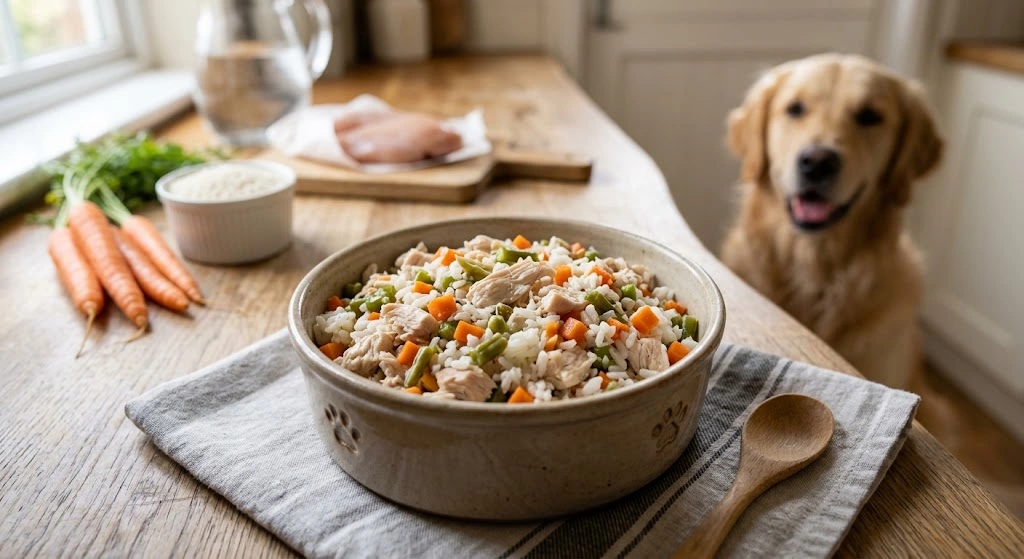
What Should Chicken and Rice for Dogs Look Like?
The finished meal should be soft, moist, plain, and easy to chew. It should not resemble a seasoned human chicken-and-rice dish.
How Much Chicken and Rice Should You Feed a Dog?
There is no single safe portion for every dog. Calorie needs vary with body size, age, activity, body condition, health status, and the rest of the dog’s diet.
Avoid assuming that one cup of chicken and rice represents the correct meal for every dog. When accurate feeding matters, your veterinarian can determine an appropriate amount based on your dog’s individual needs.
Ask
Ask your veterinarian how much food your dog should receive each day.
Measure
Use a kitchen scale when precise portions are important.
Monitor
Record what you offer, what your dog eats, stool quality, hydration, and behavior.
Avoid adding treats, table scraps, or rich foods while monitoring digestive symptoms.
How Long Can Dogs Eat Chicken and Rice?
Plain chicken and rice is not designed to be a permanent diet. It does not supply the complete balance of nutrients required for long-term canine health.
For temporary digestive upset, a veterinarian may recommend simplified feeding for a limited period followed by a return to an appropriate regular diet.
Why Long-Term Feeding Is Different
Chicken and rice supplies calories, protein, and carbohydrate, but those nutrients alone do not make a complete canine diet.
Adding a few vegetables or a generic multivitamin does not automatically transform chicken and rice into complete dog food.
How to Transition Your Dog Back to Regular Food
Once your veterinarian says your dog is ready to return to its normal diet, follow the recommended transition rather than making a sudden change.
- Increase the regular food while decreasing the temporary chicken-and-rice meal.
- Keep portions consistent during the transition.
- Introduce only one major dietary change at a time.
- Avoid rich treats while changing foods.
- Monitor stool quality and appetite.
- Slow the transition if your veterinarian recommends doing so.
- Contact your veterinarian if digestive problems return or worsen.
White Rice vs. Brown Rice for Dogs
White rice is the traditional choice for a simple chicken-and-rice bland meal. Brown rice contains more fiber and has a different nutritional profile, so it may not serve the same purpose in a veterinarian-directed bland feeding plan.
White Rice
Commonly used for the traditional short-term chicken-and-rice approach when recommended by a veterinarian.
Brown Rice
Can appear in properly formulated dog diets, but should not be added simply because it appears more nutritious.
Key Point
The appropriate carbohydrate depends on the purpose of the diet and the individual dog’s condition.
Can You Add Vegetables to Chicken and Rice?
Some homemade dog-food recipes contain vegetables, but more ingredients are not automatically better.
If your veterinarian has recommended a very simple bland meal, adding extra ingredients can defeat the purpose of keeping the food limited and predictable.
Ingredients to Avoid
Can Dogs Eat Chicken Thighs Instead?
Dogs can eat properly cooked chicken thigh meat, but thigh meat is generally fattier than chicken breast.
That difference can matter when a veterinarian recommends a lower-fat meal. For a simple chicken-and-rice recipe intended for digestive upset, skinless chicken breast is the more conservative choice.
For a complete homemade diet, however, the choice of chicken cut should be determined by the nutritional formulation rather than convenience alone.
Chicken and Rice for Puppies
If a puppy develops digestive problems, contact your veterinarian rather than adapting an adult feeding plan.
- Don’t assume adult feeding advice applies to a puppy.
- Don’t use chicken and rice as a long-term replacement for puppy food.
- Follow veterinary instructions for hydration, feeding, and diet.
- Seek prompt veterinary care if symptoms are severe or persistent.
Chicken and Rice for Adult Dogs
For a healthy adult dog, plain chicken and rice may be used for a short period when a veterinarian recommends it.
Adult dogs still need complete nutrition as part of their normal daily diet. If your goal is to feed fresh homemade meals regularly, use a complete and balanced recipe formulated for your dog’s individual needs rather than relying on chicken and rice alone.
When Chicken and Rice Is Not Enough
Chicken and rice can simplify a meal, but it cannot determine why your dog is sick. Digestive symptoms can have many causes, including dietary changes, infections, parasites, foreign objects, toxins, and underlying disease.
Call Your Veterinarian Promptly If You Notice
- Blood in vomit or stool
- Repeated vomiting
- Severe or worsening diarrhea
- Marked lethargy or weakness
- Signs of dehydration
- Significant abdominal pain
- A swollen or painful abdomen
- Persistent loss of appetite
- Symptoms in a very young puppy
- Symptoms in a dog with a significant existing health condition
Don’t keep extending a homemade bland diet simply because your dog seems slightly better.
Chicken and Rice vs. Veterinary Gastrointestinal Food
| Option | Best Use | Complete & Balanced? | Key Consideration |
|---|---|---|---|
| Chicken + white rice | Short-term use when appropriate | No | Simple, but nutritionally incomplete |
| Veterinary GI diet | Certain digestive conditions | Designed to be complete | Use according to veterinary guidance |
| Complete commercial dog food | Regular feeding | Formulated to meet nutritional needs | Select an appropriate life-stage formula |
| Professionally formulated homemade diet | Long-term homemade feeding | Can be complete when properly formulated | Requires precise formulation and adherence |
How to Cook Chicken and Rice Safely
Food safety matters for dogs just as it does for people. Raw poultry can carry harmful bacteria, while cooked food can become unsafe when left at room temperature for too long.
How to Store Chicken and Rice Dog Food
Don’t leave a large pot of cooked chicken and rice sitting on the counter until it cools. Divide it into shallow containers and refrigerate promptly.
Refrigerator Storage
Keep portions refrigerated at 40°F (4°C) or below and use most cooked leftovers within 3 to 4 days.
Freezer Storage
Freeze portions you do not expect to use within several days. Meal-sized containers make thawing easier and reduce repeated warming and cooling.
Reheating
When reheating leftovers, heat them thoroughly to 165°F (74°C), then allow the food to cool to a comfortable serving temperature before giving it to your dog.
Slow Cooker Chicken and Rice for Dogs
A slow cooker can be convenient, but the same ingredient and food-safety rules apply.
- Use thawed chicken rather than putting frozen chicken into a slow cooker.
- Use plain chicken, plain rice, and water if this diet has been recommended.
- Cook until the chicken reaches 165°F (74°C) internally.
- Remove bones, skin, and excess fat.
- Cool the finished food promptly.
Homemade Chicken and Rice for Long-Term Feeding
If you want to prepare homemade food every day, work with your veterinarian or a Board Certified Veterinary Nutritionist to develop an appropriate formulation.
If You Want to Feed Homemade Food Every Day
- Ask your veterinarian whether homemade feeding is appropriate.
- Use a recipe formulated for your specific dog.
- Follow the recipe exactly.
- Don’t casually substitute ingredients.
- Use required vitamin and mineral supplements when prescribed by the formulation.
- Reassess the diet if your dog’s age, weight, activity, or health changes.
What Makes a Complete Dog Food?
A complete diet must provide the nutrients a dog needs in appropriate amounts and proportions. That includes considerably more than protein and carbohydrates.
Protein
Protein plus the essential amino acids dogs need.
Fats
Fat and essential fatty acids in appropriate amounts.
Minerals
Calcium, phosphorus, and trace minerals in appropriate proportions.
Vitamins
Essential vitamins supplied at appropriate levels.
Energy
Appropriate calorie density for the dog’s needs.
Nutrient Ratios
The relationship between nutrients matters—not just the presence of each one.
This is why a homemade recipe can look wholesome while still being nutritionally incomplete.
A Practical Chicken and Rice Decision Guide
Mild Digestive Upset
Ask your veterinarian whether a short-term bland meal is appropriate.
Repeated Vomiting
Don’t rely on chicken and rice alone. Veterinary assessment may be necessary.
Puppy With Diarrhea
Contact your veterinarian instead of adapting an adult homemade feeding plan.
Healthy Dog + Homemade Goal
Use a complete and balanced homemade recipe rather than plain chicken and rice.
Chronic Health Condition
Ask your veterinarian before changing the diet because specialized nutrition may be required.
Common Chicken and Rice Mistakes to Avoid
Frequently Asked Questions
Can dogs eat chicken and rice every day?
Plain chicken and rice should not be used as a dog’s permanent sole diet. It does not provide the complete range and balance of nutrients required for long-term feeding. For daily homemade feeding, use a properly formulated complete recipe designed for your dog’s needs.
Is chicken and rice good for dogs with diarrhea?
It may be appropriate for some dogs with short-term digestive upset, but it is not automatically the best choice for every case. Veterinary gastrointestinal diets may be more appropriate in some situations. Severe, persistent, bloody, or otherwise concerning diarrhea warrants veterinary advice.
What is the correct chicken-to-rice ratio for dogs?
A commonly used short-term bland-diet ratio is approximately 2 parts cooked white rice to 1 part cooked chicken by weight. The amount and duration still depend on the individual dog and the veterinarian’s recommendations.
Can I add salt or seasoning to chicken and rice for my dog?
Keep a veterinarian-directed bland meal plain and unseasoned. Avoid onion, garlic, salty sauces, butter, and unnecessary oils.
Can puppies eat chicken and rice?
A puppy may receive a temporary homemade diet under veterinary direction, but chicken and rice is not a complete puppy diet. Growing dogs have specific nutritional requirements, so it should not be used as a regular meal without appropriate professional formulation.
How long does homemade chicken and rice last in the refrigerator?
Properly refrigerated cooked leftovers should generally be used within 3 to 4 days. Refrigerate perishable food promptly and freeze portions you do not expect to use within that period.
Is homemade chicken and rice better than prescription gastrointestinal dog food?
Not necessarily. A veterinary gastrointestinal diet can be formulated to provide complete nutrition while meeting specific digestive needs. Traditional chicken and rice is simpler but nutritionally incomplete. Your veterinarian can help determine which approach fits your dog’s condition.
Final Thoughts
A chicken and rice dog food recipe can be useful as a short-term, veterinarian-guided option for some dogs, but simplicity should never be confused with complete nutrition.
If your veterinarian recommends this approach, use plain cooked chicken and white rice, avoid harmful seasonings, handle the food safely, measure portions carefully, and monitor your dog’s condition.
If your dog needs homemade food beyond a brief period, move beyond the basic bowl of chicken and rice. Work with your veterinarian or a qualified veterinary nutritionist on a complete diet formulated for your dog’s life stage and individual needs.
Read More :