Make a spectacular traditional Norwegian kransekake with chewy almond rings, royal icing, an 18-ring tower, mold-free instructions, baking tips, troubleshooting, and celebration ideas.
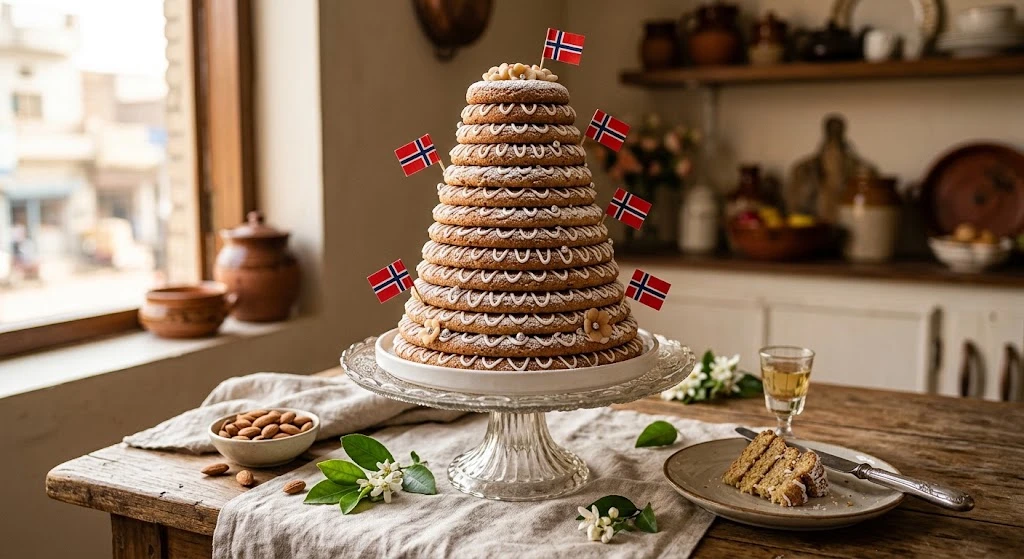
Kransekake is a spectacular Norwegian almond cake made from a simple dough of almonds, powdered sugar, and egg whites. Instead of being baked as one cake, the dough is shaped into 18 graduated rings, baked until lightly golden, and stacked into a tall tower using royal icing as edible glue.
The finished cake has a distinctive contrast: slightly crisp edges, a tender chewy center, and a rich almond flavor. It is especially associated with Norwegian Christmas celebrations, weddings, birthdays, anniversaries, and other special occasions.
This version is designed for home bakers, including anyone making kransekake without specialty molds. The most important details are the dough consistency, ring thickness, baking time, and avoiding overbaking.
Quick Answer: What Is Kransekake?
Kransekake, also called kransekake cake or Norwegian wreath cake, is a traditional Norwegian dessert made from an almond-based dough and powdered sugar, with egg whites used to bind the mixture.
A traditional tower contains 18 rings, arranged from the largest at the bottom to the smallest at the top. Royal icing is piped between the rings to hold the tower together and create the characteristic white zigzag decoration.
The key to good kransekake is simple: bake the rings only until the outside is set and lightly colored while the center remains soft and chewy.
Kransekake Recipe at a Glance
Ingredients for Kransekake
The traditional dough is remarkably simple. Many Norwegian versions use only ground almonds, powdered sugar, and egg whites, although modern recipes often add almond extract or other flavorings.
Kransekake Ingredients
Simple almond dough + royal icing for the classic Norwegian tower.
For the Almond Rings
- 500 g finely ground almond flour
- 500 g powdered sugar
- 3 large egg whites, about 90–100 g total
- 1 teaspoon pure almond extract
- ¼ teaspoon fine salt
For Preparing the Molds
- Nonstick baking spray or softened butter
- Fine semolina, for dusting
For the Royal Icing
- 480 g powdered sugar
- 3 tablespoons meringue powder
- 4 tablespoons water, plus a little more if needed
- Optional: gel food coloring for decorative accents
Why a Kitchen Scale Helps
A digital kitchen scale is strongly recommended. Kransekake depends on getting the almond-to-sugar-to-egg-white balance right. Measuring 500 g of almond flour and 500 g of powdered sugar gives you much more control than using loosely packed cups.
Equipment You Need
Traditional Equipment
- 18-ring kransekake molds
- Large mixing bowl or food processor
- Digital kitchen scale
- Rolling surface
- Cooling racks
- Piping bag
- Small round piping tip
- Baking sheets
- Pastry brush
- Spatula
No Specialty Molds?
You do not need specialty molds to make kransekake. The mold-free method uses parchment paper, a ruler, a pencil, and carefully measured dough ropes.
How to Make Kransekake Dough
- Combine the Almond Flour and Sugar. Place the almond flour, powdered sugar, and salt in a large bowl. Whisk thoroughly to break up lumps. If the almond flour is coarse, pulse it briefly with the powdered sugar in a food processor. The goal is a fine, even mixture, not almond butter.
- Add the Egg Whites Gradually. Add about two-thirds of the egg whites and mix. Add the remaining egg white a little at a time until the dough comes together. You may not need every drop.
- Check the Dough. The finished dough should be soft but firm, moldable, slightly tacky, and able to hold its shape. It should not be wet or runny.
- Add Almond Extract. Mix in the almond extract until evenly distributed.
- Test a Small Piece. Roll a small piece between your palms. If it forms a smooth rope without crumbling, the consistency is right. If it crumbles, add a tiny amount of remaining egg white. If sticky, work in a little powdered sugar.
- Rest the Dough. Shape the dough into a disk, cover tightly, and let it rest for about 30 minutes.
How to Shape the 18 Kransekake Rings
The rings need to become progressively smaller as you work upward. If you have molds, divide the dough into workable portions and roll each portion into a rope approximately ½ inch thick.
The Most Important Shaping Rule
Keep the rope thickness consistent.
A thick rope creates a heavy, bulky ring. A thin rope can bake too quickly and become dry. Aim for approximately ½ inch (1.25 cm) in diameter.
Forming Each Ring
- Roll the dough into an even rope.
- Match the rope length to the mold or parchment template.
- Join the ends.
- Smooth the seam with your fingers.
- Place the ring into the mold or onto prepared parchment.
- Gently flatten the top surface.
Flattening the top slightly gives the next ring a more stable surface during assembly.
Kransekake Ring Size Chart
If you’re making kransekake without molds, you can draw graduated circles on parchment. A practical mold-free approach uses 18 progressively larger circles.
| Ring | Approx. Diameter |
|---|---|
| 1 | 2¼ inches |
| 2 | 2½ inches |
| 3 | 2¾ inches |
| 4 | 3 inches |
| 5 | 3½ inches |
| 6 | 3¾ inches |
| 7 | 4¼ inches |
| 8 | 4½ inches |
| 9 | 4¾ inches |
| 10 | 5 inches |
| 11 | 5¼ inches |
| 12 | 5½ inches |
| 13 | 5¾ inches |
| 14 | 6 inches |
| 15 | 6½ inches |
| 16 | 7 inches |
| 17 | 7½ inches |
| 18 | 8 inches |
These are practical template dimensions rather than a universal standard. Mold manufacturers can use slightly different ring sizes.
How to Make Kransekake Without Molds
You can make an impressive kransekake with nothing more specialized than parchment paper, a ruler, and a pencil.
Step 1: Draw the Templates
Turn the parchment over so the pencil markings will not directly touch the dough. Draw the 18 circles using the size chart above.
Step 2: Roll the Dough
Roll portions of dough into approximately ½-inch-thick ropes. Make each rope slightly longer than the circumference of its template.
Step 3: Form the Rings
Place the rope over the circle, join the ends, and smooth the seam. The ring should sit directly over the template line.
Step 4: Flatten the Top
Very gently press the upper surface so that it is reasonably level. This makes stacking easier later.
Molded vs. Mold-Free Kransekake
| Method | Advantages | Challenges |
|---|---|---|
| Kransekake molds | Consistent sizes and shapes | Requires specialty equipment |
| Parchment templates | No special equipment required | Requires careful shaping |
| Hand-measured rings | Fast and flexible | Sizes can become inconsistent |
How to Bake Kransekake Without Drying It Out
Preheat your oven to 300°F (150°C) with a rack positioned in the lower third.
If using molds, lightly grease them and dust with fine semolina.
Look for These Doneness Cues
Properly Baked
- Surface looks dry and set
- Edges are very lightly golden
- Rings hold their shape
- Center remains relatively soft
Avoid Deep Browning
Dark golden rings are usually a warning sign. They can indicate that the cake is moving toward a dry, hard texture.
After Baking
Let the rings cool in their molds or on the baking sheet for about 10 minutes. Then transfer them carefully to a cooling rack and allow them to cool completely before assembly.
How to Tell When Kransekake Is Done
The visual test is more useful than an exact minute count.
| Stage | Outside | Inside | Shape |
|---|---|---|---|
| Properly baked | Dry and lightly golden | Soft and chewy | Firm enough to lift |
| Underbaked | Very soft | Excessively wet | May lose shape |
| Overbaked | Noticeably brown | Hard or dry | Brittle edges |
How to Make Royal Icing for Kransekake
Royal icing has two jobs: decoration and structural support.
Royal Icing Formula
- 480 g powdered sugar
- 3 tablespoons meringue powder
- 4 tablespoons water
Beat until the icing becomes thick enough to hold a defined line. If it is too stiff to pipe, add water a few drops at a time. If it is too loose, add additional powdered sugar.
What Consistency Should Kransekake Icing Have?
- Thick enough to hold a zigzag
- Sticky enough to glue rings together
- Not so stiff that it tears while piping
A small round piping tip works particularly well.
How to Assemble a Kransekake Tower
- Place the largest ring on your serving plate.
- Pipe a continuous zigzag or thin line of icing around its top.
- Place the next-largest ring on top.
- Press gently so the icing makes contact.
- Repeat with progressively smaller rings.
- Finish with the smallest ring.
Keep the Tower Straight
After placing each ring, step back and look at the tower from the side. If one ring is leaning, correct it immediately.
Don’t Overload the Icing
You don’t need a thick layer of icing. A thin, continuous line provides plenty of adhesive while preserving the almond flavor and keeping the finished cake visually clean.
How to Get a Soft, Chewy Kransekake
The characteristic texture comes from balancing almond flour, sugar, egg white, and baking time.
For a Chewy Result
- Use finely ground almonds or almond flour.
- Do not add excessive powdered sugar.
- Keep ropes close to ½ inch thick.
- Avoid deep browning.
- Cool rings before handling.
- Protect the finished cake from dry air.
The Biggest Mistake
The biggest mistake is usually overbaking, not underbaking. The outside should be set while the interior remains pleasantly chewy.
Almond Flour vs. Ground Almonds for Kransekake
| Ingredient | Expected Result |
|---|---|
| Fine almond flour | Smooth, consistent dough |
| Ground blanched almonds | Traditional-style almond texture |
| Almond meal | Coarser texture and darker appearance |
| Whole almonds ground at home | More control, but texture depends on grinding |
For the most predictable home-baking result, use fine almond flour. If you grind almonds yourself, stop as soon as they become fine crumbs.
Is Kransekake the Same as Marzipan?
No.
Kransekake and marzipan are related because both are almond-and-sugar preparations, but they are not interchangeable.
Marzipan
Generally softer and more pliable, marzipan is commonly used for candy, molded decorations, and cake covering.
Kransekake Dough
Specifically formulated to bake into firm rings with a chewy almond center and lightly crisp exterior.
Kransekake vs. Almond Cookies
| Feature | Kransekake | Almond Cookies |
|---|---|---|
| Shape | Graduated rings | Individual cookies |
| Structure | Tall tower | Usually flat |
| Almond Flavor | Strong | Varies |
| Texture | Crisp outside, chewy center | Varies |
| Icing | Often structural | Usually decorative |
| Occasion | Celebrations | Everyday or holiday baking |
The tower structure is what makes kransekake distinctive.
Kransekake for Christmas
Kransekake has a strong association with Norwegian Christmas traditions and Scandinavian celebrations. It is also commonly connected with weddings and other major occasions.
Christmas Decoration Ideas
- Powdered sugar
- Small edible decorations
- Silver or white sugar pearls
- Norwegian-inspired seasonal decorations
- Small flags or celebration picks
Kransekake for Weddings and Special Events
A kransekake tower makes an excellent alternative to a conventional layered cake.
Elegant Wedding Decorations
- White royal icing
- Edible flowers
- Fresh berries
- Sugar flowers
- Minimalist gold accents
- A small cake topper
Because the tower is already visually dramatic, simple decoration often looks more elegant than excessive decoration.
Kransekake Variations
Chocolate Kransekake
Add a small amount of unsweetened cocoa powder while adjusting the dry ingredients carefully. Cocoa changes the balance of the dough, so it should not simply replace almond flour gram-for-gram.
Orange Kransekake
Add finely grated orange zest for a brighter citrus note. Orange pairs particularly well with almond.
Lemon Kransekake
Add finely grated lemon zest to the dough or a small amount of lemon juice to the icing.
Cardamom Kransekake
A little ground cardamom adds a Scandinavian-inspired flavor without overpowering the almonds.
Gingerbread Kransekake
For a holiday variation, incorporate ginger, cinnamon, and cloves while keeping the classic almond base.
Common Kransekake Problems and How to Fix Them
Why Is My Kransekake Hard?
The most common reason is overbaking.
- Reduce the baking time.
- Check earlier.
- Avoid dark browning.
- Make sure the ropes aren’t too thin.
Why Did My Kransekake Crack?
Small cracks can happen when the dough is too dry or when the rings are shaped unevenly.
- Add egg white gradually until the dough is pliable.
- Roll ropes evenly.
- Smooth seams before baking.
- Avoid excessive powdered sugar during shaping.
Why Did the Rings Spread?
Possible causes include dough that is too soft, insufficient resting, thin rings, or an oven that was not fully preheated.
Why Are My Rings Uneven?
The most reliable solution is to use a scale and templates. Measure dough portions rather than guessing and compare each ring with its parchment circle.
Why Did My Rings Stick to the Molds?
- Prepare molds with nonstick spray or butter.
- Add a light coating of fine semolina.
- Tap out excess semolina before filling.
- Allow rings to cool before removing them.
Why Is My Tower Leaning?
Common causes include uneven ring sizes, rings that were not flattened on top, too much icing in one area, or rings placed slightly off-center.
Correct the alignment after every ring instead of waiting until the tower is finished.
Can You Make Kransekake Ahead of Time?
Yes. Kransekake is well suited to advance preparation. The baked rings can be prepared before final assembly, allowing you to divide the work across different days.
Practical Make-Ahead Plan
1–2 days before serving: Bake and cool the rings.
Day of serving: Prepare the icing, assemble the tower, and decorate.
This is especially useful for Christmas and wedding preparation when several desserts may need to be finished at once.
Can You Freeze Kransekake?
Kransekake rings can be frozen, but the texture is best protected when they are well wrapped and protected from freezer odors and moisture.
- Cool the rings completely.
- Wrap them securely.
- Place them in an airtight freezer-safe container.
- Thaw while still protected from excessive condensation.
- Assemble after the rings have returned to room temperature.
How to Store Kransekake
Keep assembled kransekake covered from excessive air exposure. In a dry environment, prolonged exposure can make the almond rings harder.
Avoid storing the finished tower where condensation or excessive humidity can soften the icing.
Is Kransekake Gluten-Free?
Traditional kransekake is generally made without wheat flour, making the basic recipe naturally gluten-free in terms of its traditional ingredients.
However, ingredient labels and cross-contact still matter.
- Choose certified gluten-free ingredients where appropriate.
- Check the almond flour label.
- Check powdered sugar and decorating ingredients.
- Use clean equipment.
- Avoid wheat-based semolina.
- Prevent cross-contact with wheat flour.
For a strictly gluten-free kitchen, use a suitable gluten-free mold-release ingredient instead of conventional wheat semolina.
Egg and Nut Allergy Information
The two major allergens in this recipe are almonds and eggs.
Nut Allergy
Almonds are an essential component of traditional kransekake, so this recipe is not suitable for people with almond allergies.
Do not substitute another nut without developing a separate recipe because different nuts have different fat, moisture, and structural properties.
Egg Safety
The dough contains egg whites, which are baked. The icing uses meringue powder rather than raw fresh egg whites.
How to Serve Kransekake
Kransekake is usually served by breaking off or cutting pieces of individual rings.
Perfect Pairings
- Coffee
- Tea
- Scandinavian cookies
- Christmas dessert tables
Special Occasions
- Weddings
- Anniversaries
- Birthdays
- Holiday celebrations
Because it is rich and almond-forward, small portions are often enough.
Expert Tips for the Best Kransekake
1. Use a Scale
Weigh the ingredients and, if possible, the dough portions.
2. Don’t Overwork the Dough
Mix only until the dough comes together.
3. Keep Rope Thickness Consistent
A rope around ½ inch thick is a useful target.
4. Watch the Color
Lightly golden is good. Deep brown usually means the rings have gone too far.
5. Cool Completely
Warm rings are fragile. Give them time to firm before assembly.
6. Use Icing Sparingly
The icing should act as glue, not a thick filling.
7. Assemble Slowly
Check the alignment after every ring.
8. Make a Template
Parchment templates dramatically reduce size inconsistencies.
Frequently Asked Questions About Kransekake
How many rings does a traditional kransekake have?
A traditional kransekake is commonly made with 18 graduated rings, stacked from the largest at the bottom to the smallest at the top.
Do I need kransekake molds?
No. Specialty molds make shaping easier and more consistent, but you can make the rings with parchment templates and evenly rolled dough ropes.
How thick should kransekake dough ropes be?
Aim for approximately ½ inch (1.25 cm) in diameter. Consistent thickness is more important than achieving a perfectly exact measurement on every ring.
Why does my kransekake crack?
Cracking can result from dry dough, uneven shaping, or overbaking. Add egg white gradually when mixing, avoid excessive powdered sugar during shaping, and remove rings once the outside is set.
Can I use almond meal instead of almond flour?
You can, but the texture will be different. Almond meal is usually coarser and may contain almond skins. Fine almond flour generally produces smoother, more uniform rings.
Can I make kransekake without a food processor?
Yes. A large mixing bowl works perfectly well when using commercially ground almond flour. A food processor is mainly useful when starting with whole or sliced almonds.
Can I make kransekake with marzipan?
It is not recommended as a direct one-for-one replacement. Marzipan has a different formulation and texture from kransekake dough.
Is kransekake the same as marzipan?
No. Both are almond-based, but kransekake is specifically formulated to bake into chewy almond rings that can support a stacked tower.
Is traditional kransekake gluten-free?
Traditional recipes are generally made without wheat flour, but anyone requiring strict gluten-free food should check every ingredient and prevent cross-contact.
Can I freeze kransekake?
Yes. The baked rings can be frozen when well protected. For the best appearance, thaw the rings before assembling and decorating the tower.
What does kransekake taste like?
It has a strong sweet almond flavor, with a texture that is typically slightly crisp on the outside and chewy inside.
Is kransekake a cake or a cookie?
It is best understood as a traditional almond ring confection. Although its name means “wreath cake,” the individual baked rings have a texture closer to a chewy almond cookie than a conventional sponge cake.
Complete Kransekake Recipe Card
Traditional Norwegian almond ring cake with royal icing.
Kransekake Dough
- 500 g fine almond flour
- 500 g powdered sugar
- 3 large egg whites, about 90–100 g
- 1 teaspoon almond extract
- ¼ teaspoon fine salt
For Molds
- Nonstick spray or softened butter
- Fine semolina
Royal Icing
- 480 g powdered sugar
- 3 tablespoons meringue powder
- 4 tablespoons water
Instructions
- Prepare the dough: Mix almond flour, powdered sugar, and salt. Add egg whites gradually, followed by almond extract. Mix until a soft, moldable dough forms.
- Rest: Cover the dough and let it rest for about 30 minutes.
- Prepare the oven: Heat the oven to 300°F (150°C).
- Prepare molds or templates: Grease molds and dust lightly with semolina, or draw 18 graduated circles on parchment.
- Shape: Roll dough into even ropes about ½ inch thick and form rings.
- Bake: Bake until the rings are set and lightly golden, approximately 15–20 minutes. Begin checking early because smaller rings may finish first.
- Cool: Cool the rings completely before removing them from molds or parchment.
- Make icing: Beat powdered sugar, meringue powder, and water until thick enough to pipe.
- Assemble: Pipe a thin icing line over the largest ring. Add the next ring and continue stacking from largest to smallest.
- Decorate: Finish with piped icing, powdered sugar, or other decorations.
- Serve: Allow the icing to set before moving the completed tower.
The Most Important Kransekake Takeaway
The ingredient list for kransekake is short, but successful results depend on technique.
Use fine almond flour, powdered sugar, and egg whites, keep the dough soft but shapeable, roll the ropes evenly, and avoid overbaking.
That combination of almond richness, chewy texture, delicate icing, and dramatic 18-ring presentation is what makes Norwegian kransekake such a memorable celebration dessert.
Conclusion: Make a Show-Stopping Norwegian Kransekake
This kransekake recipe gives you everything needed to make the classic Norwegian almond ring cake at home, including a complete ingredient formula, 18-ring size guide, mold-free instructions, baking cues, royal icing, assembly technique, troubleshooting, storage guidance, and food-safety notes.
You don’t have to own traditional Norwegian baking equipment to make it. Kransekake molds make the process easier, but parchment templates work surprisingly well when the dough ropes are rolled evenly.
For the best result, focus less on making the tower look perfect on the first attempt and more on getting the ring thickness, baking time, and chewy center right. Once those three details are under control, the dramatic tower comes together with little more than royal icing and patience.
Kransekake is meant to be celebrated—not rushed.
Read More :