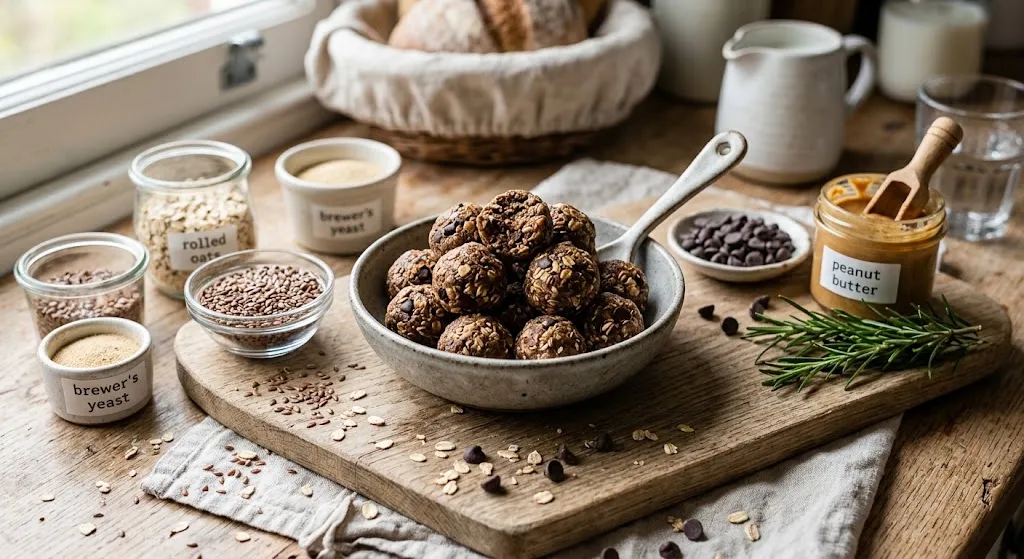
Make soft, chewy lactation balls with oats, peanut butter, ground flaxseed, maple syrup or honey, vanilla, and chocolate chips. They’re quick to prepare, freezer-friendly, and easy to grab when you need a filling snack.
If you need a quick, filling snack during the breastfeeding months, these lactation balls are an easy option to keep in the refrigerator or freezer. They are made with rolled oats, peanut butter, ground flaxseed, maple syrup or honey, vanilla, and chocolate chips, with optional brewer’s yeast for a more traditional lactation-ball recipe.
What these bites can do is make it easier to keep a satisfying, energy-dense snack within reach when meals are interrupted by feedings, pumping, diaper changes, or a baby who suddenly needs you.
Quick Answer: What Are Lactation Balls?
Lactation balls are no-bake energy bites made from ingredients such as oats, nut or seed butter, ground flaxseed, and a sweetener. Many recipes also include chocolate chips, coconut, chia seeds, dates, or brewer’s yeast.
This version takes about 15 minutes to prepare, requires no oven, and makes approximately 20–24 bite-sized balls.
For the best texture, chill the mixture before rolling. If it seems too dry, add a little more nut butter; if it is too sticky, add a spoonful of oats.
At a Glance
| Recipe Detail | What to Expect |
|---|---|
| Recipe type | No-bake snack |
| Prep time | 15 minutes |
| Chilling time | 30 minutes |
| Total time | About 45 minutes |
| Yield | 20–24 balls |
| Main ingredients | Oats, nut butter, flaxseed, sweetener |
| Optional ingredient | Brewer’s yeast |
| Dietary options | Vegan, dairy-free, gluten-free, nut-free |
| Best for | Breastfeeding and postpartum snacking |
The Best Lactation Balls Recipe
Soft, chewy, lightly sweet, and easy to eat with one hand. No food processor, stovetop, or oven required.
Ingredients
- 2 cups old-fashioned rolled oats
- ½ cup creamy peanut butter or almond butter
- ⅓ cup maple syrup or honey
- ¼ cup ground flaxseed
- ½ cup mini chocolate chips
- 1 teaspoon vanilla extract
- 1–2 tablespoons brewer’s yeast, optional
- 2 tablespoons unsweetened shredded coconut, optional
- Pinch of fine salt
- 1–3 tablespoons milk or plant milk, only if needed
Why These Ingredients Are Used
Rolled oats provide the chewy base and make the balls substantial enough to function as a snack.
Peanut butter or another nut/seed butter supplies fat, flavor, and moisture for binding.
Ground flaxseed adds texture and helps absorb some moisture.
Maple syrup or honey provides sweetness while helping hold the ingredients together.
Chocolate chips are optional, but they make the recipe taste more like an everyday treat.
Brewer’s yeast is traditional in many lactation recipes, but it should not be presented as a proven milk-supply booster.
How to Make Lactation Balls
- Combine the dry ingredients. Add rolled oats, ground flaxseed, salt, and optional brewer’s yeast and coconut to a large bowl. Stir well.
- Add the wet ingredients. Add peanut butter, maple syrup or honey, and vanilla. Mix until the mixture resembles thick, slightly sticky cookie dough.
- Fold in the chocolate chips. Stir in the mini chocolate chips. If the mixture is too stiff, add milk or plant milk 1 tablespoon at a time.
- Chill the mixture. Cover and refrigerate for about 30 minutes. This makes the mixture firmer and easier to roll.
- Roll into balls. Scoop approximately 1 tablespoon per ball and roll between your palms.
- Chill again if desired. Another 15–30 minutes in the refrigerator creates an even firmer, chewier texture.
How Should Lactation Balls Taste?
A good lactation ball should taste more like a soft oatmeal chocolate-chip snack than a medicinal supplement.
If you use a generous amount of brewer’s yeast, the flavor can become noticeably bitter or savory. Start conservatively if you are new to it.
How to Fix Lactation Balls That Won’t Hold Together
The biggest mistake with no-bake energy balls is trying to force every batch into exactly the same ratio. Nut butters vary in thickness, flaxseed absorbs differently, and oats differ in moisture.
Too Dry?
Add one of the following:
- 1 tablespoon nut or seed butter
- 1 tablespoon milk or plant milk
Mix again before adding more.
Too Sticky?
Add:
- 1–2 tablespoons rolled oats
- A little ground flaxseed
Then chill for another 15–20 minutes.
Crumbly?
Add 1 tablespoon nut butter or maple syrup, mix thoroughly, and test one ball before adjusting the entire batch.
Brewer’s Yeast Too Strong?
Reduce it in the next batch and increase flavor with vanilla, chocolate chips, cinnamon, or dates instead of simply adding more sweetener.
Important: Do Lactation Balls Increase Milk Supply?
There is not enough reliable evidence to say that lactation balls themselves increase breast milk production.
Many recipes contain ingredients traditionally described as galactagogues, including oats, flaxseed, fennel, herbs, or brewer’s yeast. Traditional use, however, is not the same thing as proven clinical effectiveness.
Brewer’s yeast is especially important to put into perspective: human evidence has not established that it increases milk production.
If you are concerned about milk supply, breastfeeding and milk-removal factors should be evaluated rather than relying on a particular food or supplement.
So Why Make Lactation Balls?
Because they can be a convenient, nutrient-dense snack.
Breastfeeding increases energy needs, and a ready-to-eat snack can be useful when meals are difficult to manage.
Keep Expectations Realistic
Think of lactation balls as convenient postpartum snacks, not as a guaranteed milk-supply solution.
How Many Lactation Balls Should You Eat?
There is no scientifically established number of lactation balls per day that guarantees increased milk production.
Treat them as a snack rather than a dosage. One or two may be enough for a small snack, while someone with a larger appetite may want more alongside fruit, yogurt, milk, or another food.
Because recipes vary significantly in size and ingredients, calorie content can also vary substantially.
Brewer’s Yeast vs. Nutritional Yeast
These ingredients are often confused, but they are not interchangeable in the context of this recipe.
| Ingredient | What It Is | Flavor | Use Here |
|---|---|---|---|
| Brewer’s yeast | Yeast associated with brewing/fermentation | Bitter, savory | Traditional ingredient |
| Nutritional yeast | Deactivated yeast used as a food | Nutty, savory, cheesy | Flavor/nutrition; not the same ingredient |
| Baking yeast | Active yeast used to make bread rise | Yeasty | Not appropriate here |
If a recipe specifically calls for brewer’s yeast, nutritional yeast should not automatically be treated as a one-for-one replacement.
Lactation Balls Without Brewer’s Yeast
You can absolutely make these balls without brewer’s yeast. Leaving it out may produce a sweeter, more familiar flavor.
Simply omit it. You do not need to replace it with nutritional yeast.
Vegan Lactation Balls
For a vegan version, use:
- Maple syrup instead of honey
- Plant-based chocolate chips
- Plant milk if additional moisture is needed
Peanut butter, almond butter, cashew butter, tahini, and sunflower seed butter can all work depending on your dietary needs.
Gluten-Free Lactation Balls
The basic ingredients can be adapted for a gluten-free diet, but oats deserve special attention.
Nut-Free Lactation Balls
For a nut-free version, replace peanut or almond butter with:
- Sunflower seed butter
- Tahini, if you enjoy its stronger flavor
- Another suitable seed butter
Allergy Safety
If preparing these for someone with a severe allergy, check every packaged ingredient for allergen statements and cross-contact warnings. A recipe can contain no obvious nuts and still be exposed to them during commercial processing.
Dairy-Free Lactation Balls
The recipe is naturally easy to make dairy-free. Use:
- Peanut butter or seed butter
- Maple syrup
- Dairy-free chocolate chips
- Plant milk if needed
No butter, cream, or regular milk is required.
Lactation Balls With Dates
Dates create a naturally sweeter variation while also adding stickiness.
Finely chop or process ½ cup soft, pitted dates and mix them into the dough. You may need slightly less maple syrup or honey.
Flavor Combination to Try
Dates + peanut butter + oats + cinnamon + dark chocolate
Chocolate Peanut Butter Lactation Balls
Add:
- 2 tablespoons unsweetened cocoa powder
- ½ cup mini chocolate chips
- An additional 1 tablespoon maple syrup, if needed
Cocoa powder absorbs moisture, so you may need a small splash of milk or another spoonful of peanut butter.
High-Protein Lactation Balls
If you want these to function as a more substantial snack, you can add a protein powder you already tolerate.
Start with 2–3 tablespoons, then adjust the texture. Protein powder can make energy balls noticeably drier, so additional nut butter or milk may be necessary.
Low-Sugar Lactation Balls
For a less-sweet snack, reduce the maple syrup or honey slightly and use unsweetened peanut butter and dark chocolate.
Because the sweetener also contributes moisture and binding, avoid removing a large portion without adjusting the remaining ingredients.
Best Ingredient Substitutions
| Original Ingredient | Possible Substitute | What to Expect |
|---|---|---|
| Peanut butter | Almond butter | Similar texture and mild flavor |
| Peanut butter | Sunflower seed butter | Nut-free option |
| Honey | Maple syrup | Vegan-friendly |
| Rolled oats | Certified GF rolled oats | Gluten-free option |
| Chocolate chips | Cacao nibs | Less sweet and more bitter |
| Flaxseed | Chia seeds | More gel-like texture |
| Cow’s milk | Unsweetened plant milk | Dairy-free |
| Brewer’s yeast | Omit | No direct replacement required |
Substitution Tip
Do not assume every substitution is 1:1. Nut butters differ in thickness, and chia seeds absorb liquid differently from ground flaxseed.
How to Store Lactation Balls
Place finished balls in an airtight container in the refrigerator. For the best quality, aim to eat them within about 1 week.
For longer storage, arrange the balls in a single layer and freeze until firm. Transfer them to a freezer-safe container or bag.
Freezer Tip
Label the container with the preparation date so you can keep track of when the batch was made.
Can You Freeze Lactation Balls?
Yes. These no-bake balls are especially convenient for freezer preparation.
- Roll the balls and place them on a parchment-lined tray.
- Freeze until firm.
- Transfer them to an airtight freezer container or freezer bag.
- Label with the preparation date.
- Thaw individual portions in the refrigerator when needed.
You can also eat them partially frozen if you prefer a firmer texture.
Are Lactation Balls Safe While Breastfeeding?
For most people, the basic ingredients in this recipe are ordinary foods commonly eaten as part of a varied diet.
However, individual allergies, intolerances, medical conditions, medications, and dietary restrictions matter.
- Peanut and tree-nut allergies
- Seed allergies
- Gluten avoidance or celiac disease
- Caffeine sensitivity, depending on the chocolate used
- Supplement-style ingredients such as brewer’s yeast
- Any ingredient you have previously reacted to
If you have a medical condition or take medication and are unsure about an ingredient such as brewer’s yeast, ask your healthcare professional.
When to Get Help for Low Milk Supply
Lactation balls should never delay appropriate help for a genuine breastfeeding problem.
If you are worried that your baby is not getting enough milk, speak with your pediatrician, obstetric clinician, midwife, or qualified lactation professional.
What Makes This Recipe Different From Lactation Cookies?
| Feature | Lactation Balls | Lactation Cookies |
|---|---|---|
| Baking required | ❌ No | Usually yes |
| Preparation | One bowl | Mixing + baking |
| Texture | Chewy, soft | Cookie-like |
| Freezer friendly | Yes | Usually |
| Ready quickly | Yes | Takes longer |
| Easy one-handed snack | Yes | Yes |
| Customizable | Very | Very |
For exhausted new parents, the biggest advantage is simple: you do not have to turn on the oven.
Practical Tips for Better Lactation Balls
Use Old-Fashioned Rolled Oats
They provide a better chewy texture than quick oats.
Use Creamy Nut Butter
Very dry or stiff peanut butter can make the mixture crumbly.
Grind Your Flaxseed
Ground flax blends more easily and helps create the desired texture.
Chill Before Judging
A soft mixture can become much easier to roll after refrigeration.
Don’t Overdo Brewer’s Yeast
More is not necessarily better. Brewer’s yeast can have a pronounced bitter flavor and has not been established as an effective human galactagogue.
Common Mistakes to Avoid
- Using too much liquid: This creates sticky balls that do not firm up properly.
- Adding too many dry ingredients: Excess oats or protein powder can make the mixture crumbly.
- Using whole flaxseed: The texture and binding will change.
- Treating brewer’s yeast as required: It is optional.
- Promising increased milk supply: Current evidence does not justify that claim.
- Making a huge batch immediately: Test the recipe first and adjust the texture.
Frequently Asked Questions
What are the main ingredients in lactation balls?
The most common base ingredients are rolled oats, nut or seed butter, ground flaxseed, and a sweetener. Chocolate chips, coconut, chia seeds, dates, vanilla, and brewer’s yeast are common additions.
Do lactation balls really boost milk supply?
There is no good evidence that lactation balls as a food reliably increase breast milk production. Brewer’s yeast is commonly included, but human evidence has not established an effect on milk supply.
Can I make lactation balls without brewer’s yeast?
Yes. Simply leave it out. You do not need to replace it with nutritional yeast.
What is the best nut butter for lactation balls?
Creamy peanut butter is an easy choice because it binds well and pairs nicely with oats and chocolate. Almond butter, cashew butter, and sunflower seed butter can also work.
Can I make lactation balls vegan?
Yes. Use maple syrup instead of honey, plant milk if needed, and vegan chocolate chips.
Can I make them gluten-free?
Yes. Use certified gluten-free oats if you need strict gluten avoidance.
Can I make lactation balls without nuts?
Yes. Sunflower seed butter is one of the easiest substitutions.
How long do lactation balls last in the refrigerator?
Keep them refrigerated in an airtight container and aim to eat them within about 1 week for best quality. Discard them if they develop an unusual smell, appearance, or texture.
Can I freeze lactation balls?
Yes. Freeze them in an airtight freezer-safe container or bag and label the preparation date.
How many lactation balls should I eat per day?
There is no evidence-based daily dose for lactation balls. Treat them as a snack and adjust the amount according to hunger and your overall diet.
Are oats proven to increase breast milk?
Oats are traditional in lactation recipes, but that does not establish that eating oats increases milk production. Their practical value here is that they make the balls filling, convenient, and easy to prepare.
What should I do if I think my milk supply is low?
Do not rely solely on lactation foods. Contact a qualified lactation professional or healthcare provider so the situation can be properly assessed.
Final Thoughts
The best lactation balls recipe does not need a long list of supposedly magical ingredients. It needs to be easy to make, genuinely tasty, filling, freezer-friendly, and honest about what the evidence does—and does not—show.
This version combines rolled oats, nut butter, ground flaxseed, maple syrup or honey, vanilla, and chocolate chips into a chewy no-bake snack that can be prepared ahead of time and grabbed whenever hunger strikes.
While the name “lactation balls” is familiar, keep expectations realistic: these are convenient postpartum snacks, not a guaranteed way to increase milk supply.
Start with the basic recipe, chill it before rolling, and adjust the moisture gradually. Once you know the texture you like, experiment with dates, cocoa, cinnamon, coconut, dark chocolate, sunflower seed butter, or other flavors.
That is the real advantage of homemade lactation balls: one dependable base recipe that can be adapted to your taste, dietary needs, and postpartum routine.
Read More :