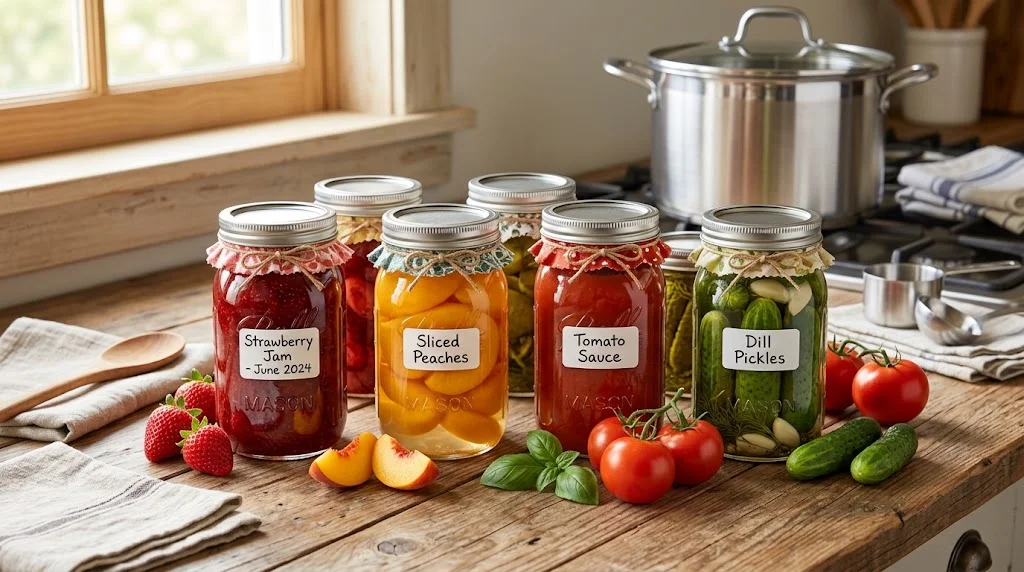
Water bath canning recipes are a great place to start if you want to preserve fruit, jams, jellies, pickles, relishes, and properly acidified tomato products at home. The key is choosing foods and recipes that have been tested for safe processing.
This complete guide explains what you can water-bath can, which projects are easiest for beginners, what equipment you need, how the process works, how altitude affects processing, and what to do when something goes wrong.
⚠️ Safety First
Home canning is a food-safety process, not simply a cooking technique. For safety-critical instructions, use current guidance from the National Center for Home Food Preservation (NCHFP), USDA, and university Extension programs. Do not improvise acidity, ingredient ratios, jar sizes, or processing times.
The best water bath canning recipes use high-acid foods or tested recipes that provide enough acidity for boiling-water processing. Good choices include strawberry jam, apple butter, applesauce, fruit preserves, dill pickles, bread-and-butter pickles, relishes, chutneys, and properly acidified tomatoes.
If you’re new to canning, start with a tested jam, jelly, fruit, or pickle recipe. Don’t improvise ingredient ratios or processing times because acidity, food density, jar size, headspace, and altitude can all affect safe processing.
Best Water Bath Canning Recipes for Beginners
Beginner-friendly projects should have straightforward ingredients, familiar preparation steps, and reliable tested instructions. Jam, jelly, applesauce, fruit, and pickles are especially useful starting points because they introduce the basic water-bath process without requiring a pressure canner.
🍓 Strawberry Jam
Bright berry flavor for toast, biscuits, and gifts.
🫐 Blueberry Jam
Deep berry flavor with simple breakfast uses.
❤️ Raspberry Jam
Tart, fragrant, and excellent with breads and pastries.
🍎 Apple Butter
Rich apple flavor with warm spice and a smooth texture.
🍏 Applesauce
Useful for breakfast, snacks, baking, and desserts.
🍑 Peach Preserves
Soft fruit pieces with a classic summer flavor.
🍐 Pear Preserves
Mild, floral fruit flavor that works well with warm spices.
🥒 Dill Pickles
Crisp, savory pickles for sandwiches and snack plates.
🥒 Bread-and-Butter Pickles
Sweet-tangy slices made for burgers and sandwiches.
❤️ Pickled Beets
Earthy beets balanced by vinegar and spices.
🍇 Fruit Jelly
Clear, smooth spreads that make attractive pantry gifts.
🍎 Apple Slices
A practical way to preserve seasonal apples for later cooking.
Important
Always follow the specific tested recipe for ingredients, jar size, headspace, and processing time.
What Foods Can You Water Bath Can?
Water bath canning is designed for high-acid foods and properly acidified recipes. The boiling-water process is appropriate for many fruits, jams, jellies, pickles, relishes, and certain tomato products when the recipe has been tested for that method.
The important point is that “fruit” or “vegetable” alone does not determine whether a recipe is safe. The finished food, its acidity, preparation, ingredients, jar size, and processing conditions all matter.
Common Water-Bath Categories
🍎 Fruits
Apples, peaches, pears, plums, cherries, berries, and grapes.
🍓 Jams & Jellies
Tested fruit formulas designed for shelf-stable processing.
🥫 Preserves & Sauces
Fruit preserves and sauces when an approved process exists.
🥒 Pickles
Tested vinegar-based or fermentation-based recipes.
🌶️ Relishes
Relishes formulated with appropriate acidity and processing.
🍅 Tomatoes
Properly acidified tomato products processed according to current tested recipes.
🚫 Foods That Need Special Caution
NCHFP specifically cautions against using its general fruit-puree recommendations for foods including bananas, dates, figs, Asian pears, cantaloupe, melons, papaya, persimmons, ripe mango, and coconut.
Never assume that adding a little vinegar or lemon juice makes an untested recipe safe. Use a tested recipe designed for the food you’re preserving.
Water Bath Canning vs. Pressure Canning
The biggest beginner mistake is treating all canning methods as interchangeable. They aren’t. A boiling-water canner is used for suitable high-acid foods, while a pressure canner is required for low-acid foods because it reaches temperatures that a boiling-water canner cannot provide.
| Water Bath Canning | Pressure Canning |
|---|---|
| High-acid foods | Low-acid foods |
| Fruits | Meat |
| Jams and jellies | Poultry |
| Pickles | Seafood |
| Relishes | Plain vegetables |
| Properly acidified tomatoes | Beans and many soups |
| Boiling-water canner | Pressure canner |
Never Use a Water Bath for These Foods
Never water-bath can meat, poultry, seafood, or plain low-acid vegetables. USDA guidance identifies pressure canning as the appropriate method for low-acid foods.
Water Bath Canning Equipment You Actually Need
You don’t need a huge collection of gadgets to begin. A basic setup can handle many beginner projects, provided the equipment is appropriate for your stove and jar size.
🫙 Basic Water-Bath Canning Setup
Build your equipment around the tested recipe and your specific jar size.
- Boiling-water canner with a fitted lid.
- Canning rack to keep jars off the bottom.
- Mason jars in the size specified by your recipe.
- Two-piece canning lids suitable for your jars.
- Screw bands in good condition.
- Jar lifter for safely moving hot jars.
- Wide-mouth funnel for cleaner filling.
- Ladle for transferring hot food.
- Headspace tool when required.
- Clean towels for cooling and handling.
- Reliable timer for processing.
How to Water Bath Can Safely
Water bath canning is straightforward when you follow the tested process instead of improvising. NCHFP recommends reading the complete instructions before beginning, preparing the canner, loading filled jars upright, maintaining the required water level, and starting the processing timer only after the water reaches a vigorous boil.
♨️ Standard Water-Bath Process
A general workflow. The specific tested recipe always takes priority.
- Choose a current tested recipe.
- Prepare the canner and rack.
- Heat the water according to the recipe.
- Prepare the food exactly as directed.
- Fill hot jars to the specified headspace.
- Remove trapped air when the recipe calls for it.
- Wipe jar rims clean.
- Apply lids and screw bands according to current instructions.
- Place jars upright in the canner.
- Make sure the required amount of water covers the jars.
- Cover the canner and bring the water to a vigorous boil.
- Start timing only when the recipe says to start.
- Maintain a complete boil throughout processing.
- Remove jars carefully after processing.
- Cool jars undisturbed for 12–24 hours.
- Check seals, label jars, and store properly.
⏱️ If the Water Stops Boiling
If the water stops boiling during processing, bring it back to a vigorous boil and restart the full processing time from the beginning according to NCHFP guidance.
Best Fruit Water Bath Canning Recipes
Fruit is one of the largest water-bath canning categories, but individual fruits still need appropriate tested procedures. Whole fruit, slices, syrup-packed fruit, juice-packed fruit, and purees can have different instructions.
🍑 Canned Peaches
Soft, fragrant fruit for breakfast and desserts.
🍐 Canned Pears
Mild and delicate with a naturally sweet flavor.
🍎 Apple Slices
Useful for pies, crisps, oatmeal, and sauces.
🍏 Applesauce
Smooth, versatile, and beginner-friendly.
🍑 Apricots
Bright fruit flavor for breakfast and desserts.
🫐 Blueberries
Excellent for pancakes, muffins, and spoon desserts.
🫐 Blackberries
Rich berry flavor with many dessert uses.
🍒 Cherries
Tart or sweet depending on the variety and recipe.
🍒 Cranberries
Naturally sharp flavor that works well with holiday meals.
🍇 Grapes
Useful for fruit preserves and other tested preparations.
🟣 Plums
Deep color and sweet-tart flavor.
❤️ Raspberries
Fragrant fruit suited to jams and preserves.
🌿 Rhubarb
Tart stalks that work well in tested sweet preserves.
🍓 Strawberries
A classic choice for jams and preserves.
🍐 Quince
Firm fruit that develops a rich aroma when cooked.
Jam, Jelly, and Preserve Recipes
Jams and jellies are among the most popular water-bath canning projects because they turn seasonal fruit into compact pantry staples. They also make attractive homemade gifts when jars are labeled and stored correctly.
🍓 Strawberry Jam
Bright, familiar, and excellent for beginners.
🫐 Blueberry Jam
Deep berry flavor with a soft spread.
❤️ Raspberry Jam
Tart and fragrant with a classic texture.
🫐 Blackberry Jam
Rich and slightly tangy.
🍑 Peach Jam
Soft, sunny flavor for breakfast breads.
🍑 Apricot Jam
Intensely fruity and naturally aromatic.
🟣 Plum Jam
Sweet-tart with a deep fruit character.
🍒 Cherry Jam
Rich and colorful for toast and pastries.
🍇 Grape Jelly
Familiar flavor with a smooth, clear spread.
🍎 Apple Jelly
Bright fruit flavor and an attractive translucent finish.
🍒 Cranberry Jelly
Tangy and especially useful during the holidays.
🫐 Mixed-Berry Jam
Use only a tested formula designed for the combination.
Don’t Freestyle Jam Ratios
Pectin, sugar, fruit quantity, and cooking time are not automatically interchangeable. A recipe developed with commercial pectin may behave differently from a traditional no-pectin formula. Don’t simply combine fruits from different recipes.
Pickle and Relish Recipes
Pickles are especially satisfying when you have a large summer harvest. Their sharp flavor also gives canned food a different role from sweet preserves.
🥒 Pickling Safety Rule
Acid concentration matters. Don’t reduce vinegar, change vinegar strength, or substantially alter proportions in a tested recipe unless the recipe specifically permits the modification.
Dill Pickles
Crisp, savory, and useful with sandwiches.
Bread-and-Butter Pickles
Sweet-tangy slices for burgers and snacks.
Pickled Beets
Earthy, colorful, and tangy.
Pickled Carrots
Crunchy and bright when prepared with a tested formula.
Pickled Green Beans
A useful option for preserving a garden harvest.
Pickled Onions
Tangy and excellent with tacos and sandwiches.
Pickled Peppers
Great for sandwiches, pizza, and savory plates.
Pickled Cauliflower
Crisp vegetable texture with bold acidity.
Zucchini Pickles
A practical option for a heavy zucchini harvest.
Cucumber Relish
Sweet-tangy and useful as a condiment.
Corn Relish
Colorful and useful alongside grilled foods.
Chow-Chow
A mixed vegetable relish found in several regional traditions.
Tomato and Salsa Water Bath Canning Recipes
Tomatoes require more attention than many beginners expect. Their acidity can vary, which is why current tested tomato recipes often require added acidification.
🍅 Crushed Tomatoes
A versatile base for soups, sauces, and pasta.
🍅 Whole Tomatoes
Useful for later cooking.
🍅 Tomato Juice
A practical pantry ingredient.
🍅 Tomato Sauce
Useful for quick weeknight meals.
🌶️ Tomato Salsa
Bright and useful with chips or cooked dishes.
🌶️ Green Tomato Salsa
A tangy option for late-season tomatoes.
🍅 Tomato Relish
A savory condiment for sandwiches.
🍅 Acidified Tomato Products
Follow the specific tested formula carefully.
🍅 Critical Tomato Rule
Don’t copy an old family tomato recipe and assume it is safe because tomatoes are acidic. Current tested recipes may require bottled lemon juice or citric acid in specified amounts.
Follow the recipe exactly rather than estimating acidity yourself.
Chutney, Sauce, and Condiment Recipes
Chutneys and sauces can turn seasonal produce into useful pantry foods and thoughtful gifts. However, recipes vary widely in acidity and ingredient ratios.
Apple Chutney
Sweet, tangy, and warmly spiced.
Mango Chutney
Fruity and aromatic when made from a tested recipe.
Cranberry Chutney
Especially useful around holiday meals.
Tomato Chutney
Savory-sweet with concentrated tomato flavor.
Peach Chutney
Excellent with grilled or roasted foods.
Plum Chutney
Deep fruit flavor with a sweet-tart edge.
Fruit Barbecue Sauce
Only use a tested canning formula.
Tomato Sauce
A practical pantry staple when properly acidified.
⚠️ A Thick Sauce Is Not Automatically Safe
Don’t water-bath can a homemade sauce simply because it contains vinegar or tomatoes. The complete formulation and processing instructions still matter.
Summer Water Bath Canning Recipes
Summer is when many home cooks have more produce than they can eat immediately. Canning can turn that short harvest window into pantry food for later months.
Strawberry Jam
Preserve peak-season berries in a classic spread.
Blueberry Preserves
A useful way to preserve summer berries.
Peach Preserves
Capture ripe summer peach flavor.
Pickled Cucumbers
A classic harvest-season project.
Dill Pickles
Crunchy and savory.
Pickled Green Beans
Useful for preserving garden surplus.
Cherry Preserves
Bright fruit flavor for desserts.
Raspberry Jam
Fragrant and tart.
Tomato Salsa
Use a tested acidified formula.
Acidified Tomatoes
Follow the exact tested process.
Peach Chutney
Sweet-tangy and savory-friendly.
Mixed Berry Preserves
Only use a tested formula.
Fall and Holiday Canning Recipes
Fall canning shifts toward apples, pears, cranberries, late tomatoes, and warming spices. These jars can also become thoughtful homemade gifts during the holiday season.
Applesauce
Useful for breakfasts, snacks, and baking.
Apple Butter
Rich, smooth, and warmly spiced.
Apple Jelly
Bright flavor with a clear appearance.
Pear Preserves
Mild and naturally sweet.
Spiced Pears
A warming fall preparation.
Cranberry Jelly
Tangy and holiday-friendly.
Cranberry Sauce
Use a tested canning recipe.
Pickled Beets
Colorful, earthy, and tangy.
Tomato Sauce
Follow current acidification requirements.
Late-Season Tomato Salsa
Use a tested salsa formula.
Apple Chutney
Sweet, tangy, and spiced.
Pear Chutney
Fruity with a sweet-tart character.
Water Bath Canning for Small Kitchens and Small Batches
You don’t need a garden or a large pantry to enjoy home canning. A small kitchen can still handle modest batches if you have appropriate equipment and enough workspace.
1. Start Small
Begin with one tested jam recipe.
2. Match Your Jars
Choose recipes compatible with available jar sizes.
3. Prep First
Prepare ingredients before heating the canner.
4. Label Immediately
Record the food, recipe, and date.
5. Avoid Unapproved Scaling
Don’t double or halve recipes unless the source permits it.
6. Can What You Eat
Build your pantry around foods your household already enjoys.
How to Adjust Water Bath Canning for Altitude
Altitude matters because water boils at a lower temperature as elevation increases. That changes the processing conditions used by a tested recipe.
⛰️ Altitude Adjustment Checklist
Use the altitude table supplied with your specific tested recipe.
- Find your elevation.
- Open the tested recipe you’re using.
- Find its altitude-specific processing table.
- Select the correct jar size and pack style.
- Use the processing time listed for your elevation.
Don’t Use a Generic Altitude Rule
Never use a generic “add five minutes” rule for every canning recipe. The correct adjustment depends on the specific tested process.
Common Water Bath Canning Mistakes
Most canning problems aren’t caused by complicated equipment. They’re caused by changing a recipe, guessing at processing conditions, or skipping an important step.
- Using an untested recipe simply because it looks similar to a safe one.
- Reducing vinegar in a pickle recipe.
- Reducing required acid in tomato recipes.
- Changing jar sizes without checking the tested process.
- Guessing processing time based on another recipe.
- Starting the timer before a full boil is reached.
- Letting the water level fall below the required level.
- Tilting jars when moving them from the canner.
- Pressing down on lids during cooling.
- Ignoring altitude adjustments.
- Water-bath canning low-acid foods.
- Using damaged or cracked jars.
What to Do When a Canning Jar Doesn’t Seal
A failed seal does not automatically mean the food is ruined. However, you shouldn’t simply put an unsealed jar on the pantry shelf.
🫙 If a Jar Fails to Seal
- Don’t press the lid repeatedly to test it.
- Check whether the lid has formed a proper seal after cooling.
- Refrigerate an unsealed jar and use it promptly according to the recipe’s storage guidance.
- If you intend to reprocess food, use current guidance for that specific food rather than guessing.
- Investigate possible causes such as improper headspace, food residue on the rim, damaged jar rims, or incorrect lid preparation.
🚨 If You See Spoilage, Don’t Taste It
When a home-canned food shows mold, fermentation, leakage, an unusual odor, or other signs of spoilage, don’t taste it to determine whether it is safe.
For low-acid foods especially, unsafe processing can create serious hazards without obvious warning signs. Improperly canned low-acid foods should be discarded rather than tasted.
How to Store Home-Canned Food
Once jars have cooled and sealed, remove the screw bands unless your current lid manufacturer’s instructions say otherwise. Wash away food residue, label the jars, and store them in a cool, dry, dark place.
✓ Check Seals
Inspect each jar after the cooling period.
✓ Clean Jars
Wash the outside and remove residue.
✓ Label Batches
Record food name, recipe, and date.
✓ Store Correctly
Keep jars cool, dry, dark, and away from direct light.
✓ Rotate Stock
Move older jars toward the front.
✓ Refrigerate Opened Jars
Follow the specific recipe’s storage guidance.
Where to Find Tested Water Bath Canning Recipes
The safest recipe collection is not necessarily the one with the most creative flavor combinations. Look for recipes backed by research-tested processing methods.
National Center for Home Food Preservation
A leading source for home food preservation information, including boiling-water canning procedures and tested processing guidance.
USDA Complete Guide to Home Canning
A major reference for tested home-canning procedures and food-specific processing guidance.
University Extension Programs
Extension services provide practical food-preservation education and explain why validated recipes matter.
Ball
A long-established home-preservation resource with equipment and recipe information.
Simply Canning
Beginner-oriented tutorials and recipe collections that should still be checked against current validated processing guidance.
🔎 A Useful Rule
Popularity is not the same as safety validation. A recipe with thousands of comments may still be unsuitable for shelf-stable canning if its formulation has not been properly tested.
How to Choose the Right Canning Recipe
The right recipe should fit your food, equipment, experience, available time, and intended use. Build your pantry around your actual cooking habits rather than simply trying to produce the largest number of jars.
| Your Situation | Useful Recipe Categories |
|---|---|
| If you’re completely new | Jam, jelly, applesauce, simple fruit, tested pickle recipes |
| If you have a garden | Tomatoes, pickles, relishes, fruit, tested tomato sauces |
| If you’re making gifts | Jam, jelly, fruit preserves, pickles, chutney |
| If you want weeknight convenience | Canned tomatoes, tomato sauce, applesauce, fruit, pickled vegetables |
Frequently Asked Questions
What are the easiest water bath canning recipes for beginners?
Jam, jelly, applesauce, fruit, and properly tested pickles are common beginner choices. They allow you to learn jar filling, headspace, processing, cooling, and seal checking without starting with pressure canning.
Choose one current tested recipe and follow it exactly before experimenting with more advanced projects.
Can I water bath can vegetables?
Plain low-acid vegetables generally require pressure canning, not a boiling-water bath. Some vegetables can be safely canned as pickles or other acidified products when a tested recipe provides the correct acidity and processing instructions.
Can I water bath can homemade tomato sauce?
Yes, some tomato sauces can be water-bath canned, but you must use a tested recipe with the required acidification and processing schedule. Processing can vary by jar size and elevation.
Can I change the ingredients in a canning recipe?
Don’t assume you can. Changing acidity, ingredient ratios, density, jar size, or processing conditions can affect safety. Use the tested recipe as written unless the source specifically gives an approved substitution or variation.
How long do water-bath canned foods last?
Shelf life depends on the specific food, recipe, storage conditions, and seal. For best quality, follow storage recommendations from the tested recipe or authoritative preservation source rather than assuming every jar has the same shelf life.
Store sealed jars in a cool, dry, dark place and use older jars first.
Do I need to sterilize jars before water bath canning?
It depends on the processing time and recipe. Current USDA guidance notes that jars processed for 10 minutes or longer in a boiling-water canner generally do not require separate presterilization, while shorter processes have different requirements.
Always follow the current instructions for the specific recipe you’re using.
What happens if the water stops boiling during processing?
Bring the water back to a vigorous boil and restart the full processing time from the beginning according to NCHFP guidance. Don’t simply add the minutes that were lost.
Read More :