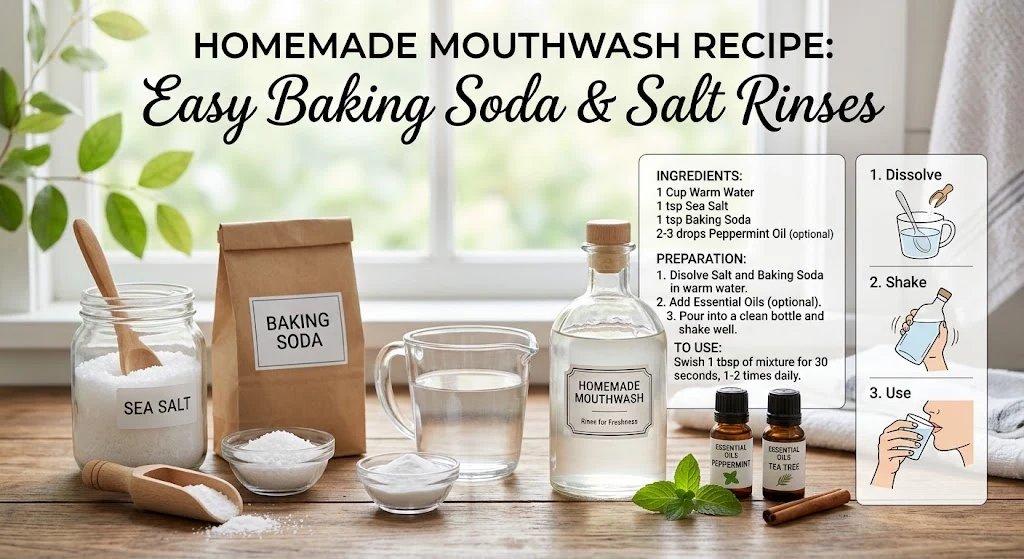
Learn how to make homemade mouthwash with baking soda or salt, plus safe directions, storage tips, ingredient warnings, and dental-care gu
Introduction
If you want a simple homemade mouthwash recipe, you can make a basic rinse with ingredients already in your kitchen. Salt water and baking soda rinses are the most straightforward options.
The important part is knowing what a homemade rinse can actually do. It can provide a simple rinse or temporary freshening, but it does not replace brushing with fluoride toothpaste, cleaning between your teeth, or professional dental care. The American Dental Association classifies mouthrinses as either cosmetic or therapeutic and notes that mouthwash is an addition to daily oral hygiene, not a replacement for brushing and flossing. (ADA)
Quick Answer
The simplest homemade mouthwash recipe is a salt-water rinse: dissolve ½ teaspoon of table salt in 8 ounces of warm water, swish gently, and spit it out. Mayo Clinic gives this same salt-water mixture for mouth-sore care. (Mayo Clinic)
For a baking soda option, mix 1 teaspoon baking soda with ½ cup warm water when using it as a mouth rinse for canker-sore discomfort. (Mayo Clinic)
What Homemade Mouthwash Actually Does
Homemade mouthwash is best viewed as a simple supportive rinse, not a homemade version of every commercial mouthwash. Its effects depend on the ingredients and the reason you’re rinsing.
- Salt water: A simple rinse commonly used for mouth comfort.
- Baking soda and water: An alkaline rinse used for certain mouth-care situations.
- Salt plus baking soda: A mild combination sometimes used when a bland rinse is preferred.
- Commercial fluoride rinse: A different category designed to deliver a specific active ingredient.
- Therapeutic mouthwash: May contain ingredients intended to address plaque, gingivitis, bad breath, or tooth decay. (ADA)
🌿 The Key Distinction Is Purpose
The key distinction is purpose. A homemade rinse may be useful for comfort or simple rinsing, while a therapeutic mouthwash is formulated and evaluated for a particular oral-health purpose.
Best Homemade Mouthwash Recipe: Salt Water
For most people looking for the simplest homemade mouth rinse, salt water is the best starting point. It requires only two ingredients and has a long history of use for gentle mouth rinsing.
Mayo Clinic recommends ½ teaspoon of table salt in 8 ounces of warm water for rinsing with canker sores. That does not mean the mixture treats every oral problem, but it provides a well-established simple rinse formula. (Mayo Clinic)
Ingredients
- ½ teaspoon table salt
- 8 ounces warm water
Preparation
- Add the salt to warm water.
- Stir until the salt dissolves.
- Take a comfortable mouthful.
- Swish gently around your mouth.
- Spit it out rather than swallowing it.
Best Uses
- Mild mouth irritation
- Simple saline rinsing
- Canker-sore comfort
- A bland alternative to strongly flavored mouthwash
⚠️ Important Note
Use warm, not hot, water. A homemade rinse should feel comfortable rather than sting or burn.
Baking Soda Mouthwash Recipe
A baking soda mouth rinse is another simple option. Mayo Clinic recommends 1 teaspoon of baking soda in ½ cup of warm water for canker-sore care. (Mayo Clinic)
Because that recommendation is specifically presented for mouth-sore care, don’t automatically assume the same mixture is necessary for everyday oral hygiene.
Ingredients
- 1 teaspoon baking soda
- ½ cup warm water
Preparation
- Measure the baking soda carefully.
- Stir it into warm water.
- Continue stirring until it is mostly dissolved.
- Swish gently.
- Spit it out rather than swallowing it.
What It Tastes Like
Baking soda has a mild, slightly salty and alkaline taste. It won’t taste like peppermint mouthwash, and that’s part of its appeal for people who dislike strong flavors.
When It May Be Useful
A baking soda rinse can be considered when you want a simple, bland mouth rinse, particularly for temporary mouth discomfort. Mayo Clinic specifically includes baking soda rinses among home-care measures for canker sores. (Mayo Clinic)
Salt Water vs. Baking Soda Mouthwash
Both are simple, but they aren’t identical.
| Feature | Salt Water | Baking Soda |
|---|---|---|
| Main ingredient | Salt | Sodium bicarbonate |
| Taste | Mildly salty | Mild and alkaline |
| Main appeal | Simple saline rinse | Bland alkaline rinse |
| Canker-sore guidance | Yes | Yes |
| Cavity prevention | Not a substitute for fluoride | Not a substitute for fluoride |
| Essential oils needed | No | No |
| Best for beginners | Yes | Yes |
If you simply want a basic homemade rinse, start with salt water. If you specifically prefer a baking soda rinse, use the established preparation above.
Can You Combine Salt and Baking Soda?
You can find many homemade formulas combining salt and baking soda, particularly in mouth-care instructions for people dealing with mouth irritation.
However, more ingredients do not automatically make a rinse better. The American Dental Association emphasizes that mouthrinses serve different purposes, and therapeutic products are formulated around specific active ingredients and claims. (ADA)
For a simple home rinse, there is little reason to keep adding ingredients just to make the recipe more complicated.
If you have a dentist or healthcare professional recommending a particular salt-and-baking-soda formula for your situation, follow their concentration and frequency instructions.
Which Homemade Mouthwash Should You Choose?
The right choice depends on why you want to rinse.
Choose salt water if:
- You want the simplest recipe.
- You prefer a bland rinse.
- You are looking for a traditional saline rinse.
- You want to avoid essential oils.
- Strong commercial mouthwash flavors bother you.
Choose baking soda if:
- You prefer an alkaline-tasting rinse.
- You want a simple baking-soda preparation.
- A healthcare professional has suggested a baking soda rinse for mouth comfort.
Choose a commercial therapeutic rinse if:
- Your dentist recommends fluoride.
- You need targeted plaque or gingivitis control.
- You have a specific oral-health condition requiring a medicated rinse.
- You need an active ingredient that a kitchen recipe cannot reliably provide.
The ADA notes that therapeutic mouthrinses may contain fluoride, cetylpyridinium chloride, essential oils, peroxide, or chlorhexidine, depending on the product and purpose. (ADA)
Can Homemade Mouthwash Prevent Cavities?
Do not treat homemade salt water or baking soda rinses as substitutes for fluoride cavity prevention.
Fluoride is the important distinction here. Commercial fluoride mouthrinses are formulated to deliver fluoride in a controlled product, while a kitchen-made rinse does not provide the same standardized fluoride exposure.
The ADA notes that therapeutic mouthrinses can help with tooth decay and other oral-health concerns when they contain appropriate active ingredients. (ADA)
For everyday cavity prevention, focus on the basics:
- Brush twice daily with fluoride toothpaste.
- Clean between your teeth regularly.
- Limit frequent sugary snacks and drinks.
- Visit your dentist according to your individual needs.
- Use a fluoride mouthrinse when your dental professional recommends one.
A homemade rinse can be an addition, but it shouldn’t replace those habits.
Homemade Mouthwash for Bad Breath
A homemade rinse may make your mouth feel fresher for a short time, but persistent bad breath deserves more attention than stronger mouthwash.
Bad breath can be associated with food debris, tongue coating, dry mouth, gum problems, dental decay, and other causes. Masking the odor doesn’t necessarily address the reason it keeps returning.
For occasional freshness, focus on basic oral hygiene first:
- Brush your teeth twice daily.
- Clean your tongue gently.
- Clean between your teeth.
- Drink water regularly.
- Rinse your mouth when appropriate.
- Avoid relying on strong flavoring to cover persistent odor.
If bad breath continues despite good oral hygiene, ask a dentist about the cause rather than continually changing homemade recipes.
Homemade Mouthwash for a Sore Mouth
Simple salt-water and baking soda rinses are commonly recommended for certain types of mouth discomfort.
Mayo Clinic recommends a salt-water rinse or baking soda rinse for canker-sore care. It also advises avoiding foods that are rough, acidic, or spicy when they worsen irritation. (Mayo Clinic)
For a sore mouth, keep the rinse simple.
- Use warm rather than hot water.
- Swish gently rather than aggressively.
- Spit the rinse out.
- Avoid adding concentrated essential oils.
- Stop if the rinse makes irritation worse.
- Seek professional advice if sores persist, recur frequently, or become unusually painful.
A sore mouth caused by cancer treatment, surgery, infection, medication, or another condition may require individualized care. Don’t rely on a homemade rinse as the only treatment.
What About Essential Oils in Homemade Mouthwash?
Essential oils are popular in DIY mouthwash recipes because peppermint, spearmint, clove, and other oils create a strong flavor.
That doesn’t make them necessary.
🛡️ Essential Oil Safety
Concentrated essential oils can cause harm if swallowed or used improperly. Poison Control notes that some essential oils can cause serious toxicity when swallowed, and children are particularly vulnerable to accidental ingestion. (Poison Control)
For a beginner-friendly homemade rinse, skip essential oils altogether.
If you already use a commercially formulated mouthwash containing essential oils, that’s different. Commercial formulations are designed around specific concentrations and manufacturing controls.
Ingredients I Would Skip in DIY Mouthwash
A good homemade mouthwash doesn’t need a long ingredient list.
Avoid experimenting with concentrated or poorly controlled ingredients simply because they sound more powerful.
Skip concentrated essential oils
They can irritate tissues and can be dangerous when swallowed. (Poison Control)
Don’t improvise with hydrogen peroxide
Hydrogen peroxide appears in some DIY mouthwash recipes online, but concentration and exposure matter. A homemade mixture isn’t automatically safe because the ingredient is sold over the counter.
If a dentist recommends a peroxide rinse for a specific reason, follow the exact instructions provided rather than creating a stronger DIY formula.
Avoid acidic ingredients
Lemon juice, vinegar, and other acidic ingredients are poor choices for routine mouth rinsing. A sour taste doesn’t make a mouth rinse more effective.
Avoid abrasive powders
Don’t turn a mouth rinse into a tooth-scrubbing experiment with coarse powders or gritty ingredients.
Skip complicated herbal mixtures
Homemade herbal extracts can vary in concentration and quality. If you need a therapeutic mouthwash, a standardized product is a better choice.
Can You Use Homemade Mouthwash Every Day?
There isn’t one universal daily schedule that fits every homemade rinse or every person.
The correct frequency depends on why you’re using the rinse and what your dentist recommends.
A homemade rinse also lacks the standardized formulation and preservation system found in a commercial mouthwash. For that reason, making a small fresh batch is more sensible than preparing a large bottle and storing it for weeks.
Don’t use a homemade rinse more often simply because you think stronger or more frequent rinsing must work better.
How to Store Homemade Mouthwash
Water-based homemade mouthwash is different from commercially manufactured mouthwash.
Commercial products are manufactured with controlled formulations, packaging, and quality standards. A kitchen-made rinse doesn’t have those controls.
🫙 Homemade Mouthwash Storage Tips
- Make a small amount.
- Use a clean glass or container.
- Avoid touching the liquid with used cups or toothbrushes.
- Keep the container covered.
- Don’t store homemade rinse for extended periods.
- Make a fresh batch rather than relying on an old bottle.
- Discard the mixture if it becomes cloudy, contaminated, or otherwise changes.
For people with special medical circumstances, follow the storage instructions provided by their healthcare team.
Can Children Use Homemade Mouthwash?
Children need extra caution with mouthwash.
The ADA says children younger than 6 should not use mouthrinse unless directed by a dentist, because they may not have sufficient swallowing control and can accidentally ingest it. (ADA)
That makes homemade mouthwash particularly inappropriate as a casual DIY project for young children.
For older children, don’t assume an adult recipe is automatically suitable. Ask the child’s dentist about the appropriate product, ingredients, amount, and frequency.
Never encourage a child to swallow mouthwash.
Homemade Mouthwash vs. Commercial Mouthwash
The biggest difference isn’t whether one looks more “natural.”
It’s formulation and purpose.
| Homemade Rinse | Commercial Therapeutic Mouthwash |
|---|---|
| Simple ingredients | Standardized formulation |
| Usually salt or baking soda | May contain active ingredients |
| Made at home | Manufactured under controlled conditions |
| No ADA Seal for the homemade formula | Some products carry the ADA Seal |
| Not a substitute for fluoride care | Some products provide fluoride |
| Useful for simple rinsing or comfort | May target specific oral-health needs |
| No long-term storage advantage | Designed for packaged storage |
The ADA says products carrying its Seal of Acceptance have submitted evidence supporting their safety and effectiveness for the claimed use. (ADA)
That doesn’t make every commercial mouthwash necessary. It simply means a therapeutic commercial product can provide something a kitchen recipe cannot: a standardized formulation evaluated for a specific purpose.
What Should You Use After Brushing?
Don’t assume that immediately rinsing your mouth with any homemade mixture is automatically the best next step.
The ADA notes that the order of oral-care products can depend on their ingredients and manufacturers’ instructions. Mouthrinse should also never replace brushing and interdental cleaning. (ADA)
A sensible routine is:
- Brush with fluoride toothpaste.
- Clean between your teeth regularly.
- Follow the directions for any therapeutic mouthrinse.
- Use homemade rinses only for their intended supportive purpose.
- Ask your dentist if you’re unsure about timing.
If you have been prescribed a mouthrinse, follow the prescription rather than substituting a homemade recipe.
When Should You See a Dentist?
A homemade mouthwash is not a substitute for diagnosing an oral-health problem.
Make a dental appointment if you have:
- Persistent tooth pain
- Swollen gums or facial swelling
- Recurring gum bleeding
- Persistent bad breath
- A sore that doesn’t heal
- Repeated mouth ulcers
- Loose or damaged teeth
- Pain when chewing
- Sensitivity that keeps returning
- Symptoms that worsen despite home care
If you have severe swelling, trouble breathing, or difficulty swallowing, seek urgent medical care.
The goal of a homemade rinse is simple: support basic mouth care when appropriate, not hide a problem that needs professional attention.
How to Make Homemade Mouthwash Safely
A good DIY mouthwash routine is more about simplicity than adding more ingredients.
🛡️ Safe Homemade Mouthwash Checklist
- Use a simple, clearly measured recipe.
- Use clean equipment and fresh water.
- Make small batches.
- Never swallow the rinse.
- Don’t add concentrated essential oils casually.
- Don’t use acidic ingredients as routine rinses.
- Don’t assume homemade mouthwash prevents cavities.
- Don’t give mouthwash to children under 6 unless a dentist specifically directs it. (ADA)
- Stop if the rinse causes significant burning or irritation.
- Keep brushing with fluoride toothpaste.
- Contact a dentist when symptoms persist.
Simple Homemade Mouthwash Variations
Once you understand the basic options, there is no need to create a dozen complicated recipes.
Plain Salt Water
Best for: A simple saline rinse.
Ingredients: ½ teaspoon salt + 8 ounces warm water.
Taste: Mildly salty.
Source guidance: Mayo Clinic uses this mixture for canker-sore rinsing. (Mayo Clinic)
Baking Soda Rinse
Best for: A simple baking soda rinse.
Ingredients: 1 teaspoon baking soda + ½ cup warm water.
Taste: Mild and alkaline.
Source guidance: Mayo Clinic recommends this preparation for canker-sore care. (Mayo Clinic)
Salt and Baking Soda Rinse
Best for: Situations where a healthcare professional has specifically recommended a combined bland rinse.
Important: Use the concentration provided by your healthcare professional rather than combining ingredients randomly.
Homemade Mouthwash Recipe: The Bottom Line
The best homemade mouthwash is usually the simplest one.
For a basic saline rinse, dissolve ½ teaspoon salt in 8 ounces of warm water, swish gently, and spit. For a baking soda rinse used for canker-sore care, Mayo Clinic recommends 1 teaspoon baking soda in ½ cup warm water. (Mayo Clinic)
Don’t add ingredients just to make the recipe sound stronger. Homemade mouthwash cannot replace fluoride toothpaste, brushing, interdental cleaning, professional dental care, or a dentist-recommended therapeutic rinse. (ADA)
FAQs
Is homemade mouthwash better than store-bought mouthwash?
Not necessarily. Homemade rinses are simpler, but commercial therapeutic mouthwashes can contain standardized active ingredients for specific oral-health purposes. (ADA)
If your dentist recommends fluoride or another therapeutic ingredient, a kitchen-made rinse isn’t an equivalent replacement.
Is baking soda good for mouthwash?
Baking soda can be used in a mouth rinse, and Mayo Clinic recommends a baking soda rinse as one option for canker-sore care. (Mayo Clinic)
It should not be promoted as a cure-all or as a replacement for fluoride-based cavity prevention.
Is salt water good for your mouth?
Salt-water rinses are commonly used for simple mouth rinsing and comfort, including canker-sore care. Mayo Clinic recommends ½ teaspoon of salt in 8 ounces of warm water for this purpose. (Mayo Clinic)
A saline rinse should not replace routine brushing and cleaning between your teeth.
Can I use homemade mouthwash every day?
There isn’t one universal schedule for every homemade rinse. Use the rinse for its intended purpose and follow your dentist’s advice if you need ongoing oral care.
For routine cavity prevention, prioritize fluoride toothpaste and regular dental hygiene instead.
Can I add peppermint essential oil to homemade mouthwash?
You can find DIY recipes that use peppermint oil, but it isn’t necessary. Concentrated essential oils can be harmful when swallowed or used improperly, so a simple salt or baking soda rinse is the more conservative choice. (Poison Control)
Can children use homemade mouthwash?
Children under 6 should not use mouthrinse unless directed by a dentist, according to the ADA. (ADA)
For older children, ask their dentist which rinse, if any, is appropriate rather than automatically using an adult homemade recipe.
Can homemade mouthwash cure bad breath?
No. A rinse may temporarily improve mouth freshness, but persistent bad breath can have an underlying dental or medical cause.
If the odor continues despite good oral hygiene, speak with a dentist instead of continually changing homemade recipes.
Conclusion
A homemade mouthwash recipe doesn’t need complicated ingredients to be useful. A simple salt-water rinse or carefully prepared baking soda rinse can provide a straightforward option for certain mouth-care situations.
The most important step is knowing its limits. Homemade mouthwash is an optional addition, not a replacement for fluoride toothpaste, brushing, interdental cleaning, or professional dental advice. Start with the simplest recipe, avoid risky DIY ingredients, and talk with your dentist when symptoms persist.
Read More :