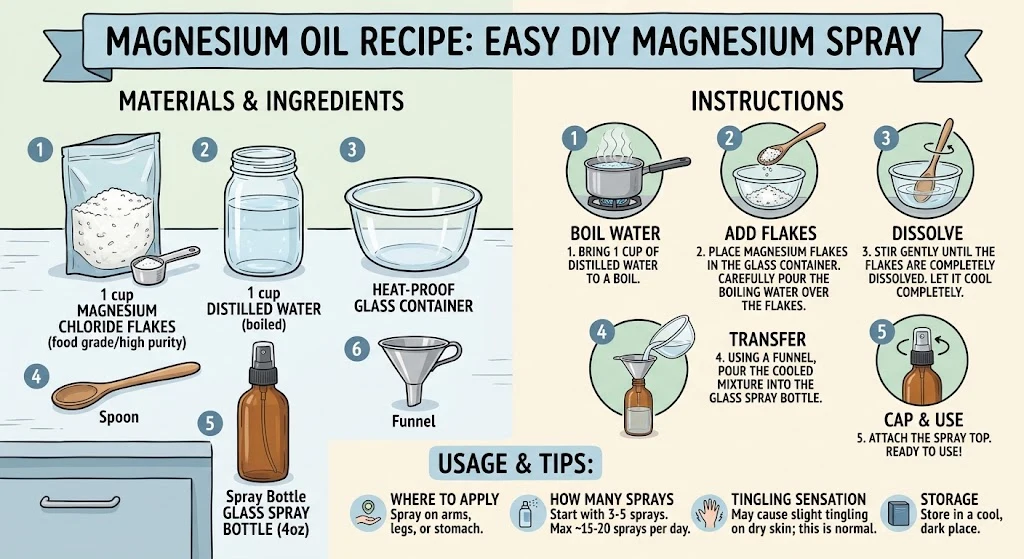
Making a homemade magnesium oil spray is surprisingly simple: you need magnesium chloride flakes, distilled water, a clean container, and a few minutes of preparation. Despite its name, magnesium oil contains no actual oil—it is a concentrated water-based solution of magnesium chloride.
This guide shows you how to make a repeatable batch, dilute it for sensitive skin, apply it properly, store it safely, and understand what current research does—and does not—tell us about magnesium absorption through skin.
Quick Answer: How Do You Make Magnesium Oil?
Combine 100 g magnesium chloride flakes with 100 g distilled water. Warm the water, dissolve the flakes completely, cool the solution to room temperature, and transfer it to a clean spray bottle. This 1:1 ratio is a practical DIY formulation, not an established medical dose.
If the solution feels too strong, dilute a portion with additional distilled water rather than forcing your skin to tolerate it.
Magnesium Oil Recipe at a Glance
If you want the recipe first, this is the basic formulation. Weighing the ingredients provides better repeatability than relying only on cups because magnesium chloride flakes vary in size and packing.
| Detail | Homemade Magnesium Oil |
|---|---|
| Main ingredient | Magnesium chloride flakes |
| Liquid | Distilled water |
| Starting ratio | 1:1 by weight |
| Difficulty | Beginner |
| Equipment | Heat-safe container, spoon, clean spray bottle |
| Method | Dissolve, cool, bottle |
| Application | Topical use on intact skin |
| Best batch size | Small batches |
| Essential oils | Optional, but unnecessary |
| Storage | Clean, tightly closed container |
Homemade Magnesium Oil Spray
Ingredients
- 100 g magnesium chloride flakes
- 100 g distilled water
What Is Magnesium Oil?
Magnesium oil is a water-based solution of magnesium chloride. It is called “oil” because the concentrated liquid can feel slippery on the skin.
Magnesium chloride is a salt containing magnesium and chloride. It dissolves readily in water, making it a common ingredient in homemade topical magnesium preparations.
The name can be misleading: magnesium oil is not an oil-based moisturizer. You do not need coconut oil, olive oil, jojoba oil, or another carrier oil for the basic recipe.
Magnesium is an essential mineral involved in many biochemical processes, including normal muscle and nerve function, energy production, and regulation of calcium and potassium transport.
Magnesium Oil Ingredients and Equipment
The base recipe needs only two ingredients. Keeping the formula simple also makes it easier to identify the cause of irritation if your skin does not tolerate the finished spray.
Ingredients
- 100 g magnesium chloride flakes
- 100 g distilled water
Equipment
- Digital kitchen scale
- Heat-safe glass measuring container
- Spoon or glass stirring rod
- Clean spray bottle
- Small funnel
- Label and marker
Why Use Distilled Water?
Distilled water is a practical choice for a simple homemade spray because it contains fewer dissolved minerals than ordinary tap water.
How to Make Magnesium Oil
The process is straightforward, but do not rush the bottling step. The flakes should dissolve completely, and the solution should be cool before it goes into the spray bottle.
- Measure 100 g of magnesium chloride flakes into a clean, heat-safe container.
- Measure 100 g of distilled water separately.
- Warm the water until hot; prolonged boiling is unnecessary.
- Pour the warm water over the magnesium chloride flakes.
- Stir until the flakes have completely dissolved.
- Check the bottom of the container for remaining crystals.
- Allow the solution to cool completely to room temperature.
- Transfer the liquid to a clean spray bottle.
- Label the bottle with the ingredients and preparation date.
- Close the bottle tightly after each use.
How Do You Know It’s Ready?
The finished solution should be clear or nearly clear, depending on the ingredients and concentration. If visible crystals remain, continue stirring before bottling.
How Strong Should Magnesium Oil Be?
Online magnesium oil recipes can be confusing because equal-volume measurements do not always produce the same concentration. Flake size and density can change how much magnesium chloride fits into a cup or spoon.
A 1:1 weight ratio provides a practical starting formulation without pretending that it represents a standardized medical dose.
If the concentrated mixture feels unpleasant, dilution is a better approach than repeatedly applying a strong solution and hoping your skin adapts.
Half-Strength Magnesium Oil
Mix 1 part finished magnesium oil with 1 part distilled water. This produces a roughly half-strength version of the original mixture.
For very sensitive skin, you can dilute it further. There is no need to force your skin to tolerate a concentrated solution.
How to Dilute Magnesium Oil
Dilution is the simplest way to make the spray more comfortable. Rather than weakening the entire batch, keep the concentrated mixture separate and dilute only the amount you plan to use.
| Strength | Mixing Ratio | Practical Use |
|---|---|---|
| Milder | 1 part magnesium oil + 1 part distilled water | Useful starting point for uncomfortable concentrated spray |
| Very gentle | 1 part magnesium oil + 2 parts distilled water | Useful when additional dilution is needed |
| Small test | Dilute a tablespoon-sized portion | Allows you to test comfort before preparing a larger diluted batch |
Use fresh distilled water for dilution. If the diluted preparation still causes burning, swelling, persistent itching, or a rash, rinse the skin and stop using it.
How to Use Magnesium Oil Spray
Start with a small amount. You can always apply more later, but using a large amount immediately makes it harder to determine how your skin responds.
Apply the spray to clean, intact skin, rather than cuts, abrasions, freshly shaved areas, or irritated patches.
Simple Application
- Spray a small amount onto clean skin.
- Spread it gently with your hands if desired.
- Allow the skin to dry.
- Wash your hands after application.
- Rinse the area if the residue feels uncomfortable.
- Reduce the concentration if the spray feels too strong.
- Stop using it if persistent irritation develops.
Magnesium Oil for Feet
Feet are a popular place to try magnesium spray because the area is easy to wash if the solution feels uncomfortable.
Keep expectations realistic. Applying magnesium oil to your feet is a topical personal-care practice; it should not be presented as a proven method for correcting magnesium deficiency.
A Simple Foot Routine
- Wash and dry your feet.
- Apply a small amount of spray.
- Spread it evenly over intact skin.
- Let the area dry before putting on socks.
- Rinse if the salty residue bothers you.
- Avoid cracked, bleeding, or irritated areas.
- Do not apply immediately after shaving.
- Start with diluted magnesium oil if your skin is sensitive.
Magnesium Oil Before Bed
Some people include magnesium spray in a relaxing evening routine. That can be a reasonable personal-care ritual, but the spray should not be presented as a proven treatment for insomnia.
Easy Evening Routine
- Shower or wash normally.
- Dry your skin completely.
- Apply a small amount of magnesium spray.
- Let it dry before putting on sleepwear.
- Rinse it off if the residue bothers you.
- Use a diluted version if concentrated spray feels harsh.
- Skip fragrance if scented products irritate your skin.
Magnesium Oil vs. Epsom Salt
Magnesium chloride and Epsom salt are not the same ingredient. Magnesium chloride contains magnesium and chloride, while Epsom salt is magnesium sulfate.
| Feature | Magnesium Chloride | Epsom Salt |
|---|---|---|
| Chemical form | Magnesium chloride | Magnesium sulfate |
| Common name | Magnesium chloride flakes | Epsom salt |
| Main DIY use here | Topical spray | Bath or soak |
| Same ingredient? | No | No |
| Direct substitute? | Not automatically | Not automatically |
| Works for this basic magnesium oil recipe? | Yes | No |
Does Magnesium Oil Absorb Through Skin?
This is one of the most important scientific questions surrounding magnesium oil.
Magnesium is essential to human health, but that does not mean a homemade magnesium chloride spray reliably delivers a meaningful amount of magnesium into the bloodstream.
A 2017 review concluded that evidence supporting claims about transdermal magnesium was insufficient.
More recently, a 2026 ex vivo skin study found minimal magnesium permeation through intact porcine skin from an aqueous magnesium sulfate solution. Much greater movement occurred when the skin barrier had been disrupted. The authors concluded that meaningful transdermal delivery from simple aqueous solutions is unlikely under normal conditions.
Earlier laboratory research has also explored magnesium interactions with skin under particular experimental conditions. However, that does not establish that a homemade spray provides a reliable nutritional dose.
If you are concerned about magnesium intake, food and appropriately selected oral supplements have a stronger evidence base for delivering magnesium to the body. Useful dietary sources include nuts, seeds, legumes, whole grains, leafy greens, and fortified foods.
Magnesium Oil for Sensitive Skin
Concentrated magnesium chloride can feel uncomfortable on some skin. A mild tingling sensation may occur, but persistent burning is not something you need to tolerate.
Skin tolerance is especially important after shaving, exfoliating, or whenever the skin barrier is already irritated.
If Your Skin Is Sensitive
- Start with a diluted preparation.
- Patch test a small area first.
- Wait to see how your skin responds.
- Avoid freshly shaved skin.
- Avoid cuts and abrasions.
- Do not add essential oils to your first batch.
- Rinse the area if strong irritation occurs.
- Stop using the product if a rash develops.
- Do not increase concentration simply to chase a stronger sensation.
Should You Add Essential Oils?
You do not need essential oils to make magnesium oil.
Adding fragrance changes the product from a simple two-ingredient spray into a more complex topical preparation. Essential oils can also irritate sensitive skin or trigger fragrance reactions.
For that reason, fragrance-free is the best starting point.
- Make the basic magnesium spray first.
- Test your skin’s response.
- Keep a fragrance-free batch available.
- If you later add fragrance, use only an ingredient intended for topical use and follow an established skin-safe dilution.
How to Store Homemade Magnesium Oil
Homemade magnesium oil is essentially a water-based salt solution without a validated cosmetic preservative system. Therefore, do not assign it an arbitrary six-month or one-year shelf life simply because the solution contains salt.
Better Storage Practices
- Use a clean spray bottle.
- Keep the cap tightly closed.
- Store it away from direct sunlight.
- Keep it away from excessive heat.
- Label the preparation date.
- Do not add fresh herbs, fruit, or other food ingredients.
- Avoid touching the spray opening with your hands.
- Make small batches.
- Do not share one bottle with several people.
- Discard it if it develops an unusual odor, unexpected cloudiness, visible contamination, or other changes.
Common Magnesium Oil Recipe Mistakes
| Common Mistake | Why It Matters | Better Approach |
|---|---|---|
| Using Epsom salt | Epsom salt is magnesium sulfate, not magnesium chloride. | Use magnesium chloride flakes for this recipe. |
| Measuring flakes only by volume | Flake size and packing affect volume. | Weigh the ingredients. |
| Making it too concentrated | More concentration can mean more skin irritation. | Dilute if needed. |
| Applying after shaving | Freshly shaved skin may be more sensitive. | Wait until the skin has settled. |
| Adding too many ingredients | Extra ingredients increase complexity and potential irritation. | Start with the two-ingredient formula. |
| Bottling while hot | Hot liquid should not be transferred immediately to the spray bottle. | Cool completely first. |
| Treating tingling as proof of effectiveness | A stronger sensation does not demonstrate systemic magnesium absorption. | Judge the product by skin comfort, not intensity. |
| Keeping it indefinitely | Homemade water-based preparations do not have validated commercial shelf lives. | Make small batches and discard questionable product. |
Magnesium, Diet, and Supplements
Magnesium oil should not distract from the bigger nutritional picture. The body needs magnesium for normal nerve and muscle function, energy production, protein synthesis, and many other processes.
Adults generally need around 310–420 mg of magnesium per day, depending on age and sex.
Good Food Sources
| Food Group | Examples |
|---|---|
| Seeds | Pumpkin seeds, chia seeds |
| Nuts | Almonds, cashews |
| Legumes | Beans, lentils |
| Vegetables | Spinach and other leafy greens |
| Grains | Whole grains |
| Fortified foods | Fortified breakfast cereals and other fortified foods |
If you suspect a magnesium deficiency, talk with a healthcare professional about your diet, medications, medical history, and whether supplementation is appropriate.
The NIH also notes that the 350 mg/day upper limit for adults applies to magnesium from dietary supplements and medications, not magnesium naturally present in food.
Magnesium Oil Safety and Skin Precautions
A homemade magnesium spray is not automatically safe for every person simply because its ingredients are familiar.
- External use only.
- Never drink homemade magnesium oil.
- Avoid eyes and mucous membranes.
- Do not apply it to open wounds.
- Do not deliberately damage skin before application.
- Patch test before regular use.
- Keep it away from young children.
- Stop using it if a persistent rash develops.
- Do not use topical magnesium as a substitute for treatment of suspected deficiency.
- Ask a healthcare professional about magnesium products if you have kidney disease or impaired kidney function.
- Discuss magnesium products with a clinician during pregnancy or breastfeeding if you have questions about safety.
Kidney function matters because the kidneys help remove excess magnesium from the body, and the risk of magnesium toxicity rises when kidney function is impaired.
Frequently Asked Questions
Is magnesium oil really oil?
No. Magnesium oil is normally a water-based magnesium chloride solution. It feels slippery on the skin, which is why it is called oil.
What is the best magnesium oil recipe?
A practical starting recipe is equal weights of magnesium chloride flakes and distilled water. The resulting solution is concentrated, so dilute it if your skin finds it uncomfortable.
Can I make magnesium oil with Epsom salt?
Not as a direct substitution. Epsom salt is magnesium sulfate, while magnesium oil recipes generally use magnesium chloride.
Why does magnesium oil burn or sting?
Concentrated salt solutions can irritate skin, especially after shaving or when the skin barrier is damaged. Dilute the solution and avoid irritated skin. Stop using it if burning persists.
Can I use magnesium oil every day?
There is no established topical dosing schedule for correcting magnesium deficiency. If you use it as a personal-care product, let your skin tolerance guide frequency rather than assuming more applications provide greater nutritional benefit.
Does magnesium oil raise magnesium levels?
Current evidence does not establish homemade topical magnesium spray as a reliable way to raise systemic magnesium levels. Research has found limited magnesium movement across intact skin, while earlier reviews found insufficient evidence for broad transdermal magnesium claims.
How long does homemade magnesium oil last?
There is no dependable shelf-life period for an unpreserved homemade spray. Make small batches, use clean equipment, store the bottle properly, and discard it if its appearance, odor, or cleanliness changes.
Conclusion
This magnesium oil recipe gives you a simple starting formulation made from magnesium chloride flakes and distilled water. Using weight measurements makes the batch more repeatable, while dilution lets you adjust the solution for skin comfort.
The bigger takeaway is equally important: magnesium oil is a topical salt solution, not a proven nutritional replacement for dietary magnesium or appropriate supplementation.
If you make it, keep the formula simple, patch test first, protect your skin barrier, and treat evidence-based nutrition as the main route for meeting your magnesium needs.
Read More :