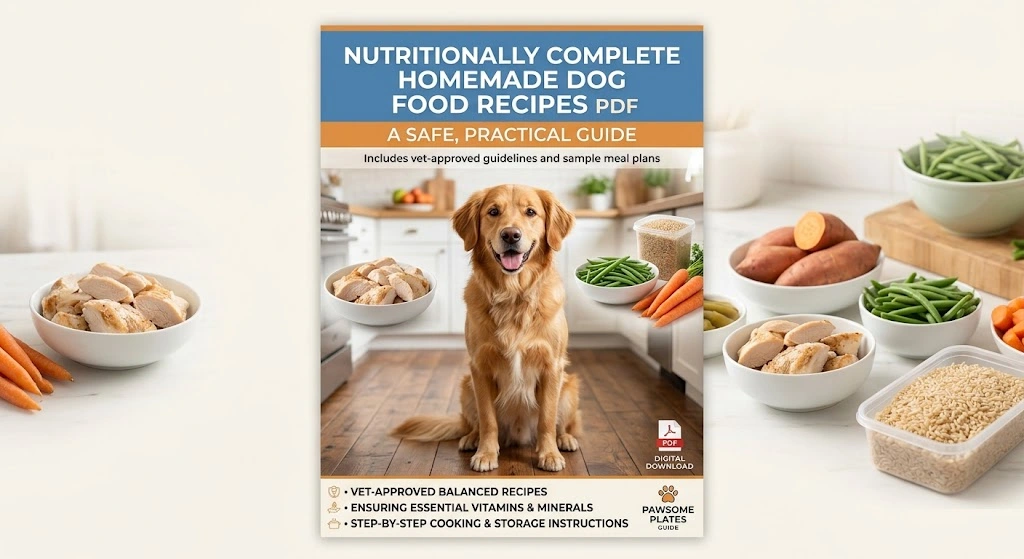
Looking for nutritionally complete homemade dog food recipes in PDF form? The most important thing to know is that a homemade meal is not automatically a complete diet simply because it contains meat, vegetables, and a carbohydrate.
A properly formulated homemade diet must provide the nutrients a dog needs for its specific life stage and calorie needs. That usually requires precise ingredient weights and carefully selected vitamin and mineral supplements.
Quick Answer: What Is the Best Homemade Dog Food PDF?
A trustworthy nutritionally complete homemade dog food PDF should contain more than ingredient combinations. Look for exact weights, preparation instructions, intended life stage, supplement instructions, feeding guidance, storage information, and the credentials of the person who formulated or reviewed the recipe.
Recent research found that only 6% of 1,726 evaluated home-prepared dog diets had the potential to be nutritionally complete under AAFCO adult-maintenance standards.
What a Good Homemade Dog Food PDF Should Include
A printable recipe can be convenient, but the PDF itself does not make a diet nutritionally complete. The formulation behind the recipe is what matters.
Recipe Details
- Exact ingredient weights, preferably in grams
- Specific meat cuts and preparation methods
- Defined cooking instructions
- Recipe yield
- Calorie information, when available
- Life-stage designation
Nutrition & Feeding Details
- Required vitamin and mineral supplements
- Exact supplement amounts
- Feeding instructions
- Storage and freezing guidance
- Substitution rules
- Clear veterinary guidance
AAFCO establishes nutrient profiles for complete and balanced pet nutrition but does not itself test or certify individual pet foods. Nutritional requirements also differ according to life stage.
Why Meat, Rice, and Vegetables Are Not Enough
A bowl of cooked chicken, rice, and carrots can look wholesome, but appearance tells you very little about nutritional completeness.
Dogs require numerous essential nutrients in appropriate amounts and ratios. A recipe can contain plenty of protein while still being deficient or excessive in other nutrients.
Changing the meat, removing a supplement, or altering the cooking method can change the nutrient profile of a formulated diet.
Wholesome Does Not Mean Complete
Wholesome means the ingredients may be suitable foods for dogs.
Complete means the finished diet supplies the required nutrients in appropriate amounts for its intended use.
Those terms are not interchangeable.
Why Chicken & Rice Shouldn’t Be a Long-Term Diet
Chicken and rice may be used in some short-term situations under veterinary guidance, but it is not a nutritionally complete long-term diet by itself.
Homemade Chicken Dog Food: What a Proper Recipe Looks Like
Chicken is inexpensive, widely available, and easy to batch-cook, making it a common ingredient in homemade dog diets.
The important point is that chicken should be treated as one ingredient in a formulated diet, rather than as the nutritional foundation by itself.
Chicken Meal Components
- Cooked chicken
- Cooked rice or another suitable carbohydrate
- Cooked vegetables such as carrots or green beans
- A veterinarian-specified vitamin and mineral supplement when required
- Fresh water
Practical Preparation Tips
- Cook chicken thoroughly before serving.
- Remove all cooked bones.
- Avoid onions, garlic, heavily salted sauces, and seasoning blends.
- Weigh ingredients when following a formulated recipe.
- Allow food to cool before portioning.
- Keep the dog’s prescribed supplement separate until the correct amount is ready to add.
Never assume that adding a generic canine multivitamin makes a recipe complete. Supplement requirements depend on the entire formulation.
Homemade Turkey Dog Food: A Simple Meal-Prep Option
Turkey works well in many homemade-diet formulations because it is widely available and can be prepared in large batches.
However, turkey cannot automatically replace chicken, beef, or another protein in a formulated recipe. Different ingredients contribute different amounts of calories, fat, minerals, and other nutrients.
Turkey Meal Components
- Fully cooked lean turkey
- A cooked carbohydrate selected for the intended recipe
- Cooked vegetables
- The exact supplements specified by a formulated diet
- Water as appropriate
Safer Meal-Prep Habits
- Use plain, unseasoned turkey.
- Remove bones and excess skin when the recipe calls for lean meat.
- Avoid turkey containing onion or garlic seasoning.
- Do not use leftover holiday turkey with gravy or rich sauces.
- Measure formulated ingredients with a kitchen scale.
- Divide the finished batch according to the recipe’s feeding instructions.
Homemade Beef Dog Food: What to Watch For
Beef can be used in homemade diets, but the fat content of the specific cut matters.
Ground beef, lean beef, beef with visible fat, and cooked beef can produce different calorie and nutrient profiles.
Beef Meal Combination
- Cooked lean beef
- Cooked rice, oats, or another recipe-specific carbohydrate
- Cooked vegetables
- A properly selected supplement system when required
This is an ingredient example, not a complete diet.
Common Beef Mistakes
- Choosing a much fattier beef than the formulated recipe specifies
- Draining or retaining fat differently from the original recipe
- Adding cheese or sauces without recalculating the diet
- Replacing a required supplement with a generic multivitamin
- Estimating portions by volume instead of weight
Homemade Fish Dog Food: Important Safety Considerations
Fish can be useful in some homemade diets, but fish recipes require careful ingredient and preparation choices.
Different fish species vary in fat, calories, nutrient content, and bone structure. Those differences matter when a recipe has been formulated precisely.
- Fully cooked, boneless fish
- Recipe-specific carbohydrate
- Cooked vegetables
- Required supplements from the formulated recipe
Fish Preparation Checklist
- Cook fish thoroughly.
- Remove bones carefully.
- Do not use raw fish as a shortcut.
- Avoid salty sauces and marinades.
- Never substitute a different fish species without checking the formulation.
- Refrigerate leftovers promptly.
Home-prepared diets containing raw or insufficiently cooked meat can create food-safety concerns for both pets and people.
Homemade Dog Food for Puppies
Growth requires carefully controlled nutrition, and nutritional mistakes during development can have serious consequences.
That makes generic internet recipes particularly inappropriate for growing puppies.
Before Feeding a Homemade Puppy Diet
- Identify the puppy’s breed or expected adult size.
- Confirm the intended growth stage.
- Discuss the diet with your veterinarian.
- Use a recipe specifically formulated for growth when appropriate.
- Follow every supplement instruction precisely.
- Monitor growth and body condition regularly.
Homemade Dog Food for Senior Dogs
Senior dogs do not all require the same diet.
An older healthy dog may have very different nutritional needs from an older dog with kidney disease, diabetes, pancreatitis, dental problems, or another medical condition.
For a Healthy Senior Dog, Consider
- Body condition
- Weight trend
- Activity level
- Appetite
- Muscle condition
- Existing medical conditions
- Current medications
- Current diet
A homemade recipe intended for a healthy adult dog should not automatically be used for a dog with kidney, liver, gastrointestinal, pancreatic, urinary, or other disease. Therapeutic diets require a much more individualized approach.
Supplements: The Part Homemade Recipes Often Get Wrong
Supplements are one of the most important parts of a properly formulated homemade diet. They are also one of the easiest parts to misuse.
Nutrients a Formula May Need to Address
- Calcium
- Essential fatty acids
- Zinc
- Iron
- Iodine
- Copper
- Vitamins
- Essential amino acids
- Other trace nutrients
Why Generic Multivitamins Can Fail
The correct supplement combination depends on the complete recipe. One product may not provide the exact nutrients or quantities required.
Some homemade diets require specific veterinary supplements or multiple supplements to meet nutrient requirements.
How to Measure Homemade Dog Food Correctly
A kitchen scale is one of the most useful tools for following a formulated homemade diet.
Cup measurements can vary because ingredients have different densities and moisture levels.
Better Measuring Habits
- Use grams when the recipe provides gram weights.
- Weigh ingredients in the specified cooked or raw state.
- Follow the recipe’s preparation instructions exactly.
- Use the specified meat cut.
- Don’t estimate supplement amounts with ordinary kitchen spoons unless the formulation specifically allows it.
- Record any approved changes.
Why Precision Matters
A recipe is a mathematical formulation, not simply a list of healthy foods.
Owners commonly alter recipes over time, including changing or removing supplements. Following the original recipe precisely helps preserve its intended nutritional profile.
What You Can and Cannot Substitute
“If my dog likes it, I can swap it.” That isn’t necessarily true.
Substitutions That Require Professional Guidance
- Chicken for beef
- Turkey for chicken
- Rice for potatoes
- Fish for poultry
- Oil quantities
- Meat quantities
- Organ-meat amounts
- Calcium sources
- Vitamin supplements
- Mineral supplements
- Cooking methods
Treat the Recipe Like a Formula
If a recipe was formulated as a complete diet, treat every listed ingredient and supplement as part of the formula.
If an ingredient becomes unavailable, ask the recipe’s formulator or your veterinary nutrition professional for an approved replacement.
How Much Homemade Dog Food Should You Feed?
Food volume does not tell you whether a dog is receiving the correct number of calories or nutrients.
Feeding Needs Can Vary With
- Body size
- Age
- Activity
- Body condition
- Neutering status
- Individual metabolism
- Health
- Recipe calorie density
A Better Feeding Approach
Start with the feeding amount supplied with the formulated recipe, then monitor:
- Body weight
- Body condition
- Appetite
- Stool quality
- Energy
- Muscle condition
Homemade Dog Food Storage, Freezing, and Reheating
Fresh homemade dog food requires the same basic food-safety discipline as other cooked perishable foods.
Refrigeration
- Cool cooked food promptly.
- Store it in clean, covered containers.
- Keep the refrigerator at 40°F (4°C) or below.
- Use a food-safe storage timeline rather than leaving food at room temperature for extended periods.
Freezing
- Divide food into meal-sized portions.
- Label each container with the preparation date.
- Freeze promptly.
- Thaw in the refrigerator when possible.
- Do not repeatedly thaw and refreeze the same portion.
Warm only the amount needed for the meal. Check the center of the food before serving so your dog does not receive a hot spot.
Do not add seasoning simply because the food tastes bland to you. Dogs don’t need human-style seasoning.
Foods Dogs Should Never Have in Homemade Meals
A homemade recipe should never contain ingredients known to be dangerous to dogs.
- Onions
- Garlic
- Chives
- Grapes
- Raisins
- Xylitol
- Alcohol
- Macadamia nuts
- Chocolate
- Caffeinated products
- Cooked bones
Accidental exposure can require urgent veterinary advice. Keep dangerous ingredients away from the preparation area to reduce cross-contamination and accidental feeding.
Raw Homemade Dog Food vs Cooked Homemade Dog Food
For most owners searching for a practical homemade diet, cooked food is the simpler safety choice.
| Approach | Potential Advantages | Important Limitations |
|---|---|---|
| Cooked homemade food | Reduces risks associated with raw animal foods; easier to handle, portion, and batch-cook. | Still requires nutritional formulation, careful food handling, and potentially specific supplements. |
| Raw homemade food | Can be prepared according to a raw-feeding approach. | Introduces additional food-safety concerns involving raw or insufficiently cooked animal foods. |
These are separate issues.
Homemade Dog Food vs Complete Commercial Dog Food
Homemade feeding isn’t automatically better or worse. The better choice depends on the individual dog, the owner’s ability to follow the diet accurately, and the quality of the formulation.
| Consideration | Homemade Diet | Complete Commercial Diet |
|---|---|---|
| Ingredient control | High | Varies by product |
| Preparation time | High | Low |
| Portion consistency | Requires careful measuring | Usually simple |
| Nutritional formulation | Owner must follow the recipe | Formulated by manufacturer |
| Storage | Requires planning | Usually convenient |
| Recipe changes | Can create nutrient problems | Product formula is standardized |
| Veterinary involvement | Especially important for formulated homemade diets | Useful when health needs exist |
The goal is to provide a safe, appropriate, nutritionally adequate diet.
How to Choose a Trustworthy Homemade Dog Food PDF
Does It Provide Exact Quantities?
A list saying “some chicken, rice, and vegetables” isn’t enough for a complete diet.
Does It Identify the Life Stage?
Adult maintenance and growth are not interchangeable nutritional targets.
Does It Explain Supplements?
A credible resource should identify required supplements and quantities rather than simply saying “add a multivitamin.”
Is the Formulator Qualified?
Look for transparent credentials. A board-certified veterinary nutritionist is particularly relevant for formulation work.
Does It Explain Substitutions?
A good resource should tell you whether ingredients can be changed.
Is It Actually a PDF?
Check whether the downloadable document actually contains the recipes rather than only a shopping list or promotional worksheet.
Is It Dated?
Nutrition resources should show when they were published or reviewed.
Does It Acknowledge Limitations?
A trustworthy resource won’t claim that one generic recipe is suitable for every dog.
Free Homemade Dog Food PDF Resources
If you’re looking for an existing printable resource rather than creating your own, there are several useful examples worth examining.
Dr. Judy Morgan’s Basic Homemade Dog Food Recipes PDF
View the Basic Homemade Dog Food Recipes PDF
The resource offers four basic recipes and identifies the formulation criteria used. The page states that the recipes were formulated using Animal Diet Formulator with FEDIAF 2021 criteria, Atwater values, an adult less-active activity level, and a gently cooked method.
This is a useful example of what transparency looks like: the resource tells readers how the recipes were formulated rather than simply calling them balanced.
Tufts University Cummings School of Veterinary Medicine
Tufts provides extensive educational material on home-cooked diets, including common formulation mistakes and the importance of following recipes exactly.
American Animal Hospital Association
AAHA recommends consultation with a board-certified veterinary nutritionist for owners choosing home-prepared diets.
The 2025 Research Every Homemade-Diet Owner Should Know
Dog Aging Project Study
Researchers evaluated 1,726 home-prepared diets reported by dog owners. Meat appeared in 90% of the diets and vegetables in 65%. Nearly half of owners also included a commercial diet or topper.
Only 6% of the evaluated diets had the potential to be nutritionally complete according to AAFCO adult-maintenance standards.
The finding does not mean homemade food is inherently bad. It shows why nutritional formulation matters.
The researchers also noted that their assessment lacked exact ingredient quantities, meaning the 6% figure should not be interpreted as proof that those diets were actually complete when fed.
A Printable Homemade Dog Food Checklist
Before using any homemade recipe for regular feeding, print or save this checklist.
Before You Start Cooking
- Confirm the recipe is intended for your dog’s life stage.
- Gather every ingredient before changing anything.
- Use a gram scale when required.
- Purchase the specified supplements.
- Follow the cooking method exactly.
- Portion the finished food according to the formulation.
- Record the preparation date.
- Store the food safely.
Common Homemade Dog Food Mistakes
1. Removing the Supplement
The supplement may be responsible for supplying nutrients that are difficult to obtain from the main ingredients.
2. Swapping Ingredients Casually
A different meat or carbohydrate can change the nutritional profile.
3. Using “Healthy” Foods Instead of Formulation
Spinach, blueberries, pumpkin, eggs, and other nutritious foods do not automatically make a diet complete.
4. Measuring by Guesswork
Small differences may matter when a recipe has been formulated precisely.
5. Feeding an Adult Recipe to a Puppy
Growth diets require different nutritional considerations.
6. Assuming Homemade Means Healthier
Homemade diets are not automatically healthier than appropriate commercial diets.
7. Ignoring Changes Over Time
A dog’s weight, activity, age, health, and nutritional needs can change.
8. Never Reviewing the Formula
Home-prepared recipes should be reviewed periodically, especially when the dog’s circumstances change.
AAHA guidance recommends that home-prepared recipes be reviewed and updated periodically, with annual review by a board-certified veterinary nutritionist specifically recommended.
Frequently Asked Questions
Are homemade dog food recipes nutritionally complete?
Not automatically. A homemade diet is complete only when its formulation supplies the required nutrients in appropriate amounts for the intended dog and life stage.
Can I use a homemade dog food recipe every day?
You can use a properly formulated recipe as a daily diet when it is appropriate for your dog and followed exactly. A generic recipe from the internet should not automatically be treated as a complete daily diet.
Do homemade dog food recipes need supplements?
Many complete homemade diets require specific vitamin and mineral supplements. The correct supplements and amounts depend on the complete formulation, so a generic multivitamin is not necessarily an adequate replacement.
Can I change chicken to turkey in a homemade dog food recipe?
Don’t make that substitution without checking the recipe. Changing an ingredient can alter calories and nutrient concentrations, particularly in a diet designed to meet specific nutrient targets.
Is chicken and rice a complete homemade dog food?
No. Chicken and rice alone do not provide a nutritionally complete long-term diet for dogs. This simple combination should not be treated as a complete maintenance diet.
Is homemade dog food safe for puppies?
Only when the diet is appropriately formulated for growth and carefully followed. Puppies have different nutritional requirements from adult dogs, so an adult recipe should not simply be scaled down.
How often should a homemade dog food recipe be reviewed?
AAHA recommends updating home-prepared recipes annually with a board-certified veterinary nutritionist. A review may also be appropriate sooner if the dog’s health, weight, activity, or nutritional needs change.
Conclusion: Choose a Formulated Homemade Dog Food Recipe
A nutritionally complete homemade dog food recipe PDF should be much more than a collection of meat, rice, and vegetable combinations. The strongest resources provide exact measurements, appropriate supplementation, preparation instructions, feeding guidance, storage information, and transparent professional formulation.
If you’re preparing homemade food for regular feeding, choose a properly formulated recipe rather than improvising one. Keep the recipe unchanged unless a qualified professional approves a substitution, and review the diet as your dog’s needs change.
The safest next step is to save a reputable printable recipe, discuss it with your veterinarian, and use a board-certified veterinary nutritionist when your dog needs an individualized homemade diet.
Trusted References
- American Animal Hospital Association — Home-Prepared Diets
- AAFCO — Understanding Pet Food & Nutritional Adequacy
- Tufts Petfoodology — Should You Make Your Own Pet Food at Home?
- Tufts Petfoodology — Common Home-Cooking Mistakes
- Tufts Petfoodology — Bland Diet Guidance
- Tufts Petfoodology — Home-Cooked Diet Mistakes & Misconceptions
- American Journal of Veterinary Research — 2025 Home-Prepared Diet Study
Read More :